JEE MAIN 2020 · 02 SEP S2Extraction of Fe, Cu, Zn, Al, Ag and AuTRANSCRIBED
Cast iron is used for the manufacture of:
- A
wrought iron and pig iron
- B
pig iron, scrap iron and steel
- C
wrought iron, pig iron and steel
- D
wrought iron and steel
Every General Principles and Processes of Isolation of Metals question JEE Main has set, grouped by the idea it tests rather than the order of the syllabus. 120 questions across 5 distinct ideas. Free to read, answer key on every one.
Questions
120
Distinct ideas
5
Share of marks
0%
Difficulty
EASY
A chapter is not one subject — it is a handful of procedures the examiner reuses. These are the ones General Principles and Processes of Isolation of Metals questions actually test.
81–100 OF 120 · NEWEST FIRST
Cast iron is used for the manufacture of:
wrought iron and pig iron
pig iron, scrap iron and steel
wrought iron, pig iron and steel
wrought iron and steel
Boron and silicon of very high purity can be obtained through:
liquation
zone refining
vapour phase refining
electrolytic refining
The INCORRECT statement is:
bronze is an alloy of copper and tin
cast iron is used to manufacture wrought iron
german silver is an alloy of zinc, copper and nickel
brass is an alloy of copper and nickel
The one that is not a carbonate ore is:
malachite
bauxite
calamine
siderite
Assertion: For the extraction of iron, haematite ore is used.
Reason: Haematite is a carbonate ore of iron.
Only the assertion is correct.
Only the reason is correct.
Both the assertion and reason are correct and the reason is the correct explanation for the assertion.
Both the assertion and reason are correct, but the reason is not the correct explanation for the assertion.
The electrolytes usually used in the electroplating of gold and silver, respectively, are:
and
and
and
and
Match the refining methods (Column I) with metals (Column II).
Column I Column II
(Refining methods) (Metals)
(I) Liquation (a) Zr
(II) Zone Refining (b) Ni
(III) Mond Process (c) Sn
(IV) Van Arkel Method (d) Ga
(I) - (b); (II) - (c); (III) - (d); (IV) - (a)
(I) - (b); (II) - (d); (III) - (a); (IV) - (c)
(I) - (c); (II) - (d); (III) - (b); (IV) - (a)
(I) - (c); (II) - (a); (III) - (b); (IV) - (d)
The correct statement regarding the given Ellingham diagram is:
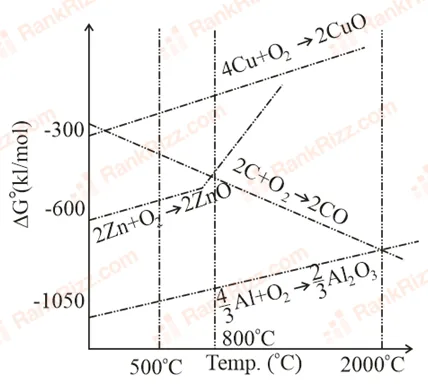
At 1400C, Al can be used for the extraction of Zn from ZnO
At 500C, coke can be used for the extraction of Zn from ZnO
At 800C, Cu can be used for the extraction of Zn from ZnO
Coke cannot be used for the extraction of Cu from CuO
The Mond process is used for the:
Purification of Zr and Ti
Purification of Ni
Extraction of Zn
Extraction of Mo
The reaction that does NOT define calcination is:
In the Hall-Heroult process, aluminium is formed at the cathode. The cathode is made out of:
Platinum
Carbon
Copper
Pure aluminium
The ore that contains the metal in the form of fluoride is known as which of the following?
cryolite
magnetite
malachite
sphalerite
The pair that does not require calcination is
ZnO and FeO . xHO
ZnO and MgO
ZnCO and CaO
FeO and CaCO . MgCO
Which respect to an ore, Ellingham diagram helps to predict the feasibility of its:
Electrolysis
Zone refining
Vapour phase refining
Thermal reduction
Match the ores (column A) with the metals (column B):
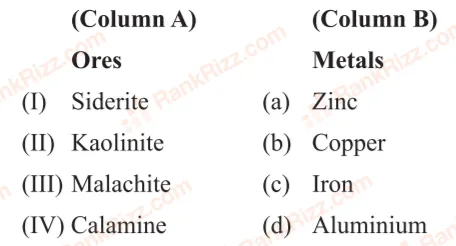
(I)-(a); (II)-(b); (III)-(c); (IV)-(d)
(I)-(c); (II)-(d); (III)-(b); (IV)-(a)
(I)-(c); (II)-(d); (III)-(a); (IV)-(b)
(I)-(b); (II)-(c); (III)-(d); (IV)-(a)
The correct statement is:
Pig iron is obtained from cast iron.
The Hall-Heroult process is used for the production of aluminium and iron.
leaching of bauxite using concentrated NaOH solution gives sodium aluminate and sodium silicate.
the blistered appearance of copper during metallurgical process is due to the evolution of CO.
The ore that contains both iron and copper is:
Azurite
Malachite
Dolomite
Copper pyrites
The correct statement is:
Aniline is a froth stabilizer.
Zone refining process is used for the refining of titanium.
Zincite is a carbonate ore.
Sodium cyanide cannot be used in the metallurgy of silver.
Hall Heroult's process is given by:
The idea of froth flotation method came from a person X and this method is related to the process Y of ores. X and Y, respectively, are:
Washer man and reduction
Fisher women and concentration
Fisher man and reduction
Washer woman and concentration
OTHER CHEMISTRY CHAPTERS