RankRizzStart free

General Principles and Processes of Isolation of Metals — JEE Main Previous Year Questions

Every General Principles and Processes of Isolation of Metals question JEE Main has set, grouped by the idea it tests rather than the order of the syllabus. 120 questions across 5 distinct ideas. Free to read, answer key on every one.

Questions

120

Distinct ideas

5

Share of marks

0%

Difficulty

EASY

The ideas inside General Principles and Processes of Isolation of Metals

A chapter is not one subject — it is a handful of procedures the examiner reuses. These are the ones General Principles and Processes of Isolation of Metals questions actually test.

01Occurrence of metals: minerals and oresset 23×
02Concentration of ores, calcination and roastingset 19×
03Thermodynamic principles and Ellingham diagramset 20×
04Extraction of Fe, Cu, Zn, Al, Ag and Auset 35×
05Refining of metalsset 23×

Every General Principles and Processes of Isolation of Metals question

61–80 OF 120 · NEWEST FIRST

JEE MAIN 2021 · 27 JUL S1Thermodynamic principles and Ellingham diagramTRANSCRIBED

The statement that is INCORRECT about Ellingham diagram is

  1. A

    provides idea about the reaction rate.

  2. B

    provides idea about free energy change.

  3. C

    provides idea about changes in the phases during the reaction.

  4. D

    provides idea about reduction of metal oxide.
JEE MAIN 2021 · 17 MAR S1Thermodynamic principles and Ellingham diagramTRANSCRIBED

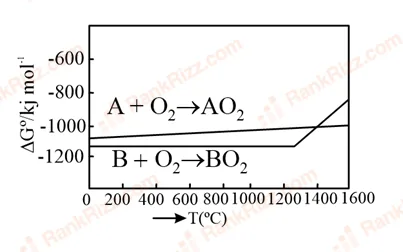
The point of intersection and sudden increase in the slope, in the diagram given below, respectively, indicates:

  1. A

    and melting or boiling point of the metal oxide

  2. B

    \Delta G > 0 and decomposition of the metal oxide

  3. C

    \Delta G < 0 and decomposition of the metal oxide

  4. D

    and reduction of the metal oxide

JEE MAIN 2021 · 27 JUL S2Extraction of Fe, Cu, Zn, Al, Ag and AuTRANSCRIBED

The addition of silica during the extraction of copper from its sulphide ore:-

  1. A

    converts copper sulphide into copper silicate

  2. B

    converts iron oxide into iron silicate

  3. C

    reduces copper sulphide into metallic copper

  4. D

    reduces the melting point of the reaction mixture

JEE MAIN 2021 · 26 AUG S1Thermodynamic principles and Ellingham diagramTRANSCRIBED

Given below are two statements.
Statement I: The choice of reducing agents for metals extraction can be made by using the Ellingham diagram, a plot of vs temperature.
Statement II: The value of increases from left to right in the Ellingham diagram.
In the light of the above statements, choose the most appropriate answer from the options given below:

  1. A

    Statement I is false but Statement II is true

  2. B

    Both Statement I and Statement II are true

  3. C

    Statement I is true but Statement II is false

  4. D

    Both Statement I and Statement II are false

JEE MAIN 2021 · 17 MAR S2Occurrence of metals: minerals and oresTRANSCRIBED

Match List-I and List-II:
List-I                                                       List-II
a. Haematite                                           i. AlO . xHO
b. Bauxite                                               ii. FeO
c. Magnetite                                           iii. CuCO . Cu(OH)
d. Malachite                                            iv. FeO
Choose the correct answer from the options given below:

  1. A

    (a)-(ii), (b)-(iii), (c)-(i), (d)-(iv)

  2. B

    (a)-(iv), (b)-(i), (c)-(ii), (d)-(iii)

  3. C

    (a)-(i), (b)-(iii), (c)-(ii), (d)-(iv)

  4. D

    (a)-(ii), (b)-(i), (c)-(iv), (d)-(iii)

JEE MAIN 2021 · 18 MAR S2Refining of metalsTRANSCRIBED

Match list-I with list-II :

    List-I   List-II
(a)   Mercury   (i)   Vapour phase refining
(b)   Copper   (ii)   Distillation refining
(c)   Silicon   (iii)   Electrolytic refining
(d)   Nickel   (iv)   Zone refining


Choose the most appropriate answer from the option given below:

  1. A

    a - i, b - iv, c - ii, d - iii

  2. B

    a - ii, b - iii, c - i, d - iv

  3. C

    a - ii, b - iii, c - iv, d - i

  4. D

    a - ii, b - iv, c - iii, d - i

JEE MAIN 2021 · 25 FEB S1Thermodynamic principles and Ellingham diagramTRANSCRIBED

Ellingham diagram is a graphical representation of:

  1. A

    vs P

  2. B

    vs T

  3. C

    vs T

  4. D

    vs T

JEE MAIN 2021 · 20 JUL S2Concentration of ores, calcination and roastingTRANSCRIBED

Consider two chemical reactions (A) and (B) that take place during metallurgical process:
(A) ZnCO ZnO + CO
(B) 2ZnS + 3O 2ZnO + 2SO
The correct option of names given to them respectively is:

  1. A

    (A) is calcination and (B) is roasting

  2. B

    Both (A) and (B) are producing same product so both are roasting

  3. C

    Both (A) and (B) are producing same product so both are calcination

  4. D

    (A) is roasting and (B) is calcination

JEE MAIN 2021 · 22 JUL S1Occurrence of metals: minerals and oresTRANSCRIBED

Sulphide ion is soft base and its ores are common for metals
(a) Pb (b) Al (c) Ag (d) Mg
Choose the correct answer from the options given below

  1. A

    a and c only

  2. B

    a and d only

  3. C

    a and b only

  4. D

    c and d only

JEE MAIN 2021 · 25 FEB S2Occurrence of metals: minerals and oresTRANSCRIBED

The major components of German Silver are:

  1. A

    Zn, Ni and Ag

  2. B

    Cu, Zn and Ni

  3. C

    Ge, Cu and Ag

  4. D

    Cu, Zn and Ag

JEE MAIN 2021 · 31 AUG S1Extraction of Fe, Cu, Zn, Al, Ag and AuTRANSCRIBED

Given below are two statements : one is labelled as Assertion (A) and the other is labelled as Reason (R).
Assertion (A) : Aluminium is extracted from bauxite by the electrolysis of molten mixture of AlO with cryolite.
Reason (R) : The oxidation state of Al in cryolite is +3.
In the light of the above statements, choose the most appropriate answer from the options given below:

  1. A

    Both (A) and (R) are correct and (R) is the correct explanation of (A).

  2. B

    (A) is true but (R) is false.

  3. C

    Both (A) and (R) are correct but (R) is not the correct explanation of (A).

  4. D

    (A) is false but (R) is true.

JEE MAIN 2021 · 31 AUG S2Refining of metalsTRANSCRIBED

In the electrolytic refining of blister copper, the total number of main impurities, from the following, removed as anode mud is _________.
Pb, Sb, Se, Te, Ru, Ag, Au and Pt

JEE MAIN 2020 · 06 SEP S2Thermodynamic principles and Ellingham diagramTRANSCRIBED

For a reaction . The free energy change is plotted as a function of temperature. The temperature below which the oxide is stable could be inferred from the plot as the point at which:

  1. A

    the slope change from negative to positive

  2. B

    the free energy change show a change from negative to positive value

  3. C

    the slope changes from positive to negative

  4. D

    the slope changes from positive to zero

JEE MAIN 2020 · 08 JAN S2Extraction of Fe, Cu, Zn, Al, Ag and AuTRANSCRIBED

Among the reactions (a) - (d), the reaction(s) that does/do not occur in the blast furnace during the extraction of iron is/are:
(a) CaO + SiO CaSiO
(b) 3FeO + CO 2FeO + CO
(c) FeO + SiO FeSiO
(d) FeO Fe + O

  1. A

    a

  2. B

    a and d

  3. C

    c and d

  4. D

    d

JEE MAIN 2020 · 06 SEP S2Refining of metalsTRANSCRIBED

The element that can be refined by distillation is:

  1. A

    nickel

  2. B

    zinc

  3. C

    tin

  4. D

    gallium

JEE MAIN 2020 · 05 SEP S1Thermodynamic principles and Ellingham diagramTRANSCRIBED

An Ellingham diagram provides information about:

  1. A

    the conditions of pH and potential under which a species is thermodynamically stable

  2. B

    the temperature dependence of the standard Gibbs energies of formation of some metal oxides

  3. C

    the pressure dependence of the standard electrode potentials of reduction reactions involved in the extraction of metals

  4. D

    the kinetics of the reduction process

JEE MAIN 2020 · 07 JAN S2Refining of metalsTRANSCRIBED

The refining method used when the metal and the impurities have low and high melting temperatures, respectively, is

  1. A

    liquation

  2. B

    vapour phase refining

  3. C

    zone refining

  4. D

    distillation

JEE MAIN 2020 · 07 JAN S1Extraction of Fe, Cu, Zn, Al, Ag and AuTRANSCRIBED

The purest form of commercial iron is:

  1. A

    pig iron

  2. B

    wrought iron

  3. C

    cast iron

  4. D

    scrap iron and pig iron

JEE MAIN 2020 · 09 JAN S1Thermodynamic principles and Ellingham diagramTRANSCRIBED

According to the following diagram, A reduces when the temperature is:

  1. A

    < 1400°C

  2. B

    > 1400°C

  3. C

    > 1200°C but < 1400°C

  4. D

    < 1200°C

JEE MAIN 2020 · 04 SEP S1Refining of metalsTRANSCRIBED

Among statements (a) - (d), the correct ones are:
(a) Lime stone is decomposed to CaO during the extraction of iron from its oxides.
(b) In the extraction of silver, silver is extracted as an anionic complex.
(c) Nickel is purified by Mond's process.
(d) Zr and Ti are purified by Van Arkel method.

  1. A

    (a), (b), (c) and (d)

  2. B

    (a), (c) and (d) only

  3. C

    (b), (c) and (d) only

  4. D

    (c) and (d) only