Electrochemistry — JEE Main Previous Year Questions
Every Electrochemistry question JEE Main has set, grouped by the idea it tests rather than the order of the syllabus. 227 questions across 8 distinct ideas. Free to read, answer key on every one.
JEE MAIN 2019 · 09 JAN S2Electrode potentials, electrochemical series and cell EMFTRANSCRIBED
If the standard electrode potential for a cell is 2 V at 300 K, the equilibrium constant (K) for the reaction. Zn(s)+Cu2+(aq)⇌Zn2+(aq)+Cu(s) at 300 K is approximately: (R=8 J K−1 mol−1, F=96000 C mol−1)
JEE MAIN 2019 · 10 JAN S2Electrode potentials, electrochemical series and cell EMFTRANSCRIBED
In the cell, Pt(s)|H2(g, 1 bar)|HCl(aq)|AgCl(s)|Ag(s)|Pt(s), the cell potential is 0.92 V when a 10−6 molar HCl solution is used. The standard electrode potential of Ag|AgCl|Cl− electrode is: (Given, F2.303RT=0.06 V at 298 K)
JEE MAIN 2019 · 10 APR S1Conductance, conductivity and molar conductivityTRANSCRIBED
Consider the statements S1 and S2: S1: Conductivity always increases with decreases in the concentration of electrolyte. S2: Molar conductivity always increases with decreases in the concentration of electrolyte. The correct option among the following
JEE MAIN 2019 · 11 JAN S2Electrode potentials, electrochemical series and cell EMFTRANSCRIBED
Given the equilibrium constant: KC of the reaction: Cu(s)+2Ag+(aq)→Cu2+(aq)+2Ag(s) is 10×1015. Calculate the E°cell of this reaction at 298 K. [2.303FRT at 298 K = 0.059 V]
JEE MAIN 2019 · 08 APR S2Electrode potentials, electrochemical series and cell EMFTRANSCRIBED
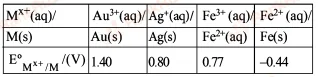
Calculate the standard cell potential (in V) of the cell in which the following reaction takes place: Fe2+(aq) + Ag+(aq) → Fe3+(aq) + Ag(s) Given that EAg+/Ag0=x V, EFe2+/Fe0=y V, EFe3+/Fe0=z V
JEE MAIN 2019 · 09 APR S1Electrode potentials, electrochemical series and cell EMFTRANSCRIBED
The standard Gibbs energy for the given cell reaction in kJ mol−1 at 298 K is: Zn(s) + Cu2+(aq) → Zn2+(aq) + Cu(s), E0 = 2 V at 298 K (Faraday's constant, F = 96000 C mol−1)
JEE MAIN 2019 · 12 JAN S2Conductance, conductivity and molar conductivityTRANSCRIBED
Λm° for NaCl, HCl and NaA are 126.4, 425.9 and 100.5 S cm2 mol−1 respectively. If the conductivity of 0.001 M HA is 5×10⁻⁵ S cm−1, degree of dissociation of HA is
JEE MAIN 2019 · 12 JAN S1Electrode potentials, electrochemical series and cell EMFTRANSCRIBED
The standard electrode potential E° and its temperature coefficient (dTdE) for a cell are 2 V and −5×10⁻⁴ V K−1 at 300 K, respectively. The reaction is Zn(s) + Cu2+(aq) → Zn2+(aq) + Cu(s). The standard reaction enthalpy (ΔrH−) at 300 K in mol−1 is [Use R = 8 J K−1 mol−1 and F = 96,500 C mol−1]
JEE MAIN 2019 · 12 APR S2Conductance, conductivity and molar conductivityTRANSCRIBED
The decreasing order of electrical conductivity of the following aqueous solutions is: (A) 0.1 M Formic acid, (B) 0.1 M Acetic acid, (C) 0.1 M Benzoic acid.
JEE MAIN 2019 · 09 JAN S1Electrolysis and Faraday's lawsTRANSCRIBED
The anodic half-cell of lead-acid battery is recharged using electricity of 0.05 Faraday. The amount of PbSO4 electrolyzed in g during the process is: (Molar mass of PbSO4=303 g mol−1)
JEE MAIN 2019 · 10 JAN S1Electrode potentials, electrochemical series and cell EMFTRANSCRIBED
Consider the following reduction processes: Zn2++2e−→Zn(s);E∘=−0.76 V Ca2++2e−→Ca(s);E∘=−2.87 V Mg2++2e−→Mg(s);E∘=−2.36 V Ni2++2e−→Ni(s);E∘=−0.25 V The reducing power of the metals increases in the order:
JEE MAIN 2018 · 08 APR OFFLINEElectrolysis and Faraday's lawsTRANSCRIBED
How long (approximate) should water be electrolysed by passing through 100 amperes current so that the oxygen released can completely burn 27.66 g of diborane? (Atomic weight of B = 10.8 u)
JEE MAIN 2018 · 15 APR S1Conductance, conductivity and molar conductivityTRANSCRIBED
When an electric current is passes through acidified water, 112 mL of hydrogen gas at N.T.P. was collected at the cathode in 965 seconds. The current passed, in ampere, is:
JEE MAIN 2017 · 02 APR OFFLINEElectrode potentials, electrochemical series and cell EMFTRANSCRIBED
Given E°Cl2/Cl− = 1.36 V, E°Cr3+/Cr = -0.74 V E°Cr2O72−/Cr3+ = 1.33 V, E°MnO4−/Mn2+ = 1.51 V Among the following, the strongest reducing agent is: