RankRizzStart free

Electrochemistry — JEE Main Previous Year Questions

Every Electrochemistry question JEE Main has set, grouped by the idea it tests rather than the order of the syllabus. 227 questions across 8 distinct ideas. Free to read, answer key on every one.

Questions

227

Distinct ideas

8

Share of marks

4.4%

Difficulty

MEDIUM

The ideas inside Electrochemistry

A chapter is not one subject — it is a handful of procedures the examiner reuses. These are the ones Electrochemistry questions actually test.

01Electrode potentials, electrochemical series and cell EMFset 106×
02Galvanic cells, cell notation and salt bridgeset 1×
03Nernst equation and concentration cellsset 4×
04Relation of EMF with Gibbs energy and equilibrium constantset 5×
05Electrolysis and Faraday's lawsset 16×
06Conductance, conductivity and molar conductivityset 70×
07Kohlrausch's law and its applicationsset 8×
08Batteries, fuel cells and corrosionset 17×

Every Electrochemistry question

41–60 OF 227 · NEWEST FIRST

JEE MAIN 2025 · 28 JAN S2Conductance, conductivity and molar conductivityTRANSCRIBED

Electrolysis of 600 mL aqueous solution of NaCl for 5 min changes the pH of the solution to 12 . The current in Amperes used for the given electrolysis is ____. (Nearest integer).
JEE MAIN 2025 · 02 APR S1Electrode potentials, electrochemical series and cell EMFTRANSCRIBED

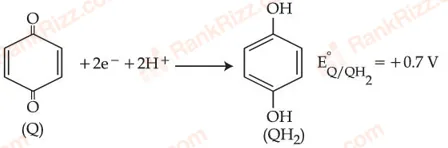
Consider the following electrochemical cell at standard condition.

The couple represents quinhydrone electrode, the half cell reaction is given below:

image

[Given: and ]

The value of the ammonium halide salt () used here is ______. (nearest integer)

JEE MAIN 2025 · 02 APR S2Conductance, conductivity and molar conductivityTRANSCRIBED

0.2 % (w/v) solution of NaOH is measured to have resistivity 870.0 m m. The molar conductivity of the solution will be _________ mS dm mol.
(Nearest integer)

JEE MAIN 2025 · 07 APR S1Electrode potentials, electrochemical series and cell EMFTRANSCRIBED

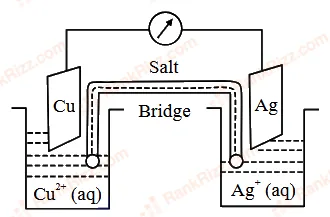
1 Faraday electricity was passed through (1.5 M, 1 L)/Cu and 0.1 Faraday was passed through (0.2 M, 1 L)/Ag electrolytic cells. After this the two cells were connected as shown below to make an electrochemical cell. The emf of the cell thus formed at 298 K is ______. (Given: V, V, V)

image
JEE MAIN 2025 · 04 APR S2Kohlrausch's law and its applicationsTRANSCRIBED

The molar conductance of an infinitely dilute solution of ammonium chloride was found to be 185 S cm mol and the ionic conductance of hydroxyl and chloride ions are 170 and 70 S cm mol, respectively. If molar conductance of 0.02 M solution of ammonium hydroxide is 85.5 S cm mol, its degree of dissociation is given by . The value of x is ______. (Nearest integer)

JEE MAIN 2025 · 28 JAN S1Conductance, conductivity and molar conductivityTRANSCRIBED

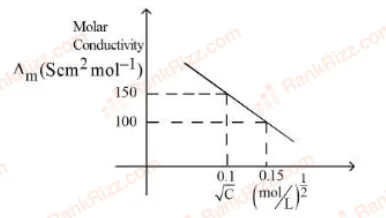
Given below is the plot of the molar conductivity vs for KCl in aqueous solution.

page14_img2


If, for the higher concentration of KCl solution, the resistance of the conductivity cell is 100Ω, then the resistance of the same cell with the dilute solution is Ω The value of is __________ (Nearest integer)

JEE MAIN 2025 · 08 APR S2Electrode potentials, electrochemical series and cell EMFTRANSCRIBED

Consider the following half cell reaction: . The reaction was conducted with the ratio of . The pH value at which the EMF of the half cell will become zero is _____ . (nearest integer value)  [Given : standard half cell reduction potential  V, V]

JEE MAIN 2024 · 09 APR S2Batteries, fuel cells and corrosionTRANSCRIBED

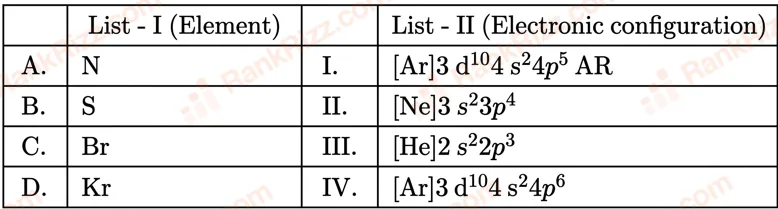
Match List I with List II:

image


Choose the correct answer from the options given below:

  1. A

    A-III, B-II, C-I, D-IV

  2. B

    A-II, B-I, C-IV, D-III

  3. C

    A-I, B-IV, C-III, D-II

  4. D

    A-IV, B-III, C-II, D-I

JEE MAIN 2024 · 06 APR S2Electrode potentials, electrochemical series and cell EMFTRANSCRIBED

How can an electrochemical cell be converted into an electrolytic cell?

  1. A

    Applying an external opposite potential lower than cell.

  2. B

    Reversing the flow of ions in salt bridge.

  3. C

    Applying an external opposite potential greater than cell.

  4. D

    Exchanging the electrodes at anode and cathode.

JEE MAIN 2024 · 27 JAN S2Batteries, fuel cells and corrosionTRANSCRIBED

Which of the following statements is not correct about rusting of iron?

  1. A

    Coating of iron surface by tin prevents rusting, even if the tin coating is peeling off.

  2. B

    When pH lies above 9 or 10, rusting of iron does not take place.

  3. C

    Dissolved acidic oxides , in water act as catalyst in the process of rusting.

  4. D

    Rusting of iron is envisaged as setting up of electrochemical cell on the surface of iron object.

JEE MAIN 2024 · 04 APR S1Electrode potentials, electrochemical series and cell EMFTRANSCRIBED

What pressure (bar) of H₂ would be required to make emf of hydrogen electrode zero in pure water at 25°C?

  1. A

  2. B

  3. C

  4. D

JEE MAIN 2024 · 30 JAN S2Electrode potentials, electrochemical series and cell EMFTRANSCRIBED

Reduction potential of ions are given below:
: V; : V; : V
The correct order of their oxidising power is:

  1. A

    ClO_4^- > IO_4^- > BrO_4^-

  2. B

    BrO_4^- > IO_4^- > ClO_4^-

  3. C

    BrO_4^- > ClO_4^- > IO_4^-

  4. D

    IO_4^- > BrO_4^- > ClO_4^-

JEE MAIN 2024 · 08 APR S2Electrode potentials, electrochemical series and cell EMFTRANSCRIBED

The emf of cell 

image

It could be increased by :

  1. A

    decreasing concentration of both and ions

  2. C

    increasing concentration of ions

  3. D

    increasing concentration of both and ions

JEE MAIN 2024 · 09 APR S1Conductance, conductivity and molar conductivityTRANSCRIBED

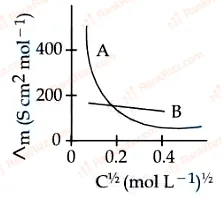
The molar conductivity for electrolytes A and B are plotted against as shown below. Electrolytes A and B respectively are 

page6_img5
  1. A

    A: strong electrolyte ; B: weak electrolyte

  2. B

    A: weak electrolyte ; B: weak electrolyte

  3. C

    A: weak electrolyte ; B: strong electrolyte

      • D

        A: strong electrolyte ; B: strong electrolyte

      JEE MAIN 2024 · 09 APR S2Conductance, conductivity and molar conductivityTRANSCRIBED

      Which out of the following is a correct equation to show change in molar conductivity with respect to concentration for a weak electrolyte, if the symbols carry their usual meaning :

      1. A

      2. B

      3. C

      4. D

      JEE MAIN 2024 · 04 APR S1Electrode potentials, electrochemical series and cell EMFTRANSCRIBED

      One of the commonly used electrode is calomel electrode. Under which of the following categories, calomel electrode comes?

      1. A

        Oxidation-Reduction electrodes

      2. B

        Metal ion-Metal electrodes

      3. C

        Gas-Ion electrodes

      4. D

        Metal-Insoluble Salt-Anion electrodes

      JEE MAIN 2024 · 31 JAN S1Batteries, fuel cells and corrosionTRANSCRIBED

      The metals that are employed in the battery industries are A. Fe, B. Mn, C. Ni, D. Cr, E. Cd. Choose the correct answer from the options given below:

      1. A

        B, C and E only

      2. B

        A, B, C, D and E

      3. C

        A, B, C and D only

      4. D

        B, D and E only

      JEE MAIN 2024 · 05 APR S2Electrolysis and Faraday's lawsTRANSCRIBED

      The quantity of silver deposited when one coulomb charge is passed through solution :

      1. A

        1 g of silver

      2. B

        1 electrochemical equivalent of silver

      3. C

        1 chemical equivalent of silver

      4. D

        0.1 g atom of silver

      JEE MAIN 2024 · 08 APR S2Electrode potentials, electrochemical series and cell EMFTRANSCRIBED

      The reaction; occurs in which of the following galvanic cell :

      1. A

      2. B

      3. C

      4. D

      JEE MAIN 2024 · 31 JAN S1Conductance, conductivity and molar conductivityTRANSCRIBED

      Identify the factor from the following that does not affect electrolytic conductance of a solution.

      1. A

        The nature of the electrolyte added.

      2. B

        The nature of the electrode used.

      3. C

        Concentration of the electrolyte.

      4. D

        The nature of solvent used.