JEE MAIN 2019 · 12 JAN S1Colour and magnetic behaviour of complexes from CFTTRANSCRIBED
The pair of metal ions that can give a spin only magnetic moment of 3.9 BM for the complex , is:
- A
and
- B
and
- C
and
- D
and
Every Coordination Compounds question JEE Main has set, grouped by the idea it tests rather than the order of the syllabus. 373 questions across 10 distinct ideas. Free to read, answer key on every one.
Questions
373
Distinct ideas
10
Share of marks
7.7%
Difficulty
MEDIUM
A chapter is not one subject — it is a handful of procedures the examiner reuses. These are the ones Coordination Compounds questions actually test.
281–300 OF 373 · NEWEST FIRST
The pair of metal ions that can give a spin only magnetic moment of 3.9 BM for the complex , is:
and
and
and
and
The magnetic moment of an octahedral homoleptic Mn(II) complex is 5.9 B.M. The suitable ligand for this complex is:
CO
Ethylenediamine
A reaction of cobalt (III) chloride and ethylenediamine in a 1 : 2 mole ratio generates two isomeric products A (violet-coloured) and B (green-coloured). A can show optical activity, but, B is optically inactive. What type of isomers do A and B represent?
Coordination isomers
Linkage isomers
Ionisation isomers
Geometrical isomers
The correct order of the spin-only magnetic moment of metal ions in the following low-spin complexes, [V(CN)], [Fe(CN)], [Ru(NH)] and [Cr(NH)], is:
V^{2+} > Cr^{2+} > Ru^{3+} > Fe^{2+}
Cr^{2+} > V^{2+} > Ru^{3+} > Fe^{2+}
Cr^{2+} > Ru^{3+} > Fe^{2+} > V^{2+}
V^{2+} > Ru^{3+} > Cr^{2+} > Fe^{2+}
Three complexes,
[CoCl(NH)](I), [Co(NH)HO](II) and [Co(NH)](III)
absorb light in the visible region. The correct order of the wavelength of light absorbed by them is:
(II) > (I) > (III)
(III) > (II) > (I)
(I) > (II) > (III)
(III) > (I) > (II)
The complex that has highest crystal field splitting energy , is:
The number of bridging CO ligand(s) and Co-Co bond(s) in , respectively are:
2 and 1
2 and 0
0 and 2
4 and 0
The compound that inhibits the growth of tumors is:
trans-[PtCl(NH)]
cis-[PtCl(NH)]
cis-[PdCl(NH)]
trans-[PdCl(NH)]
The metal's d-orbitals that are directly facing the ligands in are:
and
and
and
and
The difference in the number of unpaired electrons of a metal ion in its high-spin and low-spin octahedral complexes is two. The metal ion is:
The following ligand is:
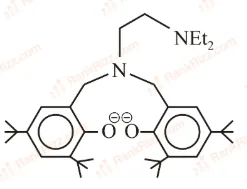
tridentate
hex dentate
bidentate
tetradentate
Two complexes (A) and (B) are violet and yellow coloured, respectively. The incorrect statement regarding them is:
Both are paramagnetic with three unpaired electrons
value of A is less than that of B
values of A and B are calculated from the energies violet and yellow light, respectively.
Both absorb energies corresponding to their complementary colors.
The calculated spin-only magnetic moments BM of the anionic and cationic species of FeHO and Fe(CN) respectively, are:
0 and 4.9
2.84 and 5.92
4.9 and 0
0 and 5.92
The incorrect statement is.
The spin-only magnetic moments of [FeHO] and [CrHO] are nearly similar.
The spin-only magnetic moment of [NiNHHO is 2.83 BM.
The gemstone, ruby, has Cr ions occupying the octahedral sites of beryl.
The color of [CoClNH] is violet as it absorbs the yellow light.
The total number of isomers for a square planar complex: is:
12
16
4
8
is an organometallic compound due to the presence of:
Mn - O bond
Mn - Mn bond
C - O bond
Mn - C bond
The degenerate orbitals of [Cr(HO)] are:
and
and
and
and
The complex ion that will lose its crystal field stabilization energy upon oxidation of metal to +3 state is:
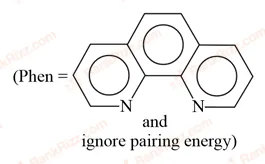
(Phen = phenanthroline, ignore pairing energy)
[Ni(phen)]
[Fe(phen)]
[Co(phen)]
[Zn(phen)]
The coordination numbers of Co and Al in [Co(Cl)(en)]Cl and K[Al(CO)], respectively are:
(en = ethane-1, 2-diamine)
3 and 3
5 and 3
5 and 6
6 and 6
The crystal field stabilization energy (CFSE) of [FeHO]Cl and K[NiCl], respectively, are:
and
and
and
and
OTHER CHEMISTRY CHAPTERS