JEE MAIN 2021 · 22 JUL S1Colour and magnetic behaviour of complexes from CFTTRANSCRIBED
The total number of unpaired electrons present in [Co(NH)]Cl and [Co(NH)]Cl is ___.
Every Coordination Compounds question JEE Main has set, grouped by the idea it tests rather than the order of the syllabus. 373 questions across 10 distinct ideas. Free to read, answer key on every one.
Questions
373
Distinct ideas
10
Share of marks
7.7%
Difficulty
MEDIUM
A chapter is not one subject — it is a handful of procedures the examiner reuses. These are the ones Coordination Compounds questions actually test.
241–260 OF 373 · NEWEST FIRST
The total number of unpaired electrons present in [Co(NH)]Cl and [Co(NH)]Cl is ___.
Three moles of AgCl get precipitated when one mole of an octahedral co-ordination compound with empirical formula CrCl.3NH.3HO reacts with excess of silver nitrate. The number of chloride ions satisfying the secondary valency of the metal ion is ___.
The number of stereo isomers possible for is ______.
[ox = oxalate]
The molecule in which hybrid MOs involve only one d-orbital of the central atom is:
Complex A has a composition of . If the complex on treatment with conc. loses 13.5% of its original mass, the correct molecular formula of A is:
[Given: atomic mass of Cr = 52 amu and Cl = 35 amu]
The d-electron configuration of , and respectively are:
and
and
and
and
Among (a) - (d), the complexes that can show geometrical isomerism are:
(a) [Pt(NH)Cl]
(b) [Pt(NH)Cl]
(c) [Pt(NH)Cl(NO)]
(d) [Pt(NH)ClBr]
b and c
d and a
c and d
a and b
The correct order of the spin-only magnetic moments of the following complexes is:
(I)
(II)
(III)
(IV)
The number of possible optical isomers for the complexes MAB with sp and dsp hybridized metal atom, respectively, is:
Note: A and B are unidentate neutral and unidentate monoanionic ligands, respectively.
0 and 2
2 and 2
0 and 0
0 and 1
The number of isomers possible for is:
2
4
1
3
Simplified absorption spectra of three complexes ((i) and (ii) and (iii)) of ion are provided below; their values are marked as A, B and C respectively. The correct match between the complexes and their values is: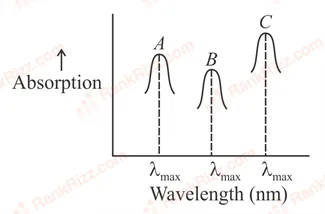
(i)
(ii)
(iii)
A-(iii), (B)-(i), C-(ii)
A-(ii), (B)-(i), C-(iii)
A-(ii), (B)-(iii), C-(i)
A-(i), (B)-(ii), C-(iii)
The Crystal Field Stabilization Energy (CFSE) of (\Delta_0 < P) is:
The IUPAC name of the complex [Pt(NH)Cl(NHCH)]Cl is
Diamminechlorido (methanamine) platinum (II) chloride
Diammine(methanamine)chlorido platinum (II) chloride
Diamminechlorido (aminomethane) platinum (II) chloride
Bisammine (methanamine) chlorido platinum (II) chloride
Complex X of composition has a spin only magnetic moment of 3.83 B.M. It reacts with and shows geometrical isomerism. The IUPAC nomenclature of X is:
Hexaaquachromium(III) chloride
Tetraaquadichlorido chromium(IV) chloride dihydrate
Dichloridotetraaqua chromium(IV) chloride dihydrate
Tetraaquadichlorido chromium(III) chloride dihydrate
The values of the crystal field stabilization energies for a high spin metal ion in octahedral and tetrahedral fields, respectively, are:
and
and
and
and
The isomer(s) of that has/have a Cl - Co - Cl angle of 90, is/are:
meridional and trans
cis and trans
trans only
cis only
Among the statements (a) - (d), the incorrect ones are:
(a) Octahedral Co(III) complexes with strong field ligands have very high magnetic moments
(b) When \Delta_0 < P, the d-electron configuration of Co(III) in an octahedral complex is
(c) Wavelength of light absorbed by [Co(en)] is lower than that of [CoF]
(d) If the for an octahedral complex of Co(III) is 18,000 cm, the for its tetrahedral complex with the same ligand will be 16,000 cm.
(a) and (d) only
(c) and (d) only
(a) and (b) only
(b) and (c) only
The pair in which both the species have the same magnetic moment (spin only) is:
and
and
and
and
The complex that can show fac- and mer-isomers is:
[Co(NH)Cl]
[Pt(NH)Cl]
[CoCl(en)]
[Co(NH)(NO)]
The one that is not expected to show isomerism is:
OTHER CHEMISTRY CHAPTERS