RankRizzStart free

Chemical Kinetics — JEE Main Previous Year Questions

Every Chemical Kinetics question JEE Main has set, grouped by the idea it tests rather than the order of the syllabus. 231 questions across 8 distinct ideas. Free to read, answer key on every one.

Questions

231

Distinct ideas

8

Share of marks

5.5%

Difficulty

MEDIUM

The ideas inside Chemical Kinetics

A chapter is not one subject — it is a handful of procedures the examiner reuses. These are the ones Chemical Kinetics questions actually test.

01Rate of reactionset 2×
02Rate law, order and molecularityset 40×
03Integrated rate laws and half-life (zero and first order)set 85×
04Methods to determine order of reactionset 24×
05Parallel, consecutive and reversible reactionsset 1×
06Arrhenius equation and activation energyset 62×
07Collision theory and effect of catalyst on rateset 1×
08Radioactivity and nuclear reactionsset 16×

Every Chemical Kinetics question

141–160 OF 231 · NEWEST FIRST

JEE MAIN 2021 · 27 AUG S2Arrhenius equation and activation energyTRANSCRIBED

The first order rate constant for the decomposition of CaCO at 700 K is s and activation energy is 209 kJ mol. Its rate constant (in s) at 600 K is . The value of x is _________. (Nearest integer)
[Given R = 8.31 J K mol; log = -2.19, = ]
JEE MAIN 2021 · 16 MAR S2Integrated rate laws and half-life (zero and first order)TRANSCRIBED

A and B decompose via first order kinetics with half-lives 54.0 min and 18.0 min respectively. Starting from an equimolar non-reactive mixture of A and B, the time taken for the concentration of A to become 16 times that of B is ________ min. (Round off to the Nearest Integer).

JEE MAIN 2021 · 25 FEB S1Arrhenius equation and activation energyTRANSCRIBED

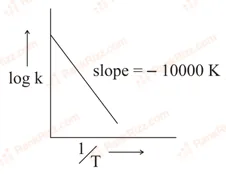
For the reaction, , the plot of log k v/s is given below:


The temperature at which the rate constant of the reaction is s is ______ K.
(Rounded-off to the nearest integer) [Given: The rate constant of the reaction is s at 500 K.]

JEE MAIN 2021 · 17 MAR S1Integrated rate laws and half-life (zero and first order)TRANSCRIBED

For a certain first order reaction 32% of the reactant is left after 570 s. The rate constant of this reaction is ________ s. (Round off to the Nearest Integer).
[Given: , ]

JEE MAIN 2021 · 27 JUL S2Integrated rate laws and half-life (zero and first order)TRANSCRIBED

For the first order reaction A 2B, 1 mole of reactant A gives 0.2 moles of after 100 minutes. The half life of the reaction is _________ min. (Round off to nearest integer).
[
Properties of logarithms:
]
(Round off to the nearest integer)

JEE MAIN 2021 · 22 JUL S1Integrated rate laws and half-life (zero and first order)TRANSCRIBED

NO 2NO + O
In the above first order reaction the initial concentration of NO is mol L at 318 K. The concentration of NO after 1 hour was mol L. The rate constant of the reaction at 318 K is ___ min (Nearest integer):
[Given : log 3 = 0.477, log 5 = 0.699]

JEE MAIN 2021 · 26 FEB S2Arrhenius equation and activation energyTRANSCRIBED

If the activation energy of a reaction is 80.9 kJ mol, the fraction of molecules at 700 K, having enough energy to react to form products is . The value of is (Rounded off to the nearest integer) [Use R = 8.31 J K mol]

JEE MAIN 2021 · 24 FEB S1Integrated rate laws and half-life (zero and first order)TRANSCRIBED

Gaseous cyclobutene isomerizes to butadiene in a first order process which has a 'K' value of s at 153°C. The time in minutes it takes for the isomerization to proceed 40% to completion at this temperature is ______ (Rounded off to the nearest integer)

JEE MAIN 2020 · 03 SEP S2Rate law, order and molecularityTRANSCRIBED

For the reaction , which statement is correct?

  1. A

  2. B

  3. C

  4. D

JEE MAIN 2020 · 08 JAN S2Arrhenius equation and activation energyTRANSCRIBED

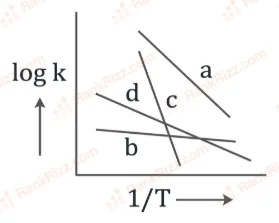
Consider the following plots of rate constant versus for four different reactions. Which of the following orders is correct for the activation energies of these reactions?

image
  1. A

    E_b > E_a > E_d > E_c

  2. B

    E_a > E_c > E_d > E_b

  3. C

    E_c > E_a > E_d > E_b

  4. D

    E_b > E_d > E_c > E_a

JEE MAIN 2020 · 05 SEP S1Integrated rate laws and half-life (zero and first order)TRANSCRIBED

A flask contains a mixture of compounds A and B. Both compounds decompose by first-order kinetics. The half-lives for A and B are and , respectively. If the concentrations of A and B are equal initially, the time required for the concentration of A to be four times that of B (in s) is: (Use )

  1. A

    180

  2. B

    900

  3. C

    300

  4. D

    120

JEE MAIN 2020 · 07 JAN S2Rate law, order and molecularityTRANSCRIBED

For the reaction the observed rate expression is, rate . The rate expression for the reverse reaction is:

  1. A

  2. B

  3. C

  4. D

JEE MAIN 2020 · 06 SEP S1Methods to determine order of reactionTRANSCRIBED

Consider the following reactions:

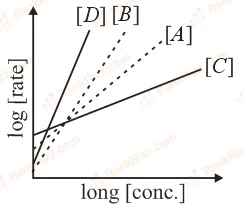
The order of the above reactions are a, b, c and d, respectively. The following graph is obtained when log[rate] vs log[conc.] are plotted:

Among the following, the correct sequence for the order of the reactions is:

  1. A

    d > a > b > c

  2. B

    a > b > c > d

  3. C

    c > a > b > d

  4. D

    d > b > a > c

JEE MAIN 2020 · 02 SEP S2Methods to determine order of reactionTRANSCRIBED

The results given in the below table were obtained during kinetic studies of the following reaction:

Experiment[A]/mol L[B]/mol LInitial rate/mol L min
I0.10.1
II0.10.2
III0.20.1
IVX0.2
V0.3Y


X and Y in the given table are respectively:

  1. A

    0.4, 0.4

  2. B

    0.4, 0.3

  3. C

    0.3, 0.4

  4. D

    0.3, 0.3

JEE MAIN 2020 · 09 JAN S1Arrhenius equation and activation energyTRANSCRIBED

For the following reactions:


It was found that the is decreased by 30 KJ/mol in the presence of catalyst. If the rate remains unchanged, the activation energy for catalysed reaction is (Assume pre-exponential factor is same):

  1. A

    75 KJ/mol

  2. B

    105 KJ/mol

  3. C

    135 KJ/mol

  4. D

    198 KJ/mol

JEE MAIN 2020 · 03 SEP S1Integrated rate laws and half-life (zero and first order)TRANSCRIBED

It is true that:

  1. A

    A second order reaction is always a multistep reaction

  2. B

    A zero order reaction is a multi-step reaction

  3. C

    A first order reaction is always a single step reaction

  4. D

    A zero order reaction is a single step reaction

JEE MAIN 2020 · 08 JAN S1Arrhenius equation and activation energyTRANSCRIBED

The rate of a certain biochemical reaction at physiological temperature (T) occurs times faster with enzyme than without. The change in the activation energy upon adding enzyme is:

  1. A

  2. B

  3. C

  4. D

JEE MAIN 2020 · 05 SEP S2Arrhenius equation and activation energyTRANSCRIBED

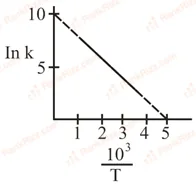
The rate constant of a reaction is measured at different temperature , and the data are plotted in the given figure. The activation energy of the reaction in is: (R is gas constant)

  1. A

  2. B

  3. C

  4. D

JEE MAIN 2020 · 07 JAN S1Radioactivity and nuclear reactionsTRANSCRIBED

During the nuclear explosion, one of the products is Sr with half life of 6.93 years. If 1g of Sr was absorbed in the bones of a newly born baby in place of Ca, how much time, in years, is required to reduce it by 90% if it is not lost metabolically

JEE MAIN 2020 · 09 JAN S2Arrhenius equation and activation energyTRANSCRIBED

A sample of milk splits after 60 min at 300K and after 40 min at 400K when the population of lactobacillus acidophilus in it doubles. The activation energy (in kJ/mol) for this process is closest to ___________.
(Given, J mol K, , )