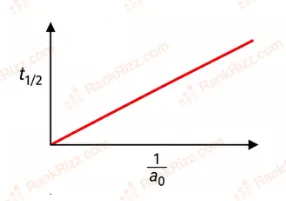
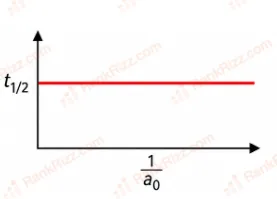
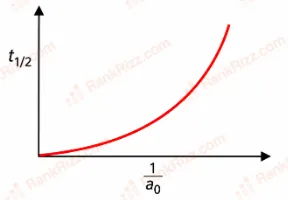
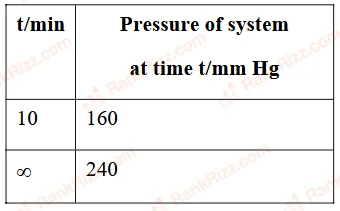
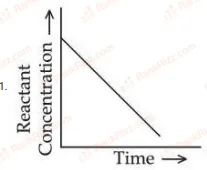
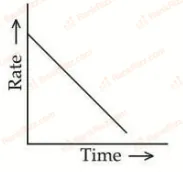
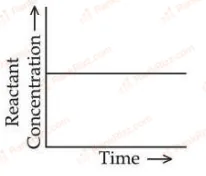
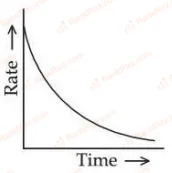
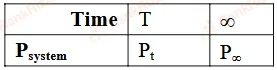
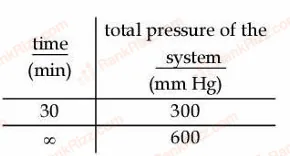
For the thermal decomposition of reactant AB(g), the following plot is constructed.
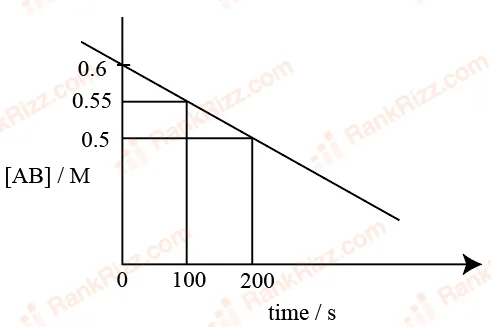
The half life of the reaction is 'x' min.
x= ____ min. (Nearest integer)
Every Chemical Kinetics question JEE Main has set, grouped by the idea it tests rather than the order of the syllabus. 231 questions across 8 distinct ideas. Free to read, answer key on every one.
Questions
231
Distinct ideas
8
Share of marks
5.5%
Difficulty
MEDIUM
A chapter is not one subject — it is a handful of procedures the examiner reuses. These are the ones Chemical Kinetics questions actually test.
21–40 OF 231 · NEWEST FIRST
For the thermal decomposition of reactant AB(g), the following plot is constructed.
The half life of the reaction is 'x' min.
x= ____ min. (Nearest integer)
The half-life of is 245 days. After x days, 75% of original activity remained. The value of x in days is ___ . (Nearest integer)
(Given: log 3 = 0.4771 and log 2 = 0.3010)
(first reaction)
(second reaction)
Consider the above two first-order reactions. The rate constant for first reaction at 500 K is double of the same at 300 K. At 500 K, 50% of the reaction becomes complete in 2 hour. The activation energy of the second reaction is half of that of first reaction. lf the rate constant at 500 K of the second reaction becomes double of the rate constant of first reaction at the same temperature; then rate constant for the second reaction at 300 K is______ (nearest integer).
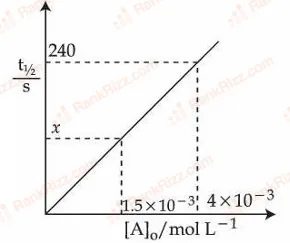
For the reaction at , the half life () is plotted as a function of initial concentration of as give below.
The value of in the given figure is ______ s (Nearest integer)
Decomposition of a hydrocarbon follows the equation . The activation energy of reaction is __________ kJ mol. (Nearest Integer) Given : R = 8.3 J K mol
If the half life of a first order reaction is 6.93 minutes then the time required for completion of 99% of the reaction will be _______ minutes. (Given: log 2 = 0.3010)
Consider the following gas phase reaction being carried out in a closed vessel at 25°C.
The pressure of at 30 minutes time interval would be _____ mm Hg. (nearest integer)
Which of the following graphs is correct for a second-order reaction?


None of these
A first order reaction is 50% completed in 20 minutes at 27 °C and in 5 minutes at 47 °C. The energy of activation of the reaction is:
(Given: ln 4=1.386)
43.85 kJ/mol
55.31 kJ/mol
11.91 kJ/mol
6.65 kJ/mol
In a first order decomposition reaction, the time taken for the decomposition of reactant to one fourth and one eighth of its initial concentration are and (s), respectively. The ratio will :
Drug X becomes ineffective after 50% decomposition. The original concentration of drug in a bottle was 16mg/mL which becomes 4mg/mL in 12 months. The expiry time of the drug in months is _________
Assume that the decomposition of the drug follows first order kinetics.
2
6
12
3
Reaction is a first order reaction. It was started with pure A.
Which of the following option is incorrect?
Initial pressure of A is 80 mm Hg
The reaction never goes to completion
Rate constant of the reaction is 1.693 min
Partial pressure of A after 10 minute is 40 mm Hg
Which of the following graphs most appropriately represents a zero order reaction ?


is a first order reaction.

The reaction was started with reactant A only. Which of the following expression is correct for rate constant k?
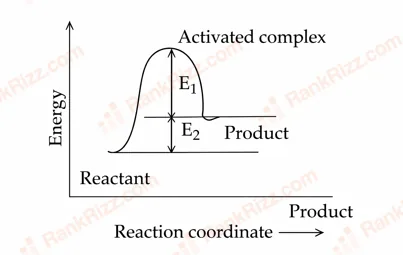
Consider the given figure and choose the correct option :

Activation energy of both forward and backward reaction is and reactant is more stable than product.
Activation energy of forward reaction is and product is less stable than reactant.
Activation energy of backward reaction is and product is more stable than reactant.
Activation energy of forward reaction is and product is more stable than reactant.
In a reaction , initial concentrations of A and B are related as . The half lives of A and B are 10 min and 40 min respectively. If they start to disappear at the same time, both following first order kinetics, after how much time will the concentration of both the reactants be same?
min
min
min
min
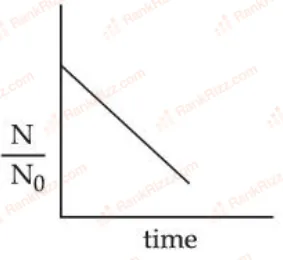
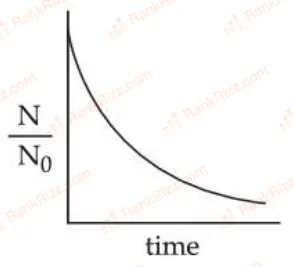
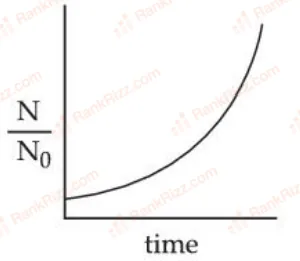
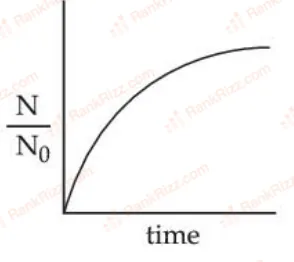
For bacterial growth in a cell culture, growth law is very similar to the law of radioactive decay. Which of the following graphs is most suitable to represent bacterial colony growth ? Where N - Number of Bacteria at any time, - Initial number of Bacteria.


For . for forward and backward reaction are 180 and 200 kJ mol respectively. If catalyst lowers for both reaction by 100 kJ mol. Which of the following statement is correct?
Catalyst does not alter the Gibbs energy change of a reaction.
Catalyst can cause non-spontaneous reactions to occur.
The enthalpy change for the reaction is +20 kJ mol.
The enthalpy change for the catalysed reaction is different from that of uncatalysed reaction.
For a reaction, in a constant volume container, no products were present initially. The final pressure of the system when of reaction gets completed is:
Rate law for a reaction between A and B is given by . If concentration of A is doubled and concentration of B is halved from their initial value, the ratio of new rate of reaction to the initial rate of reaction is
OTHER CHEMISTRY CHAPTERS