Mass of Urea NHCONH required to be dissolved in 1000 g of water in order to reduce the vapour pressure of water by 25% is ______ g. (Nearest integer)
Given: Molar mass of N, C, O and H are 14, 12, 16 and 1 g mol respectively.
Every Solutions question JEE Main has set, grouped by the idea it tests rather than the order of the syllabus. 200 questions across 7 distinct ideas. Free to read, answer key on every one.
Questions
200
Distinct ideas
7
Share of marks
4.8%
Difficulty
MEDIUM
A chapter is not one subject — it is a handful of procedures the examiner reuses. These are the ones Solutions questions actually test.
81–100 OF 200 · NEWEST FIRST
Mass of Urea NHCONH required to be dissolved in 1000 g of water in order to reduce the vapour pressure of water by 25% is ______ g. (Nearest integer)
Given: Molar mass of N, C, O and H are 14, 12, 16 and 1 g mol respectively.
An aqueous solution of volume 300 cm contains 0.63 g of protein. The osmotic pressure of the solution at 300 K is 1.29 mbar. The molar mass of the protein is _______ g mol.
Given: R = 0.083 L bar K mol
Solid Lead nitrate is dissolved in 1 litre of water. The solution was found to boil at C. When mol of NaCl is added to the resulting solution, it was observed that the solution froze at C. The solutibility product of PbCl formed is ______ at 298 K. (Nearest integer)
Given: K K kg mol and K kg mol. Assume molality to be equal to molarity in all cases.
Sea water contains % NaCl and % MgCl by weight of solution. The normal boiling point of the sea water is _____ °C (Nearest integer) Assume 100% ionization for both NaCl and MgCl. Given:
KHO K kg mol. Molar mass of NaCl and MgCl is and g mol respectively.
If the degree of dissociation of aqueous solution of weak monobasic acid is determined to be 0.3, then the observed freezing point will be _______ % higher than the expected/theoretical freezing point. (Nearest integer).
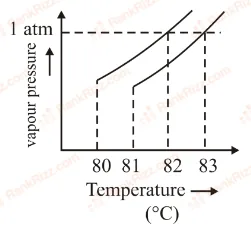
The vapour pressure vs. temperature curve for a solution solvent system is shown below.
The boiling point of the solvent is ______°C.
Solute A associates in water. When g of solute A is dissolved in g of water, it depresses the freezing point by C. The percentage association of solute A in water, is
[Given: Molar mass of A g mol. Molal depression constant of water is K kg mol]
50%
60%
70%
80%
Given below are two statements : one is labelled as Assertion and the other is labelled as Reason.
Assertion: At C, the density of a M solution of KCl [atomic masses of K & Cl are & g mol respectively], is 'x' g mL. The solution is cooled to C. The molality of the solution will remain unchanged.
Reason: The molality of a solution does not change with temperature as mass remains unaffected with temperature.
In the light of the above statements, choose the most appropriate answer from the options given below.
Assertion is true but Reason is false.
Assertion is false but Reason is true.
Both Assertion and Reason are true and Reason is the correct explanation of Assertion.
Both Assertion and Reason are true but Reason is not the correct explanation of Assertion.
Two solutions A and B are prepared by dissolving of non-volatile solutes X and Y respectively in of water. The ratio of depression in freezing points for A and B is found to be . The ratio of molar masses of X and Y is
The depression in freezing point observed for a formic acid solution of concentration is . Density of formic acid is . The Van't Hoff factor of the formic acid solution is nearly: (Given for water )
Boiling point of a aqueous solution of a nonvolatile solute A is equal to the boiling point of aqueous solution of a non-volatile solute B. The relation between molecular weights of A and B is
1.80 g of solute A was dissolved in 62.5 cm of ethanol and freezing point of the solution was found to be 155.1 K. The molar mass of solute A is _____ g mol. [Given: Freezing point of ethanol is 156.0 K. Density of ethanol is 0.80 g cm. Freezing point depression constant of ethanol is 2.00 K kg mol]
A company dissolves '' amount of at K in litre of water to prepare soda water. ______ g. (nearest integer)
(Given: partial pressure of at K bar. Henry's law constant for at K kbar. Atomic mass of H, C and O is and g mol, respectively)
A percent solution of potassium chloride was found to freeze at C. The percentage dissociation of potassium chloride is (Nearest integer)
(Molal depression constant for water is K kg mol and molar mass of KCl is g mol)
1.2 mL of acetic acid is dissolved in water to make 2.0 L of solution. The depression in freezing point observed for this strength of acid is 0.0198°C. The percentage of dissociation of the acid is ______ (Nearest integer)
[Given: Density of acetic acid is 1.02 g mL Molar mass of acetic acid is 60 g mol, K(HO) = 1.85 K kg mol]
Elevation in boiling point for 1.5 molal solution of glucose in water is 4 K. The depression in freezing point for 4.5 molal solution of glucose in water is 4 K. The ratio of molal elevation constant to molal depression constant (K/K) is
The elevation in boiling point for 1 molal solution of non-volatile solute A is . The depression in freezing point for 2 molal solution of A in the same solvent is . The ratio of and i.e., is . The value of is ______.
The osmotic pressure of blood is bar at K. To inject glucose to a patient intravenously, it has to be isotonic with blood. The concentration of glucose solution in gL is (Molar mass of glucose g mol, Lbar mol) (Nearest integer) ______
g of a non-volatile non-electrolyte solute is dissolved in g of two different solvents A and B whose ebullioscopic constants are in the ratio of . The elevation in boiling points of A and B are in the ratio (). The value of is ______ (Nearest Integer)
The vapour pressures of two volatile liquids A and B at C are Torr and Torr, respectively. If the liquid mixture contains mole fraction of A, then the mole fraction of liquid B in the vapour phase is . The value of is ______
OTHER CHEMISTRY CHAPTERS