JEE MAIN 2024 · 04 APR S2Analysis of anionsTRANSCRIBED
When and is added to a salt (A), the greenish yellow gas liberated as salt (A) is:
- A
- B
- C
- D
Every Qualitative Salt Analysis question JEE Main has set, grouped by the idea it tests rather than the order of the syllabus. 69 questions across 4 distinct ideas. Free to read, answer key on every one.
Questions
69
Distinct ideas
4
Share of marks
1.8%
Difficulty
EASY
A chapter is not one subject — it is a handful of procedures the examiner reuses. These are the ones Qualitative Salt Analysis questions actually test.
21–40 OF 69 · NEWEST FIRST
When and is added to a salt (A), the greenish yellow gas liberated as salt (A) is:
Match List I with List II
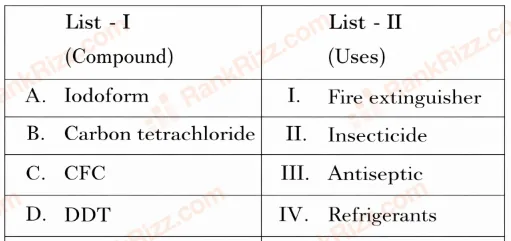
Choose the correct answer from the options given below:
A-I, B-II, C-III, D-IV
A-III, B-I, C-IV, D-II
A-II, B-IV, C-I, D-III
A-III, B-II, C-IV, D-I
In chromyl chloride test for confirmation of ion, a yellow solution is obtained. Acidification of the solution and addition of amyl alcohol and turns organic layer blue indicating formation of chromium pentoxide. The oxidation state of chromium in that is
On passing a gas, '', through Nessler's reagent, a brown precipitate is obtained. The gas '' is
HS
CO
NH
Cl
Given below are two statements:
Statement-I: The gas liberated on warming a salt with dil , turns a piece of paper dipped in lead acetate into black, it is a confirmatory test for sulphide ion.
Statement-II: In statement-I the colour of paper turns black because of formation of lead sulphite.
In the light of the above statements, choose the most appropriate answer from the options given below:
Both Statement-I and Statement-II are false
Statement-I is false but Statement-II is true
Statement-I is true but Statement-II is false
Both Statement-I and Statement-II are true
During the detection of acidic radical present in a salt, a student gets a pale yellow precipitate soluble with difficulty in solution when sodium carbonate extract was first acidified with dil. and then solution was added. This indicates presence of :
In the precipitation of the iron group (III) in qualitative analysis, ammonium chloride is added before adding ammonium hydroxide to:
increase concentration of Cl⁻ ions
increase concentration of NH₄⁺ ions
prevent interference by phosphate ions
decrease concentration of ⁻OH ions
A reagent which gives brilliant red precipitate with Nickel ions in basic medium is
sodium nitroprusside
neutral FeCl
meta-dinitrobenzene
dimethyl glyoxime
The compound that is white in color is
ammonium sulphide
lead sulphate
lead iodide
ammonium arsinomolybdate
Number of metal ions characterized by flame test among the following is _________.
, , , , , ,
The number of white coloured salts among the following is: (A) (B) (C) (D) (E) (F) (G) (H) (I) (J)
Molar mass of the salt from and which does not evolve coloured vapours on heating with concentrated is ____ g mol. (Molar mass in g mol: Na: 23, N: 14, K: 39, O: 16, Br: 80, I: 127, F: 19, Ca: 40)
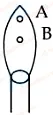
In a borax bead test under hot condition, a metal salt (one from the given) is heated at point B of the flame, resulted in green colour salt bead. The spin-only magnetic moment value of the salt is ______ BM (Nearest integer) [Given atomic number of ]
Consider the following test for a group-IV cation. The spin-only magnetic moment value of the metal complex C is ______ BM (Nearest integer)
Match List I with List II
List I (Elements) List II (Colour imparted to the flame)
A. K I. Brick Red
B. Ca II. Violet
C. Sr III. Apple Green
D. Ba IV. Crimson Red
Choose the correct answer from the options given below:
A-II, B-I, C-III, D-IV
A-II, B-IV, C-I, D-III
A-II, B-I, C-IV, D-III
A-IV, B-III, C-II, D-I
During the borax bead test with CuSO, a blue green colour of the bead was observed in oxidising flame due to the formation of
CuB
Cu
Cu(BO)
CuO
An ammoniacal metal salt solution gives a brilliant red precipitate on addition of dimethylglyoxime. The metal ion is :
An ammoniacal metal salt solution gives a brilliant red precipitate on addition of dimethylglyoxime. The metal ion is:
During the qualitative analysis of SO using dilute HSO, SO gas is evolved which turns KCrO solution (acidified with dilute HSO):
Black
Red
Green
Blue
A chloride salt solution acidified with dil. HNO gives a curdy white precipitate, [A], on addition of AgNO. [A] on treatment with NHOH gives a clear solution, B.
H[AgCl] & [Ag(NH)]Cl
H[AgCl] & (NH)[Ag(OH)]
AgCl & [Ag(NH)]Cl
AgCl & (NH)[Ag(OH)]
OTHER CHEMISTRY CHAPTERS