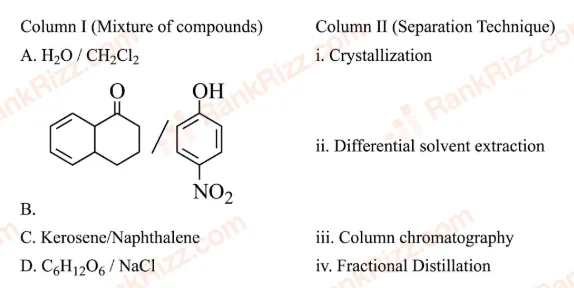
Match items of column I and II

- A
A - (iii), B - (iv), C - (ii), D - (i)
- B
A - (ii), B - (iii), C - (iv), D - (i)
- C
A - (i), B - (iii), C - (ii), D - (iv)
- D
A - (ii), B - (iv), C - (i), D - (iii)
Every Purification and Characterisation of Organic Compounds question JEE Main has set, grouped by the idea it tests rather than the order of the syllabus. 151 questions across 4 distinct ideas. Free to read, answer key on every one.
Questions
151
Distinct ideas
4
Share of marks
3.8%
Difficulty
EASY
A chapter is not one subject — it is a handful of procedures the examiner reuses. These are the ones Purification and Characterisation of Organic Compounds questions actually test.
61–80 OF 151 · NEWEST FIRST
Match items of column I and II

A - (iii), B - (iv), C - (ii), D - (i)
A - (ii), B - (iii), C - (iv), D - (i)
A - (i), B - (iii), C - (ii), D - (iv)
A - (ii), B - (iv), C - (i), D - (iii)
Match List-I with List-II.
List-I (Element detected) List-II (Reagent used/Product formed)
A. Nitrogen I. NaFeCNNO
B. Sulphur II. AgNO
C. Phosphorus III. FeFeCN
D. Halogen IV. NHMoO
A III; B I; C IV; D II
A II; B IV; C I; D III
A IV; B II; C I; D III
A II; B I; C IV; D III
Which of the following statement is correct for paper chromatography?
Water present in the pores of the paper forms the stationary phase.
Paper sheet forms the stationary phase.
Water present in the mobile phase gets absorbed by the paper which then forms the stationary phase.
Paper and water present in its pores together form the stationary phase.
Compound that will give positive Lassaigne's test for both nitrogen and halogen is
NH HCl
CHNH. HCl
NHCl
NHOH. HCl
In Dumas method for the estimation of N, the sample is heated with copper oxide and the gas evolved is passed over:
Copper gauze
Pd
Ni
Copper oxide
A, B and D only
A, B and C only
B and D only
B, C and D only
Using column chromatography, mixture of two compounds 'A' and 'B' was separated. 'A' eluted first, this indicates 'B' has
low Rf, stronger adsorption
high Rf, weaker adsorption
high Rf, stronger adsorption
low Rf, weaker adsorption
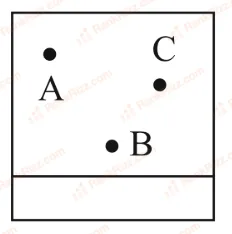
Thin layer chromatography of a mixture shows the following observation.
The correct order of elution in the silica gel column chromatography is
B, A, C
B, C, A
A, C, B
C, A, B
Given below are two statements:
Statement I: Sulphanilic acid gives esterification test for carboxyl group.
Statement II: Sulphanilic acid gives red colour in Lassigne's test for extra element detection.
In the light of the above statements, choose the most appropriate answer from the options given below:
Statement I is correct but Statement II is incorrect.
Both Statement I and Statement II are incorrect
Both Statement I and Statement II are correct
Statement I is incorrect but Statement II is correct.
Match List I with List II:
| List I (Mixture) | List II (Separation Technique) |
|---|---|
| (A) CHCl + CHNH | I. Steam distillation |
| (B) CH + CH | II. Differential extraction |
| (C) CHNH + HO | III. Distillation |
| (D) Organic compound in HO | IV. Fractional distillation |
A-IV, B-I, C-III, D-II
A-III, B-IV, C-I, D-II
A-II, B-I, C-III, D-IV
A-III, B-I, C-IV, D-II
In Carius tube, an organic compound 'X' is treated with sodium peroxide to form a mineral acid 'Y'. The solution of BaCl is added to 'Y' to form a precipitate 'Z'. 'Z' is used for the quantitative estimation of an extra element. 'X' could be
Cytosine
A nucleotide
Methionine
Chloroxylenol
In sulphur estimation. 0.471 g of an organic compound gave 1.4439 g of barium sulphate. The percentage of sulphur in the compound is _____ (Nearest Integer)
(Given: Atomic mass Ba: 137u, S: 32u, O: 16u)
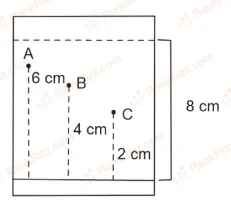
Three organic compounds A, B and C were allowed to run in thin layer chromatography using hexane and gave the following result (see figure). The R value of the most polar compound is _____

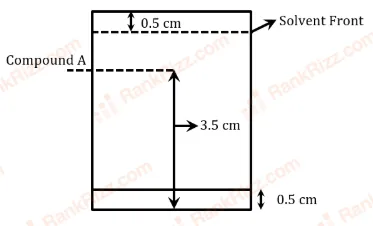
Following chromatogram was developed by adsorption of compound 'A' on a 6 cm TLC glass plate. Retardation factor of the compound 'A' is ______ .

g of an organic compound (X) gave g of AgBr in Carius method for estimation of bromine. % of bromine in the compound (X) is (Given: Molar mass AgBr g mol, Br g mol)
Which one of the following techniques is not used to spot components of a mixture separated on thin layer chromatographic plate?
(Solid)
U.V. Light
Visualisation agent as a component of mobile phase
Spraying of an appropriate reagent
The formula of the purple colour formed in Lassaigne's test for sulphur using sodium nitroprusside is
Phenol on reaction with dilute nitric acid, gives two products. Which method will be most efficient for large scale separation?
Chromatographic separation
Steam distillation
Fractional Crystallisation
Sublimation
Given below are two statements :
Statement I : In 'Lassaigne's Test', when both nitrogen and sulphur are present in an organic compound, sodium thiocyanate is formed.
Statement II : If both nitrogen and sulphur are present in an organic compound, then the excess of sodium used in sodium fusion will decompose the sodium thiocyanate formed to give NaCN and .
In the light of the above statements, choose the most appropriate answer from the options given below
Both Statement I and Statement II are correct.
Both Statement I and Statement II are incorrect.
Statement I is correct but Statement II is incorrect.
Statement I is incorrect but Statement II is correct.
Given below are two statements: one is labelled as Assertion and the other is labelled as Reason.
Assertion: A mixture contains benzoic acid and naphthalene. The pure benzoic acid can be separated out by the use of benzene.
Reason: Benzoic acid is soluble in hot water.
In the light of the above statements, choose the most appropriate answer from the options given below.
Both Assertion and Reason are true and Reason is the correct explanation of Assertion.
Both Assertion and Reason are true but Reason is not the correct explanation of Assertion.
Assertion is true but Reason is false.
Assertion is false but Reason is true.
OTHER CHEMISTRY CHAPTERS