JEE MAIN 2023 · 13 APR S1Titrimetric exercisesTRANSCRIBED
KMnO is titrated with ferrous ammonium sulphate hexahydrate in presence of dilute HSO. Number of water molecules produced for 2 molecules of KMnO is _____.
Every Principles Related to Practical Chemistry question JEE Main has set, grouped by the idea it tests rather than the order of the syllabus. 40 questions across 4 distinct ideas. Free to read, answer key on every one.
Questions
40
Distinct ideas
4
Share of marks
1.2%
Difficulty
EASY
A chapter is not one subject — it is a handful of procedures the examiner reuses. These are the ones Principles Related to Practical Chemistry questions actually test.
21–40 OF 40 · NEWEST FIRST
KMnO is titrated with ferrous ammonium sulphate hexahydrate in presence of dilute HSO. Number of water molecules produced for 2 molecules of KMnO is _____.
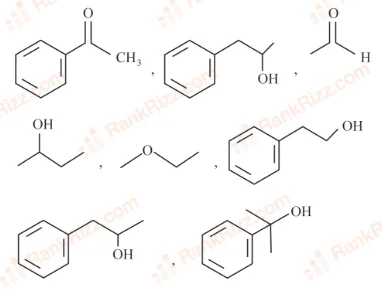
Number of compounds giving (i) red colouration with ceric ammonium nitrate and also (ii) positive iodoform test from the following is _____
In base vs. Acid titration, at the end point methyl orange is present as
quinonoid form
heterocyclic form
phenolic form
benzenoid form
For kinetic study of the reaction of iodide ion with at room temperature:
(A) Always use freshly prepared starch solution.
(B) Always keep the concentration of sodium thiosulphate solution less than that of KI solution.
(C) Record the time immediately after the appearance of blue colour.
(D) Record the time immediately before the appearance of blue colour.
(E) Always keep the concentration of sodium thiosulphate solution more than that of KI solution.
Choose the correct answer from the options given below
A, B, C only
A, D, E only
D, E only
A, B, E only
A g sample containing is treated with HCl liberating . The gas is passed into a solution of KI and mL of M is required to titrate the liberated iodine. The percentage of in the sample is ______ Nearest integer
[Atomic masses (in u) Mn = 55; Cl = 35.5; O = 16, I = 127, Na = 23, K = 39, S = 32]
A sample of 0.125 g of an organic compound when analysed by Duma's method yields 22.78 mL of nitrogen gas collected over KOH solution at 280 K and 759 mmHg. The percentage of nitrogen in the given organic compound is _____
(a) The vapour pressure of water at 280 K is 14.2 mmHg
(b) L atm K mol
Which one of the following complexes is violet in colour?
Fe[Fe(CN)] HO
[Fe(CN)NOS]
[Fe(SCN)]
[Fe(CN)]
Ceric ammonium nitrate and / alc. KOH are used for the identification of functional groups present in ______ and ______ respectively.
amine, phenol
alcohol, amine
amine, alcohol
alcohol, phenol
Seliwanoff test and Xanthoproteic test are used for the identification of ______ and ______ respectively.
aldoses, ketoses
ketoses, proteins
proteins, ketoses
ketoses, aldoses
Consider titration of NaOH solution versus 1.25 M oxalic acid solution. At the end point following burette readings were obtained.
(i) 4.5 mL (ii) 4.5 mL (iii) 4.4 mL (iv) 4.4 mL (v) 4.4 mL
If the volume of oxalic acid taken was 10.0 mL then the molarity of the NaOH solution is ______ M. (Rounded-off to the nearest integer)
0.4 g mixture of NaOH, and some inert impurities was first titrated with HCl using phenolphthalein as an indicator, 17.5 mL of HCl was required at the end point. After this methyl orange was added and titrated. 1.5 mL of same HCl was required for the next end point. The weight percentage of in the mixture is ______ (Rounded-off to the nearest integer)
When 10 mL of an aqueous solution of KMnO was titrated in acidic medium, equal volume of 0.1M of an aqueous solution of ferrous sulphate was required for complete discharge of colour. The strength of KMnO in grams per litre is _________ . (Nearest integer) [Atomic mass of K = 39, Mn = 55, O = 16]
The ratio of number of water molecules in Mohr's salt and potash alum is _________ . (Integer answer)
If you spill a chemical toilet cleaning liquid on your hand, your first aid would be:
vinegar
aqueous NaOH
aqueous NaHCO
aqueous NH
A, B and C are three biomolecules. The results of the tests performed on them are given below:
| Molisch's test | Barfoed Test | Biuret Test | |
|---|---|---|---|
| A | Positive | Negative | Negative |
| B | Positive | Positive | Negative |
| C | Negative | Negative | Positive |
A = Glucose, B = Fructose, C = Albumin
A = Lactose, B = Glucose, C = Albumin
A = Lactose, B = Glucose, C = Alanine
A = Lactose, B = Fructose, C = Alanine
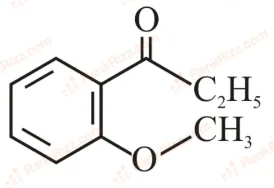
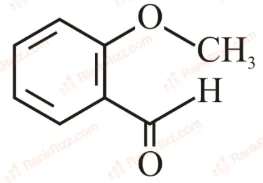
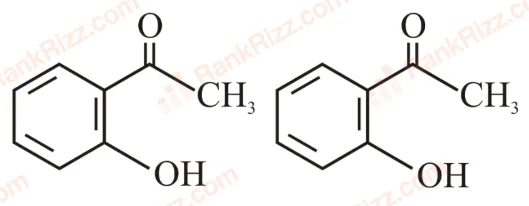
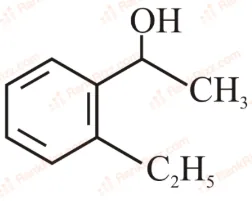
An organic compound neither reacts with neutral ferric chloride solution nor with Fehling solution. It however, reacts with Grignard reagent and gives positive iodoform test. The compound is:
For standardizing NaOH solution, which of the following is used as a primary standard?
Sodium tetra borate
Ferrous Ammonium sulphate
Oxalic acid
Dil. HCl
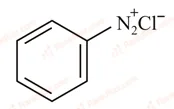
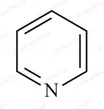
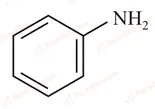
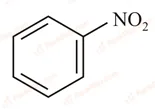
Which of the following compounds will be suitable for Kjeldahl's method for nitrogen estimation?
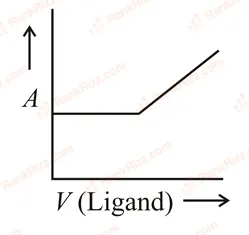
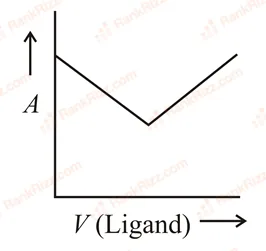
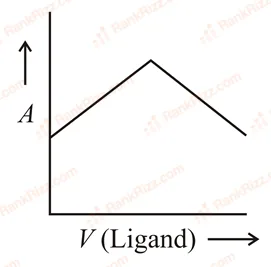
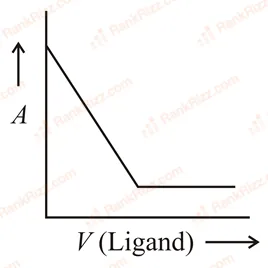
In a complexometric titration of metal ion with ligand M (Metal ion) + L(Ligand) C (Complex). End point is estimated spectrophotometrically (through light absorption). If 'M' and 'C' do not absorb light and only 'L' absorbs then the titration plot between absorbed light (A) versus volume of ligand 'L' (V) would look like:
Which of the following reagents may be used to distinguish between phenol and benzoic acid?
Tollen's reagent
Molisch reagent
Neutral
Aqueous
OTHER CHEMISTRY CHAPTERS