RankRizzStart free

p-Block Elements: Groups 15 to 18 — JEE Main Previous Year Questions

Every p-Block Elements: Groups 15 to 18 question JEE Main has set, grouped by the idea it tests rather than the order of the syllabus. 173 questions across 8 distinct ideas. Free to read, answer key on every one.

Questions

173

Distinct ideas

8

Share of marks

2%

Difficulty

EASY

The ideas inside p-Block Elements: Groups 15 to 18

A chapter is not one subject — it is a handful of procedures the examiner reuses. These are the ones p-Block Elements: Groups 15 to 18 questions actually test.

01Group 15: trends and hydridesset 73×
02Dinitrogen, ammonia, nitric acid and oxides of nitrogenset 10×
03Phosphorus and its compoundsset 1×
04Group 16: trends, dioxygen, ozone and oxidesset 32×
05Sulphur and its compoundsset 11×
06Group 17: halogens and hydrogen halidesset 28×
07Oxoacids of halogens and interhalogen compoundsset 4×
08Group 18: noble gases and xenon compoundsset 14×

Every p-Block Elements: Groups 15 to 18 question

41–60 OF 173 · NEWEST FIRST

JEE MAIN 2023 · 01 FEB S1Group 17: halogens and hydrogen halidesTRANSCRIBED

Given below are two statements:
Statement I: Chlorine can easily combine with oxygen to from oxides; and the product has a tendency to explode.
Statement II: Chemical reactivity of an element can be determined by its reaction with oxygen and halogens.

  1. A

    Both the statements I and II are true

  2. B

    Statement I is true but Statement II is false

  3. C

    Statement I is false but Statement II is true

  4. D

    Both the Statements I and II are false
JEE MAIN 2023 · 25 JAN S1Group 15: trends and hydridesTRANSCRIBED

Compound A reacts with NHCl and forms a compound B. Compound B reacts with HO and excess of CO to form compound C which on passing through or reaction with saturated NaCl solution forms sodium hydrogen carbonate. Compound A, B and C, are respectively.

  1. A

    CaCl, NH, NHHCO

  2. B

    CaCl, NH, (NH)CO

  3. C

    Ca(OH), NH, NHHCO

  4. D

    Ca(OH), NH, (NH)CO

JEE MAIN 2023 · 24 JAN S1Group 15: trends and hydridesTRANSCRIBED

Which of the Phosphorus oxoacid can create silver mirror from solution?

  1. A

  2. B

  3. C

  4. D

JEE MAIN 2023 · 24 JAN S1Group 15: trends and hydridesTRANSCRIBED

Which of the Phosphorus oxoacid can create silver mirror from AgNO solution?

  1. A

    HPO

  2. B

    HPO

  3. C

    HPO

  4. D

    HPO

JEE MAIN 2023 · 24 JAN S2Sulphur and its compoundsTRANSCRIBED

KCrO paper acidified with dilute HSO turns green when exposed to

  1. A

    Carbon dioxide

  2. B

    Sulphur trioxide

  3. C

    Hydrogen sulphide

  4. D

    Sulphur dioxide

JEE MAIN 2023 · 13 APR S2Group 17: halogens and hydrogen halidesTRANSCRIBED

The correct group of halide ions which can be oxidised by oxygen in acidic medium is

  1. A

    Br and I only

  2. B

    Br only

  3. C

    I only

  4. D

    Cl, Br and I only

JEE MAIN 2023 · 15 APR S1Group 15: trends and hydridesTRANSCRIBED

The number of P O P bonds in HPO, (HPO), and PO are respectively

  1. A

  2. B

  3. C

  4. D

JEE MAIN 2023 · 11 APR S2Group 15: trends and hydridesTRANSCRIBED

One mole of P reacts with 8 moles of SOCl to give 4 moles of A, x mole of SO and 2 moles of B. A, B and x respectively are

  1. A

    POCl, SCl and 2

  2. B

    PCl, SCl and 4

  3. C

    PCl, SCl and 2

  4. D

    POCl, SCl and 4

JEE MAIN 2023 · 29 JAN S1Group 15: trends and hydridesTRANSCRIBED

"A" obtained by Ostwald's method involving air oxidation of NH, upon further air oxidation produces "B". "B" on hydration forms an oxoacid of Nitrogen along with evolution of "A". The oxoacid also produces "A" and gives positive brown ring test

  1. A

    NO, NO

  2. B

    NO, NO

  3. C

    NO, NO

  4. D

    NO, NO

JEE MAIN 2023 · 24 JAN S2Group 16: trends, dioxygen, ozone and oxidesTRANSCRIBED

Sum of -bonds present in peroxodisulphuric acid and pyrosulphuric acid is

JEE MAIN 2023 · 08 APR S2Group 15: trends and hydridesTRANSCRIBED

The ratio of sigma and bonds present in pyrophosphoric acid is _____.

JEE MAIN 2023 · 10 APR S1Group 17: halogens and hydrogen halidesTRANSCRIBED

In the following reaction, the total number of oxygen atoms in X and Y is _______.
NaO + HO 2X
ClO + HO 2Y

JEE MAIN 2023 · 08 APR S1Group 18: noble gases and xenon compoundsTRANSCRIBED

XeF reacts with SbF to form [XeF][SbF]. = ?

JEE MAIN 2023 · 10 APR S2Group 18: noble gases and xenon compoundsTRANSCRIBED

The difference in the oxidation state of Xe between the oxidised product of Xe formed on complete hydrolysis of XeF and XeF is _______

JEE MAIN 2022 · 26 JUN S2Group 15: trends and hydridesTRANSCRIBED

The oxide which contains an odd electron at the nitrogen atom is

  1. A

  2. B

  3. C

  4. D

JEE MAIN 2022 · 25 JUN S2Group 15: trends and hydridesTRANSCRIBED

The number of bridged oxygen atoms present in compound B formed from the following reactions is

  1. A

    0

  2. B

    1

  3. C

    2

  4. D

    3

JEE MAIN 2022 · 25 JUL S1Group 15: trends and hydridesTRANSCRIBED

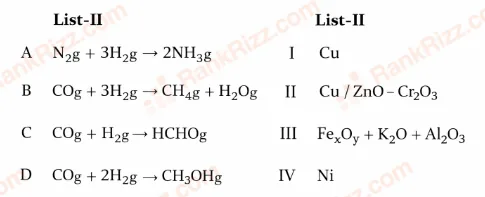
Match List - I with List - II

image

Choose the correct answer from the options given below

  1. A

    A - II, B - IV, C - I, D - III

  2. B

    A - II, B - I, C - IV, D - III

  3. C

    A - III, B - IV, C - I, D - II

  4. D

    A - III, B - I, C - IV, D - II

JEE MAIN 2022 · 28 JUN S1Group 15: trends and hydridesTRANSCRIBED

Nitrogen gas is obtained by thermal decomposition of:

  1. A

  2. B

  3. C

  4. D

JEE MAIN 2022 · 27 JUN S2Group 15: trends and hydridesTRANSCRIBED

The gas produced by treating an aqueous solution of ammonium chloride with sodium nitrite is

  1. A

  2. B

  3. C

  4. D

JEE MAIN 2022 · 28 JUN S1Group 15: trends and hydridesTRANSCRIBED

Given below are two statements :
Statement I: The pentavalent oxide of group-15 element, , is less acidic than trivalent oxide, , of the same element.
Statement II : The acidic character of trivalent oxide of group 15 elements, , decreases down the group.

  1. A

    Both Statement I and Statement II are true.

  2. B

    Both Statement I and Statement II are false.

  3. C

    Statement I is false but statement II is true.

  4. D

    Statement I true, but Statement II is false.