JEE MAIN 2026Lanthanoids and lanthanoid contractionTRANSCRIBED
Which of the following f-block elements in the +3 oxidation state is colourless?
- A
- B
- C
- D
Every d- and f-Block Elements question JEE Main has set, grouped by the idea it tests rather than the order of the syllabus. 229 questions across 7 distinct ideas. Free to read, answer key on every one.
Questions
229
Distinct ideas
7
Share of marks
4.2%
Difficulty
MEDIUM
A chapter is not one subject — it is a handful of procedures the examiner reuses. These are the ones d- and f-Block Elements questions actually test.
21–40 OF 229 · NEWEST FIRST
Which of the following f-block elements in the +3 oxidation state is colourless?
Consider the following reactions The products [A] and [B], respectively are :
Which of the following oxidation reactions are carried out by both and in acidic medium? Choose the correct answer from the options given below:
C, D and E Only
B, C and D Only
A, D and E Only
A, B and C Only
The metal ions that have the calculated spin only magnetic moment value of 4.9 B.M. are
A.
B.
C.
D.
E.
Choose the correct answer from the options given below
A, C and E only
A, D and E only
B and E only
A, B and E only
Lanthanoid ions with (A)Eu^{2+} (B)Gd^{3+} (C)Eu^{3+} (D)Tb^{3+} (E)Sm^{3+}$$ Choose the correct answer from the options given below :
(A) and (D) only
(B) and (C) only
(A) and (B) only
(B) and (E) only
Preparation of potassium permanganate from involves two step process in which the 1st step is a reaction with and to produce:
K
K
K
The correct set of ions (aqueous solution) with same colour from the following is:
The amphoteric oxide among and , upon reaction with alkali leads to formation of an oxide anion. The oxidation state of V in the oxide anion is :
+3
+4
+7
+5
Which of the following ions is the strongest oxidizing agent? (Atomic Number of )
The number of valence electrons present in the metal among Cr, Co, Fe and Ni which has the lowest enthalpy of atomisation is
8
9
6
10
The correct decreasing order of spin only magnetic moment values (BM) of , , and ions is :
Cu^+ > Cu^{2+} > Cr^{3+} > Cr^{2+}
Cu^{2+} > Cu^+ > Cr^{2+} > Cr^{3+}
Cr^{2+} > Cr^{3+} > Cu^{2+} > Cu^+
Cr^{3+} > Cr^{2+} > Cu^+ > Cu^{2+}
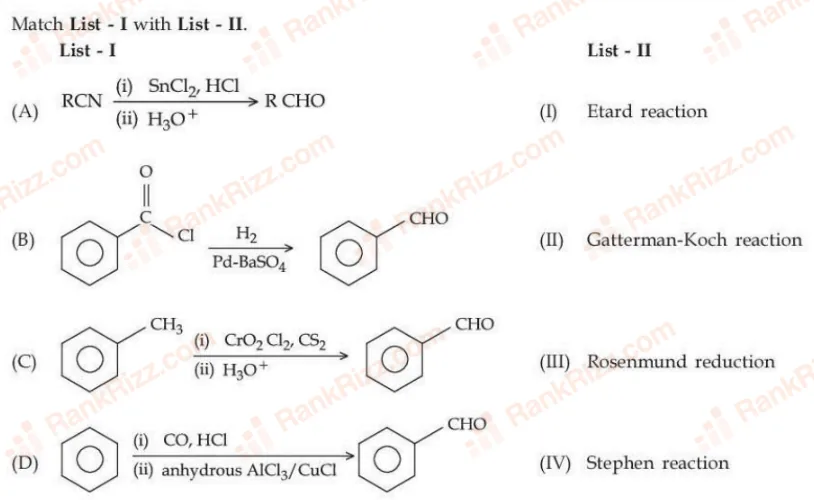
Choose the correct answer from the options given below :
(A)-(III), (B)-(IV), (C)-(II), (D)-(I)
(A)-(I), (B)-(III), (C)-(II), (D)-(IV)
(A)-(III), (B)-(IV), (C)-(I), (D)-(II)
(A)-(IV), (B)-(III), (C)-(I), (D)-(II)
Given below are two statements:
Statement I: is a stronger oxidizing agent than .
Statement II: Cr(VI) is more stable than Mo(VI).
In the light of above statements, Choose the correct answer from the options given below :
Statement I is false but Statement II is true
Statement I is true but Statement II is false
Both Statement I and Statement II are true
Both Statement I and Statement II are false
The first transition series metal 'M' has the highest enthalpy of atomisation in its series. One of its aquated ion () exists in green colour. The nature of the oxide formed by the above ion is :
neutral
acidic
basic
amphoteric
Match List - I with List - II.
List -I List - II
(A) Bronze (I) Cu, Ni
(B) Brass (II) Fe, Cr, Ni, C
(C) UK Silver coin (III) Cu, Zn
(D) Stainless Steel (IV) Cu, Sn
Choose the correct answer from the options given below :
(A)-(IV), (B)-(II), (C)-(III), (D)-(I)
(A)-(IV), (B)-(III), (C)-(I), (D)-(II)
(A)-(III), (B)-(IV), (C)-(II), (D)-(I)
(A)-(III), (B)-(I), (C)-(IV), (D)-(II)
The correct option with order of melting points of the pairs (Mn, Fe), (Tc, Ru) and (Re, Os) is :
Fe < Mn, Ru < Tc and Re < Os
Mn < Fe, Tc < Ru and Os < Re
Mn < Fe, Tc < Ru and Re < Os
Fe < Mn, Ru < Tc and Os < Re
Pair of transition metal ions having the same number of unpaired electrons is:
,
,
,
,
The molar mass of the water insoluble product formed from the fusion of chromite ore with in presence of is_______.
Niobium ( Nb ) and ruthenium (Ru) have "x" and "y" number of electrons in their respective 4 d orbitals The value of x+y is _______.
Among Sc, Mn, Co and Cu, identify the element with highest enthalpy of atomisation. The spin only magnetic moment value of that element in its +2 oxidation state is ________ BM (in nearest integer).
OTHER CHEMISTRY CHAPTERS