RankRizzStart free

Atomic Structure — JEE Main Previous Year Questions

Every Atomic Structure question JEE Main has set, grouped by the idea it tests rather than the order of the syllabus. 226 questions across 9 distinct ideas. Free to read, answer key on every one.

Questions

226

Distinct ideas

9

Share of marks

6.1%

Difficulty

EASY

The ideas inside Atomic Structure

A chapter is not one subject — it is a handful of procedures the examiner reuses. These are the ones Atomic Structure questions actually test.

01Subatomic particles and Thomson/Rutherford modelsset 2×
02Electromagnetic radiation, Planck's quantum theory and photoelectric effectset 34×
03Bohr model of hydrogen-like speciesset 35×
04Hydrogen spectrum and spectral seriesset 33×
05de Broglie wavelength and Heisenberg uncertainty principleset 25×
06Quantum mechanical model, wave function and probabilityset 20×
07Quantum numbers and shapes of orbitalsset 45×
08Radial and angular nodes and orbital energiesset 23×
09Electronic configuration and Aufbau, Pauli and Hund's rulesset 9×

Every Atomic Structure question

141–160 OF 226 · NEWEST FIRST

JEE MAIN 2021 · 25 JUL S1Electromagnetic radiation, Planck's quantum theory and photoelectric effectTRANSCRIBED

A source of monochromatic radiation wavelength 400 nm provides 1000 J of energy in 10 seconds. When this radiation falls on the surface of sodium, electrons are ejected per second. Assume that wavelength 400 nm is sufficient for ejection of electron from the surface of sodium metal. The value of x is ___. (Nearest integer)
h = 6.626 Js
JEE MAIN 2021 · 26 FEB S2de Broglie wavelength and Heisenberg uncertainty principleTRANSCRIBED

A ball weighing 10 g is moving with a velocity of 90 m s. If the uncertainty in its velocity is 5%, then the uncertainty in its position is ______ m. (Rounded off to the nearest integer)
[Given: h = Js]

JEE MAIN 2021 · 16 MAR S1Electromagnetic radiation, Planck's quantum theory and photoelectric effectTRANSCRIBED

When light of wavelength 248 nm falls on a metal of threshold energy 3.0 eV, the de-Broglie wavelength of emitted electrons is ________ (angstrom). (Round off to the Nearest Integer).
[Use: , Js; kg; ms; eV J]

JEE MAIN 2021 · 27 AUG S1Electronic configuration and Aufbau, Pauli and Hund's rulesTRANSCRIBED

The number of electrons in the ground state electronic configuration of Np (Z = 93) is _________. (Integer answer)

JEE MAIN 2021 · 17 MAR S1Quantum numbers and shapes of orbitalsTRANSCRIBED

A certain orbital has and . The number of radial nodes in this orbital is ________. (Round off to the Nearest Integer).

JEE MAIN 2021 · 25 FEB S2Electromagnetic radiation, Planck's quantum theory and photoelectric effectTRANSCRIBED

Among the following, number of metal/s which can be used as electrodes in the photoelectric cell is ______. (Integer answer)
(A) Li (B) Na (C) Rb (D) Cs

JEE MAIN 2021 · 27 AUG S1Bohr model of hydrogen-like speciesTRANSCRIBED

The kinetic energy of an electron in the second Bohr orbit of a hydrogen atom is equal to . The value of 10x is _________. ( is radius of Bohr's orbit)
(Nearest integer)
[Given: ]

JEE MAIN 2021 · 26 AUG S2Electromagnetic radiation, Planck's quantum theory and photoelectric effectTRANSCRIBED

A metal surface is exposed to 500 nm radiation. The threshold frequency of the metal for photoelectric current is Hz. The velocity of ejected electron is _________ ms (Nearest integer)
[Use: h = Js, m = kg]

JEE MAIN 2020 · 09 JAN S1de Broglie wavelength and Heisenberg uncertainty principleTRANSCRIBED

The de Broglie wavelength of an electron in the Bohr orbit is:

  1. A

  2. B

  3. C

  4. D

JEE MAIN 2020 · 05 SEP S1Bohr model of hydrogen-like speciesTRANSCRIBED

The difference between the radii of 3rd and 4th orbits of is . The difference between the radii of 3rd and 4th orbits of is . Ratio is:

  1. A

    8 : 3

  2. B

    3 : 8

  3. C

    2 : 3

  4. D

    3 : 2

JEE MAIN 2020 · 05 SEP S2Quantum mechanical model, wave function and probabilityTRANSCRIBED

The correct statement about probability density (except at infinite distance from nucleus) is:

  1. A

    It can be zero for 1s orbital

  2. B

    It can be negative for 2p orbital

  3. C

    It can be zero for 3p orbital

  4. D

    It can never be zero for 2s orbital

JEE MAIN 2020 · 02 SEP S1Electromagnetic radiation, Planck's quantum theory and photoelectric effectTRANSCRIBED

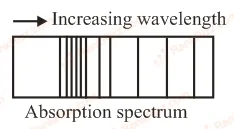
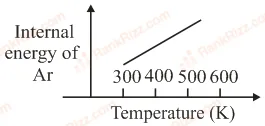
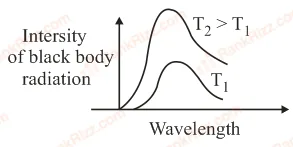
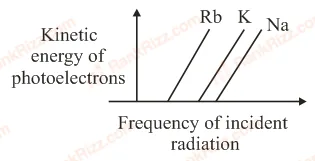
The figure that is not a direct manifestation of the quantum nature of atom is:

  1. A
  2. B
  3. C
  4. D
JEE MAIN 2020 · 04 SEP S1Hydrogen spectrum and spectral seriesTRANSCRIBED

The region in the electromagnetic spectrum where the Balmer series lines appear is:

  1. A

    Visible

  2. B

    Microwave

  3. C

    Infrared

  4. D

    Ultraviolet

JEE MAIN 2020 · 08 JAN S1Hydrogen spectrum and spectral seriesTRANSCRIBED

For the Balmer series, in the spectrum of H atom, , the correct statements among (I) to (IV) are,
(I) As wavelength decreases, the lines in the series converge.
(II) The integer is equal to 2.
(III) The lines of the longest wavelength correspond to .
(IV) The ionization energy of hydrogen can be calculated from the wave number of these lines.

  1. A

    (I), (III), (IV)

  2. B

    (I), (II), (III)

  3. C

    (I), (II), (IV)

  4. D

    (II), (III), (IV)

JEE MAIN 2020 · 02 SEP S2Quantum numbers and shapes of orbitalsTRANSCRIBED

The number of subshells associated with and quantum numbers is:

  1. A

    8

  2. B

    2

  3. C

    16

  4. D

    4

JEE MAIN 2020 · 04 SEP S2Hydrogen spectrum and spectral seriesTRANSCRIBED

The shortest wavelength of H atom in the Lyman series is . The longest wavelength in the Balmer series of He is:

  1. A

  2. B

  3. C

  4. D

JEE MAIN 2020 · 07 JAN S1Quantum numbers and shapes of orbitalsTRANSCRIBED

The number of orbitals associated with quantum numbers , is:

  1. A

    11

  2. B

    25

  3. C

    50

  4. D

    15

JEE MAIN 2020 · 03 SEP S2Quantum numbers and shapes of orbitalsTRANSCRIBED

Consider the hypothetical situation where the azimuthal quantum number, , takes values 0, 1, 2, ......... n + 1. Where n is the principal quantum number. Then, the element with atomic number:

  1. A

    9 is the first alkali metal

  2. B

    13 has a half-filled valence subshell

  3. C

    8 is the first noble gas

  4. D

    6 has a 2p-valence subshell

JEE MAIN 2020 · 08 JAN S2Bohr model of hydrogen-like speciesTRANSCRIBED

The radius of the second Bohr orbit, in terms of the Bohr radius, , in Li is:

  1. A

  2. B

  3. C

  4. D

JEE MAIN 2020 · 08 JAN S2Radial and angular nodes and orbital energiesTRANSCRIBED

Hydrogen has three isotopes (A), (B) and (C). If the number of neutron(s) in (A), (B) and (C) respectively, are (x), (y) and (z), the sum of (x), (y) and (z) is

  1. A

    3

  2. B

    2

  3. C

    4

  4. D

    1