All 90 questions of JEE Main 11 Jan 2019, Shift 2, in the order they were asked. Pick an answer on any question to check it against the key. Free to read, nothing to download.
Questions
90
Physics · Chemistry · Mathematics
Answer key
87
questions with a checked key
Under review
3
key not yet trusted
Price
Free
no sign-up
Physics
Q1JEE MAIN 2019 · 11 JAN S2Equations of motion for uniform accelerationTRANSCRIBED
A particle moves from the point (2.0i^+4.0j^) m, at t=0, with an initial velocity (5.0i^+4.0j^) ms−1. It is acted upon by a constant force which produces a constant acceleration (4.0i^+4.0j^) ms−2. What is the distance of the particle from the origin at time 2 s?
Q3JEE MAIN 2019 · 11 JAN S2Impulse and impulse-momentum theoremTRANSCRIBED
A particle of mass m is moving in a straight line with momentum p. Starting at time t=0, a force F=kt acts in the same direction on the moving particle during time interval T so that its momentum changes from p to 3p. Here k is a constant. The value of T is
Q4JEE MAIN 2019 · 11 JAN S2Torque and the rotational form of Newton's second lawTRANSCRIBED
The magnitude of torque on a particle of mass 1 kg is 2.5 Nm about the origin. If the force acting on it is 1 N, and the distance of the particle from the origin is 5 m, the angle between the force and the position vector is (in radians):
Q5JEE MAIN 2019 · 11 JAN S2Torque and the rotational form of Newton's second lawTRANSCRIBED
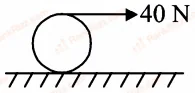
A string is wound around a hollow cylinder of mass 5 kg and radius 0.5 m. If the string is now pulled with a horizontal force of 40 N, and the cylinder is rolling without slipping on a horizontal surface (see figure), then the angular acceleration of the cylinder will be (Neglect the mass and thickness of the string)
Q6JEE MAIN 2019 · 11 JAN S2Moment of inertia of standard bodies and composite systemsTRANSCRIBED
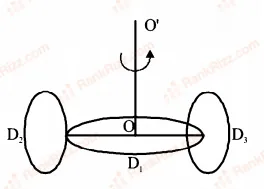
A circular disc D1 of mass M and radius R has two identical discs D2 and D3 of the same mass M and radius R attached rigidly at its opposite ends (see figure). The moment of inertia of the system about the axis OO', passing through the centre of D1, as shown in the figure, will be
Q7JEE MAIN 2019 · 11 JAN S2Simple, compound and torsional pendulumsTRANSCRIBED
The mass and the diameter of a planet are three times the respective values for the Earth. The period of oscillation of a simple pendulum on the Earth is 2 s. The period of oscillation of the same pendulum on the planet would be:
Q8JEE MAIN 2019 · 11 JAN S2Temperature scales and thermal expansionTRANSCRIBED
Two rods A and B of identical dimensions are at temperature 30°C. If A is heated upto 180°C and B upto T°C, then the new lengths are the same. If the ratio of the coefficients of linear expansion of A and B is 4 : 3, then the value of T is
Q9JEE MAIN 2019 · 11 JAN S2Temperature scales and thermal expansionTRANSCRIBED
A thermometer graduated according to a linear scale reads a value x0 when in contact with boiling water, and x0/3 when in contact with ice. What is the temperature of an object in °C, if this thermometer in the contact with the object reads x0/2?
Q10JEE MAIN 2019 · 11 JAN S2Isobaric, isochoric and polytropic processesTRANSCRIBED
In a process, temperature and volume of one mole of an ideal monoatomic gas are varied according to the relation VT = K, where K is a constant. In this process the temperature of the gas is increased by ΔT. The amount of heat absorbed by gas is (R is gas constant):
Q11JEE MAIN 2019 · 11 JAN S2Calorimetry and specific heat capacityTRANSCRIBED
When 100 g of a liquid A at 100°C is added to 50 g of a liquid B at temperature 75°C, the temperature of the mixture becomes 90°C. The temperature of the mixture, if 100 g of liquid A at 100°C is added to 50 g of liquid B at 50°C, will be:
Q12JEE MAIN 2019 · 11 JAN S2Calorimetry and specific heat capacityTRANSCRIBED
A metal ball of mass 0.1 kg is heated upto 500°C and dropped into a vessel of heat capacity 800 JK−1 and containing 0.5 kg water. The initial temperature of water and vessel is 30°C. What is the approximate percentage increment in the temperature of the water? [Specific Heat Capacities of water and metal are, respectively, 4200 Jkg−1K−1 and 400 Jkg−1K−1]
Q13JEE MAIN 2019 · 11 JAN S2Spring-block oscillationsTRANSCRIBED
A pendulum is executing simple harmonic motion and its maximum kinetic energy is K1. If the length of the pendulum is doubled and it performs simple harmonic motion with the same amplitude as in the first case, its maximum kinetic energy is K2
Q14JEE MAIN 2019 · 11 JAN S2Damped and forced oscillations and resonanceTRANSCRIBED
A simple pendulum of length 1 m is oscillating with an angular frequency 10 rad/s. The support of the pendulum starts oscillating up and down with a small angular frequency of 1 rad/s and an amplitude of 10−2 m. The relative change in the angular frequency of the pendulum is best given by:
Q15JEE MAIN 2019 · 11 JAN S2Electric dipole and dipole in external fieldTRANSCRIBED
An electric field of 1000 V/m is applied to an electric dipole at angle of 45°. The value of electric dipole moment is 10−29 C.m. What is the potential energy of the electric dipole?
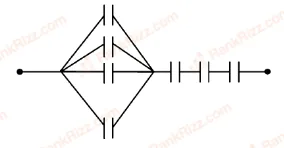
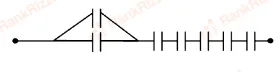
Q16JEE MAIN 2019 · 11 JAN S2Series and parallel combinations of capacitorsTRANSCRIBED
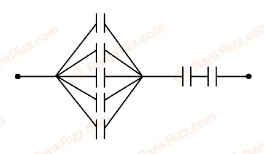
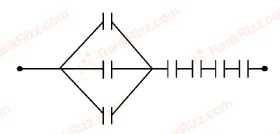
Seven capacitors, each of capacitance 2μF, are to be connected in a configuration to obtain an effective capacitance of (136)μF. Which of the combinations, shown in figures below, will achieve the desired value?
Q18JEE MAIN 2019 · 11 JAN S2Galvanometer conversion to ammeter and voltmeterTRANSCRIBED
A galvanometer having a resistance of 20Ω and 30 division on both sides has figure of merit 0.005 ampere/division. The resistance that should be connected in series such that it can be used as a voltmeter upto 15 volt, is:
Q19JEE MAIN 2019 · 11 JAN S2Magnetisation, magnetic intensity, susceptibility and permeabilityTRANSCRIBED
A paramagnetic substance in the form of a cube with sides 1 cm has a magnetic dipole moment of 20×10−6 J/T when a magnetic intensity of 60×103 A/m is applied. Its magnetic susceptibility is:
Q20JEE MAIN 2019 · 11 JAN S2Motion of charged particles in a magnetic fieldTRANSCRIBED
The region between y=0 and y=d contains a magnetic field B=Bz^. A particle of mass m and charge q enters the region with a velocity v=vi^. If d=2qBmv, the acceleration of the charged particle at the point of its emergence at the other side is:
Q21JEE MAIN 2019 · 11 JAN S2Motion of charged particles in a magnetic fieldTRANSCRIBED
A particle of mass m and charge q is in an electric and magnetic field given by E=2i^+3j^; B=4j^+6k^. The charged particle is shifted from the origin to the point P(x=1;y=1) along a straight path. The magnitude of the total work done is:
Q22JEE MAIN 2019 · 11 JAN S2Self inductance and energy stored in inductorsTRANSCRIBED
A copper wire is wound on a wooden frame, whose shape is that of an equilateral triangle. If the linear dimension of each side of the frame is increased by a factor of 3, keeping the number of turns of the coil per unit length of the frame the same, then the self inductance of the coil:
Q23JEE MAIN 2019 · 11 JAN S2Properties of EM waves: fields, energy, intensity and momentumTRANSCRIBED
A 27 mW laser beam has a cross-sectional area of 10 mm2. The magnitude of the maximum electric field in this electromagnetic wave is given by: [Given permittivity of space ϵ0=9×10⁻¹² SI units, Speed of light c=3×10⁸ m/s]
Q24JEE MAIN 2019 · 11 JAN S2Refraction at plane surfaces, Snell's law and apparent depthTRANSCRIBED
A monochromatic light is incident at a certain angle on an equilateral triangular prism and suffers minimum deviation. If the refractive index of the material of the prism is 3, then the angle of incidence is:
Q25JEE MAIN 2019 · 11 JAN S2Single slit diffractionTRANSCRIBED
In a double-slit experiment, green light (5303 Å) falls on a double slit having a separation of 19.44μm and a width of 4.05μm. The number of bright fringes between the first and the second diffraction minima is
Q26JEE MAIN 2019 · 11 JAN S2Photoelectric effect and Einstein's equationTRANSCRIBED
In a photoelectric experiment, the wavelength of the light incident on a metal is changed from 300 nm to 400 nm. The decrease in the stopping potential is close to: (ehc=1240 nm⋅V)
Q27JEE MAIN 2019 · 11 JAN S2Hydrogen spectrum and spectral seriesTRANSCRIBED
In a hydrogen like atom, when an electron jumps from the M-shell to the L-shell, the wavelength of emitted radiation is L. If an electron jumps from N-shell to the L-shell, the wavelength of emitted radiation will be:
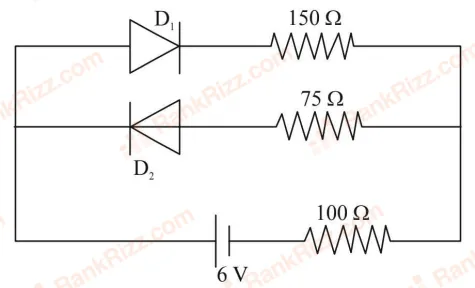
Q28JEE MAIN 2019 · 11 JAN S2p-n junction diode and its characteristicsTRANSCRIBED
The circuit shown below contains two ideal diodes, each with a forward resistance of 50Ω. If the battery voltage is 6 V, the current through the 100Ω resistance (in Amperes) is:
Q30JEE MAIN 2019 · 11 JAN S2Meter bridgeTRANSCRIBED
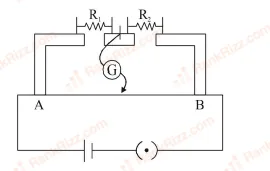
In the experimental set up of metre bridge shown in the figure, the null point is obtained at a distance of 40 cm from A. If a 10Ω resistor is connected in series with R1, the null point shifts by 10 cm. The resistance that should be connected in parallel with (R1+10)Ω such that the null point shifts back to its initial position is
Q31JEE MAIN 2019 · 11 JAN S2Concentration terms and their interconversionTRANSCRIBED
25 mL of the given HCl solution requires 30 mL of 0.1M sodium carbonate solution. What is the volume of this HCl solution required to titrate 30 mL of 0.2M aqueous NaOH solution?
Q32JEE MAIN 2019 · 11 JAN S2Electromagnetic radiation, Planck's quantum theory and photoelectric effectTRANSCRIBED
The de Broglie wavelength (λ) associated with a photoelectron varies with the frequency (ν) of the incident radiation as, [ν0 is threshold frequency]:
Q34JEE MAIN 2019 · 11 JAN S2Gibbs energy and spontaneityTRANSCRIBED
The reaction MgO(s)+C(s)→Mg(s)+CO(g), for which ΔH°=+491.1 kJ mol−1 and ΔS°=198.0 JK−1 mol−1 is not feasible at 298 K. Temperature above which reaction will be feasible is
Q35JEE MAIN 2019 · 11 JAN S2Gibbs energy and spontaneityTRANSCRIBED
The standard reaction Gibbs energy for a chemical reaction at an absolute temperature T is given by ΔG°=A−BT where A and B are non-zero constants. Which of the following is true about this reaction?
Q44JEE MAIN 2019 · 11 JAN S2Crystal lattices, unit cells and densityTRANSCRIBED
The radius of the largest sphere which fits properly at the centre of the edge of a body centred cubic unit cell is: (Edge length is represented by 'a')
Q46JEE MAIN 2019 · 11 JAN S2Electrode potentials, electrochemical series and cell EMFTRANSCRIBED
Given the equilibrium constant: KC of the reaction: Cu(s)+2Ag+(aq)→Cu2+(aq)+2Ag(s) is 10×1015. Calculate the E°cell of this reaction at 298 K. [2.303FRT at 298 K = 0.059 V]
Q47JEE MAIN 2019 · 11 JAN S2Integrated rate laws and half-life (zero and first order)TRANSCRIBED
The reaction 2X→B is a zeroth order reaction. If the initial concentration of X is 0.2M, the half-life is 6 h. When the initial concentration of X is 0.5M, the time required to reach its final concentration of 0.2M will be
Q61JEE MAIN 2019 · 11 JAN S2Relation between roots and coefficientsTRANSCRIBED
Let α and β be the roots of the quadratic equation x2sinθ−x(sinθcosθ+1)+cosθ=0(0 < \theta < 45°), and \alpha < \beta. Then ∑n=0∞(αn+βn(−1)n) is equal to:
Q64JEE MAIN 2019 · 11 JAN S2Sums of binomial coefficientsTRANSCRIBED
Let Sn=1+q+q2+…+qn and Tn=1+(2q+1)+(2q+1)2+…+(2q+1)n where q is a real number and q=1. If 101C1+101C2⋅S1+…+101C101⋅S100=αT100, then α is equal to:
Q67JEE MAIN 2019 · 11 JAN S2Intercepts and position of a pointTRANSCRIBED
A circle cuts a chord of length 4a on the x-axis and passes through a point on the y-axis, distant 2b from the origin. Then the locus of the centre of this circle, is:
Q68JEE MAIN 2019 · 11 JAN S2Chords of a parabola and position of a pointTRANSCRIBED
If the area of the triangle whose one vertex is at the vertex of the parabola, y2+4(x−a2)=0 and the other two vertices are the points of intersection of the parabola and y-axis, is 250 sq. units, then a value of 'a' is:
Q69JEE MAIN 2019 · 11 JAN S2Standard ellipse and basic propertiesTRANSCRIBED
Let the length of the latus rectum of an ellipse with its major axis along x-axis and centre at the origin, be 8. If the distance between the foci of this ellipse is equal to the length of its minor axis, then which one of the following points lies on it?
Q86JEE MAIN 2019 · 11 JAN S2Scalar (dot) productTRANSCRIBED
Let 3i^+j^, i^+3j^ and βi^+(1−β)j^ respectively be the position vectors of the points A, B and C with respect to the origin O. If the distance of C from the bisector of the acute angle between OA and OB is 23, then the sum of all possible values of β is:
Q88JEE MAIN 2019 · 11 JAN S2Distance, foot and image with respect to a planeTRANSCRIBED
If the point (2,α,β) lies on the plane which passes through the points (3,4,2) and (7,0,6) and is perpendicular to the plane 2x−5y=15, then 2α−3β is equal to:
Q89JEE MAIN 2019 · 11 JAN S2Probability using permutations and combinationsTRANSCRIBED
Let S={1,2,…,20}. A subset B of S is said to be "nice" if the sum of the elements of B is 203. Then the probability that a randomly chosen subset of S is "nice" is:
Q90JEE MAIN 2019 · 11 JAN S2Binomial distributionTRANSCRIBED
A bag contains 30 white balls and 10 red balls. 16 balls are drawn one by one randomly from the bag with replacement. If X be the number of white balls drawn, then (standard deviation of Xmean of X) is equal to: