All 90 questions of JEE Main 11 Jan 2019, Shift 1, in the order they were asked. Pick an answer on any question to check it against the key. Free to read, nothing to download.
Questions
90
Chemistry · Physics · Mathematics
Answer key
88
questions with a checked key
Under review
2
key not yet trusted
Price
Free
no sign-up
Chemistry
Q1JEE MAIN 2019 · 11 JAN S1Units, significant figures and laws of chemical combinationTRANSCRIBED
A 10 mg effervescent tablet containing sodium bicarbonate and oxalic acid releases 0.25 mL of CO2 at T = 298.15 K and P = 1 bar. If molar volume of CO2 is 25.0 L under such condition, what is the percentage of sodium bicarbonate in each tablet? [Molar mass of NaHCO3=84 g mol−1]
Q2JEE MAIN 2019 · 11 JAN S1Hydrogen spectrum and spectral seriesTRANSCRIBED
Heat treatment of muscular pain involves radiation of wavelength of about 900 nm. Which spectral line of H atom is suitable for this purpose? [RH=1×105 cm−1, h=6.6×10⁻³⁴ Js, c=3×10⁸ ms−1]
Q4JEE MAIN 2019 · 11 JAN S1Entropy and the second lawTRANSCRIBED
Two blocks of the same metal having same mass and at temperature T1, and T2, respectively, are brought in contact with each other and allowed to attain thermal equilibrium at constant pressure. The change in entropy, ΔS, for this process is:
Q5JEE MAIN 2019 · 11 JAN S1Gibbs energy and spontaneityTRANSCRIBED
For the chemical reaction X⇌Y, the standard reaction Gibbs energy depends on temperature T (in K) as ΔrG° (in kJ mol−1) =120−83T. The major component of the reaction mixture at T is:
Q6JEE MAIN 2019 · 11 JAN S1Law of mass action and equilibrium constants Kc and KpTRANSCRIBED
Consider the reaction N2(g)+3H2(g)⇌2NH3(g). The equilibrium constant of the above reaction is KP. If pure ammonia is left to dissociate, the partial pressure of ammonia at equilibrium is given by (Assume that PNH3≪Ptotal at equilibrium)
Q8JEE MAIN 2019 · 11 JAN S1Position, isotopes, preparation and properties of dihydrogenTRANSCRIBED
The correct statements among (a) to (d) regarding H2 as a fuel are: (i) It produces less pollutants than petrol. (ii) A cylinder of compressed dihydrogen weighs ~ 30 times more than a petrol tank producing the same amount of energy. (iii) Dihydrogen is stored in tanks of metal alloys like NaNi5. (iv) On combustion, values of energy released per gram of liquid dihydrogen and LPG are 50 and 142 kJ, respectively.
Q12JEE MAIN 2019 · 11 JAN S1Percentage composition, empirical and molecular formulaTRANSCRIBED
An organic compound is estimated through Dumas method and was found to evolve 6 moles of CO2, 4 moles of H2O and 1 mole of nitrogen gas. The formula of the compound is:
Q15JEE MAIN 2019 · 11 JAN S1Crystal lattices, unit cells and densityTRANSCRIBED
A solid having density of 9×10³ kg m−3 forms face centred cubic crystals of edge length 2002 pm. What is the molar mass of the solid? [Avogadro constant ≈6×10²³ mol−1, π≈3]
Q16JEE MAIN 2019 · 11 JAN S1Abnormal molar mass and van't Hoff factorTRANSCRIBED
The freezing point of a diluted milk sample is found to be −0.2°C, while it should have been −0.5°C for pure milk. How much water has been added to pure milk to make the diluted sample?
Q18JEE MAIN 2019 · 11 JAN S1Arrhenius equation and activation energyTRANSCRIBED
If a reaction follows the Arrhenius equation, the plot lnk vs (RT)1 gives straight line with a gradient (−y) unit. The energy required to activate the reactant is:
Q31JEE MAIN 2019 · 11 JAN S1Dimensional analysis: deriving and checking relationsTRANSCRIBED
The force of interaction between two atoms is given by F=αβexp(−αkTx2); where x is the distance, k is the Boltzmann constant and T is temperature and α and β are two constants. The dimensions of β is:
Q32JEE MAIN 2019 · 11 JAN S1Kinematics of uniform circular motionTRANSCRIBED
A particle is moving along a circular path with a constant speed of 10 ms−1. What is the magnitude of the change in velocity of the particle, when it moves through an angle of 60° around the centre of the circle?
Q33JEE MAIN 2019 · 11 JAN S1Non-uniform circular motion and radius of curvatureTRANSCRIBED
A body is projected at t=0 with a velocity 10 ms−1 at an angle of 60° with the horizontal. The radius of curvature of its trajectory at t=1 s is R. Neglecting air resistance and taking acceleration due to gravity g=10 ms−2, the value of R is:
Q34JEE MAIN 2019 · 11 JAN S1Head-on collisions and coefficient of restitutionTRANSCRIBED
A body of mass 1 kg falls freely from a height of 100 m, on a platform of mass 3 kg which is mounted on a spring having spring constant k=1.25×10⁶ N/m. The body sticks to the platform and the spring's maximum compression is found to be x. Given that g=10 ms−2, the value of x will be close to:
Q35JEE MAIN 2019 · 11 JAN S1Torque and the rotational form of Newton's second lawTRANSCRIBED
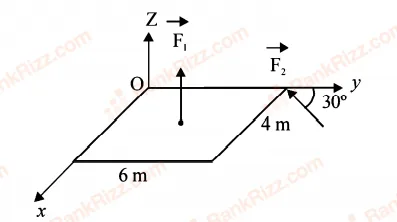
A slab is subjected to two forces F1 and F2 of same magnitude F as shown in the figure. Force F2 is in XY-plane while force F1 acts along z-axis at the point (2i^+3j^). The moment of these forces about point O will be:
Q36JEE MAIN 2019 · 11 JAN S1Moment of inertia of standard bodies and composite systemsTRANSCRIBED
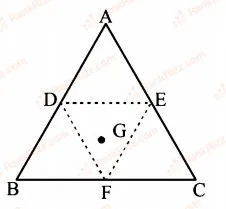
An equilateral triangle ABC is cut from a thin solid sheet of wood. (See figure) D, E and F are the mid-points of its sides as shown and G is the centre of the triangle. The moment of inertia of the triangle about an axis passing through G and perpendicular to the plane of the triangle is I0. If the smaller triangle DEF is removed from ABC, the moment of inertia of the remaining figure about the same axis is I. Then
Q37JEE MAIN 2019 · 11 JAN S1Satellites: orbital speed, period, energy and geostationary orbitsTRANSCRIBED
A satellite is revolving in a circular orbit at a height h from the earth surface, such that h≪R where R is the radius of the earth. Assuming that the effect of earth's atmosphere can be neglected the minimum increase in the speed required so that the satellite could escape from the gravitational field of earth is
Q38JEE MAIN 2019 · 11 JAN S1Equation of continuity and Bernoulli's theoremTRANSCRIBED
A liquid of density ρ is coming out of a hose pipe of radius a with horizontal speed v and hits a mesh. 50% of the liquid passes through the mesh unaffected. 25% loses all of its momentum and 25% comes back with the same speed. The resultant pressure on the mesh will be:
Q39JEE MAIN 2019 · 11 JAN S1Change of state and latent heatTRANSCRIBED
Ice at −20°C is added to 50 g of water at 40°C. When the temperature of the mixture reaches 0°C, it is found that 20 g of ice is still unmelted. The amount of ice added to the water was close to (Specific heat of water = 4.2 J/g/°C, Specific heat of Ice = 2.1 J/g/°C, Heat of fusion of water at 0°C = 334 J/g)
Q40JEE MAIN 2019 · 11 JAN S1Isothermal and adiabatic processesTRANSCRIBED
A rigid diatomic ideal gas undergoes an adiabatic process at room temperature. The relation between temperature and volume for this process is TVx = constant, then x is:
Q41JEE MAIN 2019 · 11 JAN S1Degrees of freedom, equipartition of energy and internal energyTRANSCRIBED
A gas mixture consists of 3 moles of oxygen and 5 moles of argon at temperature T. Considering only translational and rotational modes, the total internal energy of the system is
Q42JEE MAIN 2019 · 11 JAN S1Energy in simple harmonic motionTRANSCRIBED
A particle undergoing simple harmonic motion has time dependent displacement given by x(t)=Asin90πt. The ratio of kinetic to potential energy of this particle at t=210 s will be
Q43JEE MAIN 2019 · 11 JAN S1Progressive waves: wave equation, phase and intensityTRANSCRIBED
Equation of travelling wave on a stretched string of linear density 5 g/m is y=0.03sin(450t−9x) where distance and time are measured in SI units. The tension in the string is:
Q45JEE MAIN 2019 · 11 JAN S1Electric potential and potential energyTRANSCRIBED
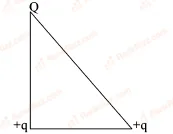
Three charges Q, +q and +q are placed at the vertices of a right-angle isosceles triangle as shown below. The net electrostatic energy of the configuration is zero, if the value of Q is:
Q47JEE MAIN 2019 · 11 JAN S1Electric power and heating effect of currentTRANSCRIBED
Two equal resistances when connected in series to a battery, consume electric power of 60 W. If these resistance are now connected in parallel combination to the same battery, the electric power consumed will be:
Q48JEE MAIN 2019 · 11 JAN S1Wheatstone bridgeTRANSCRIBED
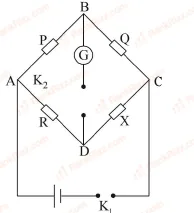
In a Wheatstone bridge (see fig.), Resistances P and Q are approximately equal. When R=400Ω, the bridge is balanced. On interchanging P and Q, the value of R, for balance, is 405Ω. The value of Y is close to
Q49JEE MAIN 2019 · 11 JAN S1Motion of charged particles in a magnetic fieldTRANSCRIBED
In an experiment, electrons are accelerated, from rest, by applying a voltage of 500 V. Calculate the radius of the path if a magnetic field 100 mT is then applied. [Charge of the electron =1.6×10⁻¹⁹ C; Mass of the electron =9.1×10⁻³¹ kg]
Q50JEE MAIN 2019 · 11 JAN S1Self inductance and energy stored in inductorsTRANSCRIBED
There are two long co-axial solenoids of same length l. The inner and outer coils have radii r1 and r2 and number of turns per unit length n1 and n2, respectively. The ratio of mutual inductance to the self-inductance of the inner-coil is:
Q51JEE MAIN 2019 · 11 JAN S1LR circuits: growth and decay of currentTRANSCRIBED
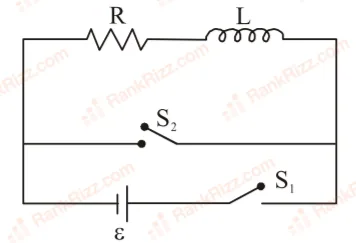
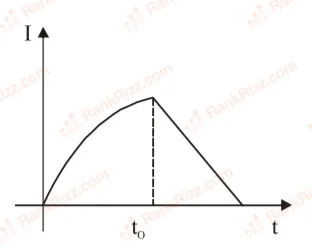
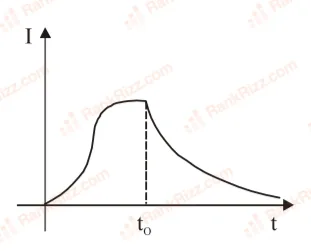
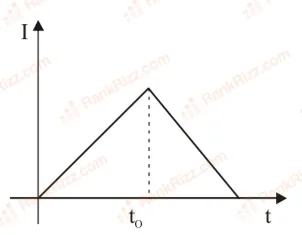
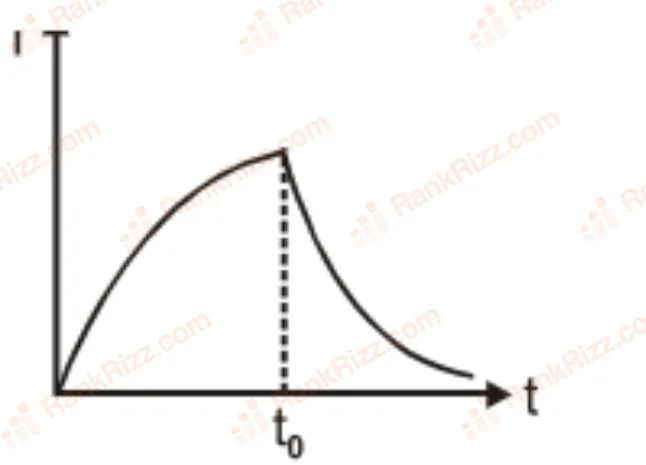
In the circuit shown, the switch S1 is closed at time t=0 and the switch S2 is kept open. At some later time (t0), the switch S1 is opened and S2 is closed. The behaviour of the current I as a function of time t is given by:
Q52JEE MAIN 2019 · 11 JAN S1Properties of EM waves: fields, energy, intensity and momentumTRANSCRIBED
An electromagnetic wave of intensity 50 Wm−2 enters in a medium of refractive index 'n' without any loss. The ratio of the magnitudes of electric fields, and the ratio of the magnitudes of magnetic fields of the wave before and after entering into the medium are respectively, given by:
Q53JEE MAIN 2019 · 11 JAN S1Thin lenses: lens formula, lens maker's formula and powerTRANSCRIBED
An object is at a distance of 20 m from a convex lens of focal length 0.3 m. The lens forms an image of the object. If the object moves away from the lens at a speed of 5 m/s the speed and direction of the image will be
Q54JEE MAIN 2019 · 11 JAN S1Refraction at plane surfaces, Snell's law and apparent depthTRANSCRIBED
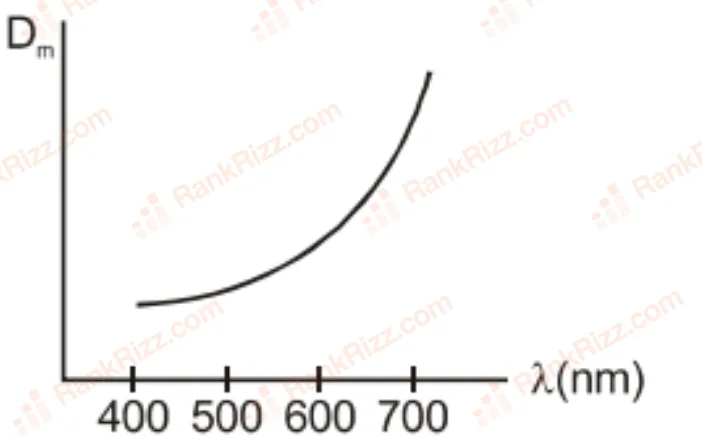
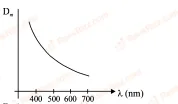
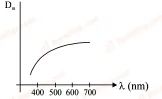
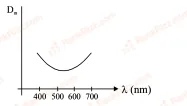
The variation of refractive index of a crown glass thin prism with wavelength of the incident light is shown. Which of the following graphs is the correct one, if Dm is the angle of minimum deviation?
Q55JEE MAIN 2019 · 11 JAN S1Wavefronts and Huygens' principleTRANSCRIBED
In a Young's double slit experiment, the path difference, at a certain point on the screen, between two interfering waves is 81 th of wavelength. The ratio of the intensity at this point to that at the centre of a bright fringe is close to:
Q56JEE MAIN 2019 · 11 JAN S1de Broglie wavelength of matter wavesTRANSCRIBED
If the deBroglie wavelength of an electron is equal to 10−3 times the wavelength of a photon of frequency 6×10¹⁴ Hz, then the speed of electron is equal to: (Speed of light =3×10⁸ m/s, Planck's constant =6.63×10⁻³⁴ J.s, Mass of electron =9.1×10⁻³¹ kg)
Q57JEE MAIN 2019 · 11 JAN S1Hydrogen spectrum and spectral seriesTRANSCRIBED
A hydrogen atom, initially in the ground state is excited by absorbing a photon of wavelength 980 A. The radius of the atom in the excited state, in terms of Bohr radius a0, will be:
Q59JEE MAIN 2019 · 11 JAN S1Modulation and demodulationTRANSCRIBED
An amplitude modulated signal is given by V(t)=10[1+0.3cos(2.2×10⁴t)]sin(5.5×10⁵t). Here t is in seconds. The sideband frequencies (in kHz) are, [Given π=22/7]
Q60JEE MAIN 2019 · 11 JAN S1PotentiometerTRANSCRIBED
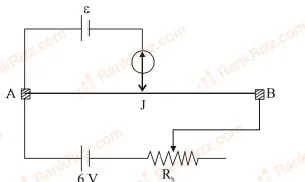
The resistance of the meter bridge AB in given figure is 4Ω. With a cell of emf ε=0.5 V and rheostat resistance Rh=2Ω the null point is obtained at some point J. When the cell is replaced by another one of emf ε=ε2 the same null point J is found for Rh=6Ω. The emf ε2 is:
Q64JEE MAIN 2019 · 11 JAN S1Geometric progression and infinite GPTRANSCRIBED
The sum of an infinite geometric series with positive terms is 3 and the sum of the cubes of its terms is 1927. Then the common ratio of this series is:
Q68JEE MAIN 2019 · 11 JAN S1Sine rule, cosine rule and projection formulaTRANSCRIBED
In a triangle, the sum of lengths of two sides is x and the product of the lengths of the same two sides is y. If x2−c2=y, where c is the length of the third side of the triangle, then the circumradius of the triangle is
Q69JEE MAIN 2019 · 11 JAN S1Intercepts and position of a pointTRANSCRIBED
A square is inscribed in the circle x2+y2−6x+8y−103=0 with its sides parallel to the coordinate axes. Then the distance of the vertex of this square which is nearest to the origin is:
Q70JEE MAIN 2019 · 11 JAN S1Position of two circles and common tangentsTRANSCRIBED
Two circles with equal radii are intersecting at the points (0,1) and (0,-1). The tangent at the point (0,1) to one of the circles passes through the centre of the other circle. Then the distance between the centres of these circles is:
Q71JEE MAIN 2019 · 11 JAN S1Intercepts and position of a pointTRANSCRIBED
The straight line x+2y=1 meets the coordinate axes at A and B. A circle is drawn through A, B and the origin. Then the sum of perpendicular distances from A and B on the tangent to the circle at the origin is:
Q72JEE MAIN 2019 · 11 JAN S1Tangents to an ellipseTRANSCRIBED
If tangents are drawn to the ellipse x2+2y2=2 at all points on the ellipse other than its four vertices then the mid points of the tangents intercepted between the coordinate axes lie on the curve:
Q76JEE MAIN 2019 · 11 JAN S1Variance and standard deviationTRANSCRIBED
The outcome of each of 30 items was observed; 10 items gave an outcome 21−d each, 10 items gave outcome 21 each and the remaining 10 items gave outcome 21+d each. If the variance of this outcome data is 34 then ∣d∣ equals:
Q88JEE MAIN 2019 · 11 JAN S1Line and plane: intersection, coplanarity and projectionTRANSCRIBED
The plane containing the line 2x−3=−1y+2=3z−1 and also containing its projection on the plane 2x+3y−z=5, contains which one of the following points?
Q89JEE MAIN 2019 · 11 JAN S1Distance, foot and image with respect to a planeTRANSCRIBED
The direction ratios of normal to the plane through the points (0,-1,0) and (0,0,1) and making an angle 4π with the plane y−z+5=0 are: 2,-1,1; 2,2−2; 2,1,−1; 23,1,−1
Q90JEE MAIN 2019 · 11 JAN S1Conditional probability and multiplication theoremTRANSCRIBED
Two integers are selected at random from the set {1,2,…,11}. Given that the sum of selected numbers is even, the conditional probability that both the numbers are even is: