RankRizzStart free

JEE Main 08 Apr 2019, Shift 1 Question Paper

All 90 questions of JEE Main 08 Apr 2019, Shift 1, in the order they were asked. Pick an answer on any question to check it against the key. Free to read, nothing to download.

Questions

90

Physics · Chemistry · Mathematics

Answer key

89

questions with a checked key

Under review

1

key not yet trusted

Price

Free

no sign-up

Physics

Q1JEE MAIN 2019 · 08 APR S1Kinematics in two dimensions using position vectorsTRANSCRIBED

Ship A is sailing towards north-east with velocity km h where points east and , north. The ship B is at a distance of 80 km east and 150 km north of Ship A and is sailing towards the west at 10 km h. A will be at the minimum distance from B in:

  1. A

    4.2 h

  2. B

    3.2 h

  3. C

    2.6 h

  4. D

    2.2 h

Q2JEE MAIN 2019 · 08 APR S1Dimensional analysis: deriving and checking relationsTRANSCRIBED

In SI units, the dimensions of is:

  1. A

  2. B

  3. C

  4. D

Q3JEE MAIN 2019 · 08 APR S1Conservation of mechanical energyTRANSCRIBED

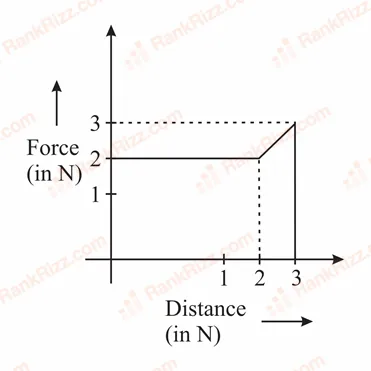
A particle moves in one dimension from rest under the influence of a force that varies with the distance traveled by the particle as shown in the figure. The kinetic energy of the particle after it has traveled 3 m is:

  1. A

    4 J

  2. B

    2.5 J

  3. C

    6.5 J

  4. D

    5 J

Q4JEE MAIN 2019 · 08 APR S1Kinetic interpretation of pressure and temperatureTRANSCRIBED

If gas molecules each of mass kg collides with a surface (perpendicular to it) elastically per second over an area 1 m with a speed m/s, the pressure exerted by the gas molecules will be of the order of:

  1. A

    2 Pa

  2. B

    4 Pa

  3. C

    6 Pa

  4. D

    8 Pa

Q5JEE MAIN 2019 · 08 APR S1Motion of centre of mass, momentum conservation and explosionsTRANSCRIBED

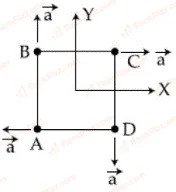
Four particles A, B, C and D with masses , , and are at the corners of a square. They have accelerations of equal magnitude with directions as shown. The acceleration of the centre of mass of the particles is:

  1. A

  2. B

  3. C

  4. D

    Zero

Q6JEE MAIN 2019 · 08 APR S1Moment of inertia of standard bodies and composite systemsTRANSCRIBED

A thin circular plate of mass and radius has its density varying as with as constant and is the distance from its centre. The moment of Inertia of the circular plate about an axis perpendicular to the plate and passing through its edge is . The value of the coefficient is:

  1. A

  2. B

  3. C

  4. D

Q7JEE MAIN 2019 · 08 APR S1Kepler's laws and planetary motionTRANSCRIBED

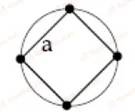
Four identical particles of mass M are located at the corners of a square of side 'a'. What should be their speed if each of them revolves under the influence of other's gravitational field in a circular orbit circumscribing the square?

  1. A

  2. B

  3. C

  4. D

Q8JEE MAIN 2019 · 08 APR S1Elastic potential energy in stretched wiresTRANSCRIBED

A boy's catapult is made of rubber cord which is 42 cm long, with 6 mm diameter of cross-section and of negligible mass. The boy keeps a stone weighing 0.02 kg on it and stretches the cord by 20 cm by applying a constant force. When released, the stone flies off with a velocity of 20 ms. Neglect the change in the area of cross-section of the cord while stretched. The Young's modulus of rubber is closest to:

  1. A

    N m

  2. B

    N m

  3. C

    N m

  4. D

    N m

Q9JEE MAIN 2019 · 08 APR S1Stress, strain, Hooke's law and Young's modulusTRANSCRIBED

A steel wire having a radius of 2.0 mm, carrying a load of 4 kg, is hanging from a ceiling. Given that g = 3.1 m s, what will be the tensile stress that would be developed in the wire?

  1. A

    N m

  2. B

    N m

  3. C

    N m

  4. D

    N m

Q10JEE MAIN 2019 · 08 APR S1Viscosity, Poiseuille's equation and Reynolds numberTRANSCRIBED

Water from a pipe is coming at a rate of 100 liters per minute. If the radius of the pipe is 5 cm, the Reynolds number for the flow is of the order of: (density of water = 100 kg/m, coefficient of viscosity of water = 1 mPa s)

  1. A

  2. B

  3. C

  4. D

Q11JEE MAIN 2019 · 08 APR S1Change of state and latent heatTRANSCRIBED

A thermally insulated vessel contains 150 g of water at 0°C. Then the air from the vessel is pumped out adiabatically. A fraction of water turns into ice and the rest evaporates at 0°C itself. The mass of evaporated water will be closest to: (Latent heat of vaporization of water = J kg and Latent heat of Fusion of water = J kg)

  1. A

    35 g

  2. B

    20 g

  3. C

    130 g

  4. D

    150 g

Q12JEE MAIN 2019 · 08 APR S1Newton's law of coolingTRANSCRIBED

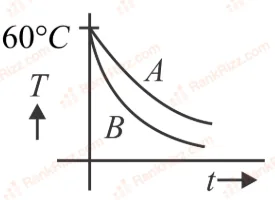
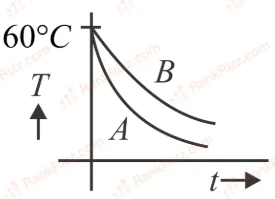
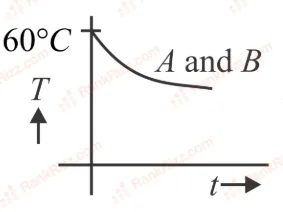
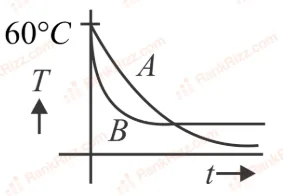
Two identical beakers A and B contain equal volumes of two different liquids at 60°C each and left to cool down. Liquid in A has density of kg m and specific heat of 2000 J kgK while the liquid in B has density kg m and specific heat of 4000 J kgK. Which of the following best describes their temperature versus time graph schematically? (assume the emissivity of both the beakers to be the same)

  1. A
    image
  2. B
    image
  3. C
    image
  4. D
    image
Q13JEE MAIN 2019 · 08 APR S1Superposition, interference and beatsTRANSCRIBED

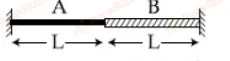
A wire of length 2L, is made by joining two wires A and B of same length but different radii r and 2r and made of the same material. It is vibrating at a frequency such that the joint of the two wires forms a node. If the number of antinodes in wire A is p and that in B is q then ratio p:q is:

  1. A

    3 : 5

  2. B

    4 : 9

  3. C

    1 : 4

  4. D

    1 : 2

Q14JEE MAIN 2019 · 08 APR S1Electric field due to point charges and superpositionTRANSCRIBED

The bob of a simple pendulum has mass 2 g and a charge of 5.0 C. It is at rest in a uniform horizontal electric field of intensity 2000 V/m. At equilibrium, the angle that the pendulum makes with the vertical is: (take g = 10 m/s)

  1. A

  2. B

  3. C

  4. D

Q15JEE MAIN 2019 · 08 APR S1Electric potential and potential energyTRANSCRIBED

A solid conducting sphere, having a charge Q, is surrounded by an uncharged conducting hollow spherical shell. Let the potential difference between the surface of the solid sphere and that of the outer surface of the hollow shell be V. If the shell is now given a charge of -4Q, the new potential difference between the same two surfaces is:

  1. A

    -2V

  2. B

    2 V

  3. C

    V

  4. D

    4 V

Q16JEE MAIN 2019 · 08 APR S1Capacitors with dielectricsTRANSCRIBED

Voltage rating of a parallel plate capacitor is 500 V. Its dielectric can withstand a maximum electric field of V/m. The plate area is m. What is the dielectric constant if the capacitance is 15 pF? (given C/Nm)

  1. A

    3.8

  2. B

    8.5

  3. C

    4.5

  4. D

    6.2

Q17JEE MAIN 2019 · 08 APR S1Cells: emf, internal resistance and combinationsTRANSCRIBED

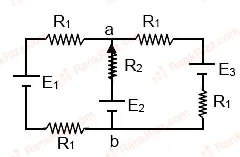
For the circuit shown, with , , V and V, the potential difference between the points 'a' and 'b' is approximately (in V):

  1. A

    3.3

  2. B

    2.3

  3. C

    2.7

  4. D

    3.7

Q18JEE MAIN 2019 · 08 APR S1Ohm's law, resistance, resistivity and colour codeTRANSCRIBED

A 200 resistor has certain colour code. If one replaced the red colour by green in the code, the new resistance will be:

  1. A

    300

  2. B

    100

  3. C

    400

  4. D

    500

Q19JEE MAIN 2019 · 08 APR S1Magnetic dipole moment of current loops and torque on loopsTRANSCRIBED

A circular coil having N turns and radius r carries a current I. It is held in the XZ plane in a magnetic field . The torque on the coil due to the magnetic field is:

  1. A

  2. B

  3. C

  4. D

    Zero

Q20JEE MAIN 2019 · 08 APR S1Motional emf in moving rods and loopsTRANSCRIBED

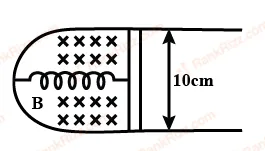
A thin strip 10 cm long is on a U shaped wire of negligible resistance and it is connected to a spring of spring constant 0.5 N m (see figure). The assembly is kept in a uniform magnetic field of 0.1 T. If the strip is pulled from its equilibrium position and released, the number of oscillations it performs before its amplitude decreases by a factor of e is N. If the mass of the strip is 50 grams, its resistance 10 and air drag negligible, N will be close to:

  1. A

    1000

  2. B

    5000

  3. C

    10000

  4. D

    50000

Q21JEE MAIN 2019 · 08 APR S1Self inductance and energy stored in inductorsTRANSCRIBED

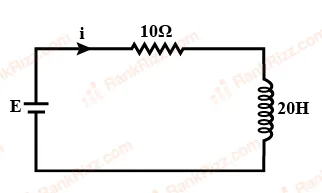
A 20 H inductor coil is connected to a 10 resistance in series as shown in figure. The time at which rate of dissipation of energy (Joule's heat) across resistance is equal to the rate at which magnetic energy is stored in the inductor, is:
  1. A

  2. B

  3. C

  4. D

Q22JEE MAIN 2019 · 08 APR S1Series LCR circuits: impedance and phaseTRANSCRIBED

An alternating voltage volt is applied to a purely resistive load of 50 . The time taken for the current to rise from half of the peak value to the peak value is:
  1. A

    7.21 ms

  2. B

    5.25 ms

  3. C

    2.24 ms

  4. D

    3.33 ms

Q23JEE MAIN 2019 · 08 APR S1Properties of EM waves: fields, energy, intensity and momentumTRANSCRIBED

A plane electromagnetic wave travels in free space along the x-direction. The electric field component of the wave at a particular point of space and time is E = 6 V m along y-direction. Its corresponding magnetic field component, B would be:

  1. A

    T along z-direction

  2. B

    T along y-direction

  3. C

    T along z-direction

  4. D

    T along x-direction

Q24JEE MAIN 2019 · 08 APR S1Refraction at plane surfaces, Snell's law and apparent depthTRANSCRIBED

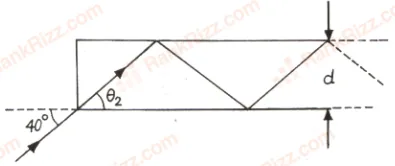
In figure, the optical fiber is m long and has a diameter of m. If a ray of light is incident on one end of the fiber at angle , the number of reflections it makes before emerging from the other end is close to: (refractive index of fiber is 1.31, sin 40° = 0.64 and sin(0.49) = 30°.)

  1. A

    55000

  2. B

    57000

  3. C

    45000

  4. D

    66000

Q25JEE MAIN 2019 · 08 APR S1Thin lenses: lens formula, lens maker's formula and powerTRANSCRIBED

An upright object is placed at a distance of 40 cm in front of a convergent lens of focal length 20 cm. A convergent mirror of focal length 10 cm is placed at a distance of 60 cm on the other side of the lens. The position and size of the final image will be:

  1. A

    40 cm from the convergent lens, twice the size of the object

  2. B

    20 cm from the convergent mirror, twice the size of the object

  3. C

    40 cm from the convergent lens, same size of the object

  4. D

    20 cm from the convergent mirror, same size of the object

Q26JEE MAIN 2019 · 08 APR S1Wavefronts and Huygens' principleTRANSCRIBED

In an interference experiment the ratio of amplitudes of coherent waves is . The ratio of maximum and minimum intensities of fringes will be:

  1. A

    4

  2. B

    9

  3. C

    2

  4. D

    18

Q27JEE MAIN 2019 · 08 APR S1de Broglie wavelength of matter wavesTRANSCRIBED

Two particles move at right angle to each other. Their de Broglie wavelengths are and respectively. The particles suffer perfectly inelastic collision. The de Broglie wavelength of the final particle, is given by:

  1. A

  2. B

  3. C

  4. D

Q28JEE MAIN 2019 · 08 APR S1Hydrogen spectrum and spectral seriesTRANSCRIBED

Radiation coming from transitions to of hydrogen atoms fall on He ions in and states. The possible transition of helium ions as they absorb energy from the radiation is:
  1. A

  2. B

  3. C

  4. D

Q29JEE MAIN 2019 · 08 APR S1p-n junction diode and its characteristicsTRANSCRIBED

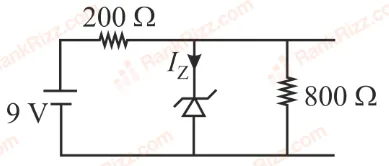
The reverse break down voltage of a Zener diode is 5.6 V in the given circuit.

image

The current I through the Zener is:
  1. A

    10 mA

  2. B

    7 mA

  3. C

    17 mA

  4. D

    15 mA

Q30JEE MAIN 2019 · 08 APR S1Elements of communication and propagation of EM wavesTRANSCRIBED

The wavelength of the carrier waves in a modern optical fiber communication network is close to:
  1. A

    2400 nm

  2. B

    900 nm

  3. C

    600 nm

  4. D

    1500 nm

Chemistry

Q31JEE MAIN 2019 · 08 APR S1Quantum numbers and shapes of orbitalsTRANSCRIBED

The quantum number of four electrons are given below:
I.
II.
III.
IV.
The correct order of their increasing energies will be:

  1. A

    I < III < II < IV

  2. B

    IV < II < III < I

  3. C

    I < II < III < II

  4. D

    IV < III < II < I

Q32JEE MAIN 2019 · 08 APR S1Electronegativity, effective nuclear charge and shieldingTRANSCRIBED

The size of the iso-electronic species Cl, Ar and Ca is affected by:

  1. A

    nuclear charge

  2. B

    azimuthal quantum number of valence shell

  3. C

    electron-electron interaction in the outer orbitals

  4. D

    Principal quantum number of valence shell

Q33JEE MAIN 2019 · 08 APR S1First law: work, heat and internal energyTRANSCRIBED

Which one of the following equations does not correctly represent the first law of thermodynamics for the given processes involving an ideal gas? (Assume non-expansion work is zero)

  1. A

    Isochoric process:

  2. B

    Isochoric process:

  3. C

    Cyclic process:

  4. D

    Adiabatic process:

Q34JEE MAIN 2019 · 08 APR S1Enthalpies of reaction and Hess's lawTRANSCRIBED

For silver, (J K mol) = 23 + 0.01T. If the temperature T of 3 moles of silver is raised from 300 K to 1000 K at 1 atm pressure, the value of will be close to:

  1. A

    16 kJ

  2. B

    62 kJ

  3. C

    13 kJ

  4. D

    21 kJ

Q35JEE MAIN 2019 · 08 APR S1Solubility product and common ion effectTRANSCRIBED

If solubility product of Zr(PO) is denoted by K and its molar solubility is denoted by S, then which of the following relation between S and K is correct?

  1. A

  2. B

  3. C

  4. D

Q36JEE MAIN 2019 · 08 APR S1Equivalent weight, n-factor and law of equivalenceTRANSCRIBED

In order to oxidize a mixture of one mole of each of FeCO, Fe(CO), FeSO and Fe(SO) in acidic medium, the number of moles of KMnO is:

  1. A

    1

  2. B

    2

  3. C

    3

  4. D

    1.5

Q37JEE MAIN 2019 · 08 APR S1Electrode potentials, electrochemical series and cell EMFTRANSCRIBED

Given that,
V;
V;
V;
V

The strongest oxidizing agent is:

  1. A

  2. B

  3. C

  4. D

Q38JEE MAIN 2019 · 08 APR S1Hardness of water and its removalTRANSCRIBED

100 mL of a water sample contains 0.81 g of calcium bicarbonate and 0.73 g of magnesium bicarbonate. The hardness of this water sample expressed in terms of equivalents of CaCO is: (molar mass of calcium bicarbonate is 162 g mol and magnesium bicarbonate is 146 g mol)

  1. A

    100 ppm

  2. B

    1,000 ppm

  3. C

    5,000 ppm

  4. D

    10,000 ppm

Q39JEE MAIN 2019 · 08 APR S1Alkali metals: properties and trendsTRANSCRIBED

The correct order of hydration enthalpies of alkali metal ions is:

  1. A

    Na^{+} &gt; Li^{+} &gt; K^{+} &gt; Rb^{+}

  2. B

    Na^{+} &gt; Li^{+} &gt; K^{+} &gt; Cs^{+} &gt; Rb^{+}

  3. C

    Li^{+} &gt; Na^{+} &gt; K^{+} &gt; Rb^{+} &gt; Cs^{+}

  4. D

    Na^{+} &gt; K^{+} &gt; Cs^{+} &gt; Rb^{+}

Q40JEE MAIN 2019 · 08 APR S1Group 13: general trends and inert pair effectTRANSCRIBED

Diborane BH reacts independently with O and HO to produce, respectively:

  1. A

    HBO and HBO

  2. B

    HBO and BO

  3. C

    BO and [BH]

  4. D

    BO and HBO

Q41JEE MAIN 2019 · 08 APR S1IUPAC nomenclature of organic compoundsTRANSCRIBED

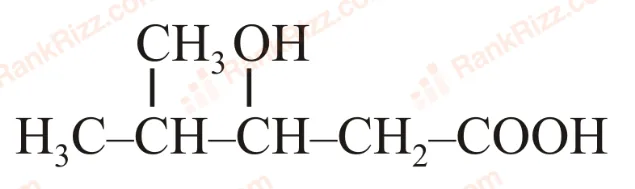
The IUPAC name of the following compound is:

  1. A

    4-Methyl-3-hydroxypentanoic acid

  2. B

    2-Methyl-3-hydroxybutanoic acid

  3. C

    3-Methyl-4-hydroxypentanoic acid

  4. D

    3-Hydroxy-4-methylpentanoic acid

Q42JEE MAIN 2019 · 08 APR S1Nucleophilic addition reactions of carbonyl compoundsTRANSCRIBED

The major product of the following reaction is:

image
  1. A
    image
  2. B
    image
  3. C
    image
  4. D
    image
Q43JEE MAIN 2019 · 08 APR S1Nucleophilic addition reactions of carbonyl compoundsTRANSCRIBED

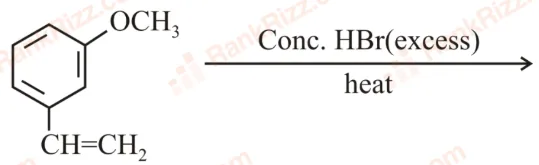
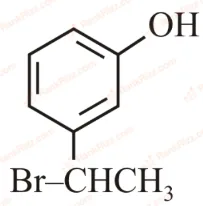
The major product of the following reaction is:

image
  1. A
    image
  2. B
    image
  3. C
    image
  4. D
    image
Q44JEE MAIN 2019 · 08 APR S1Water pollutionTRANSCRIBED

Which is wrong with respect to our responsibility as a human being to protect our environment?

  1. A

    Using plastic bags.

  2. B

    Restricting the use of vehicles

  3. C

    Avoiding the use of floodlighted facilities

  4. D

    Setting up compost tin in gardens

Q45JEE MAIN 2019 · 08 APR S1Stratospheric pollution and ozone depletionTRANSCRIBED

Assertion: Ozone is destroyed by CFCs in the upper stratosphere.
Reason: Ozone holes increase the amount of UV radiation reaching the earth.

  1. A

    Assertion and reason are correct, but the reason is not the explanation for the assertion.

  2. B

    The assertion is false, but the reason is correct.

  3. C

    Assertion and reason are incorrect.

  4. D

    Assertion and reason are both correct, and the reason is the correct explanation for the assertion.

Q46JEE MAIN 2019 · 08 APR S1Crystal lattices, unit cells and densityTRANSCRIBED

Element B forms ccp structure and A occupies half of the octahedral voids, while oxygen atoms occupy all the tetrahedral voids. The structure of bimetallic oxide is:

  1. A

  2. B

  3. C

  4. D

Q47JEE MAIN 2019 · 08 APR S1Relative lowering of vapour pressureTRANSCRIBED

The vapour pressures of pure liquids A and B are 400 and 600 mm Hg respectively at 298 K. On mixing the two liquids, the sum of their volumes is equal to the volume of the final mixture. The mole fraction of liquid B is 0.5 in the mixture. The vapour pressure of the final solution, the mole fractions of components A and B in the vapour phase, respectively are:

  1. A

    500 mm Hg, 0.5, 0.5

  2. B

    450 mm Hg, 0.4, 0.6

  3. C

    450 mm Hg, 0.5, 0.5

  4. D

    500 mm Hg, 0.4, 0.6

Q48JEE MAIN 2019 · 08 APR S1Rate law, order and molecularityTRANSCRIBED

For the reaction 2A + B C, the values of initial rate at different reactant concentrations are given in the table below.

[A] (mol L)    [B] (mol L)    Initial Rate (mol Ls)
0.05            0.05                0.045
0.10                0.05                0.090
0.20                0.10                0.72

The rate law for the reactions is:

  1. A

    Rate = k[A][B]

  2. B

    Rate = k[A][B]

  3. C

    Rate = k[A][B]

  4. D

    Rate = k[A][B]

Q49JEE MAIN 2019 · 08 APR S1Adsorption and adsorption isothermsTRANSCRIBED

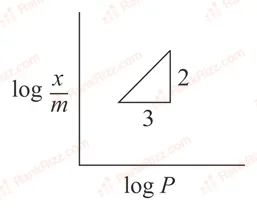
Adsorption of a gas follows Freundlich adsorption isotherm. x is the mass of the gas adsorbed on mass m of the adsorbent. The plot of vs is shown in the given graph. is proportional to:

  1. A

  2. B

  3. C

  4. D

Q50JEE MAIN 2019 · 08 APR S1Thermodynamic principles and Ellingham diagramTRANSCRIBED

Which respect to an ore, Ellingham diagram helps to predict the feasibility of its:

  1. A

    Electrolysis

  2. B

    Zone refining

  3. C

    Vapour phase refining

  4. D

    Thermal reduction

Q51JEE MAIN 2019 · 08 APR S1Lanthanoids and lanthanoid contractionTRANSCRIBED

The lanthanide ion that would show colour is:

  1. A

    Lu

  2. B

    La

  3. C

    Gd

  4. D

    Sm

Q52JEE MAIN 2019 · 08 APR S1Colour and magnetic behaviour of complexes from CFTTRANSCRIBED

The correct order of the spin-only magnetic moment of metal ions in the following low-spin complexes, [V(CN)], [Fe(CN)], [Ru(NH)] and [Cr(NH)], is:

  1. A

    V^{2+} &gt; Cr^{2+} &gt; Ru^{3+} &gt; Fe^{2+}

  2. B

    Cr^{2+} &gt; V^{2+} &gt; Ru^{3+} &gt; Fe^{2+}

  3. C

    Cr^{2+} &gt; Ru^{3+} &gt; Fe^{2+} &gt; V^{2+}

  4. D

    V^{2+} &gt; Ru^{3+} &gt; Cr^{2+} &gt; Fe^{2+}

Q53JEE MAIN 2019 · 08 APR S1Werner's theory and coordination terminologyTRANSCRIBED

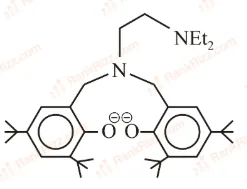
The following ligand is:

image
  1. A

    tridentate

  2. B

    hex dentate

  3. C

    bidentate

  4. D

    tetradentate

Q54JEE MAIN 2019 · 08 APR S1Detection of functional groupsTRANSCRIBED

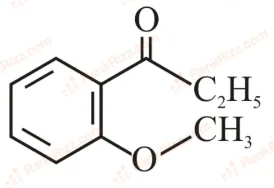
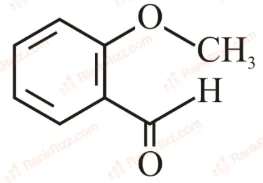
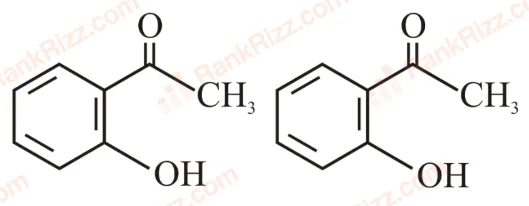
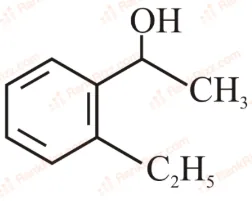
An organic compound neither reacts with neutral ferric chloride solution nor with Fehling solution. It however, reacts with Grignard reagent and gives positive iodoform test. The compound is:

  1. A
    image
  2. B
    image
  3. C
    image
  4. D
    image
Q55JEE MAIN 2019 · 08 APR S1Reactions of phenolsTRANSCRIBED

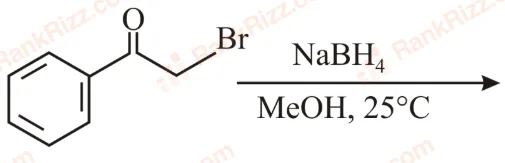
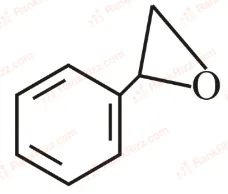
The major product of the following reaction is:

image


NaBH, MeOH, 25°C

  1. A
    image
  2. B
    image
  3. C
    image
  4. D
    image
Q56JEE MAIN 2019 · 08 APR S1Methods of purification of organic compoundsTRANSCRIBED

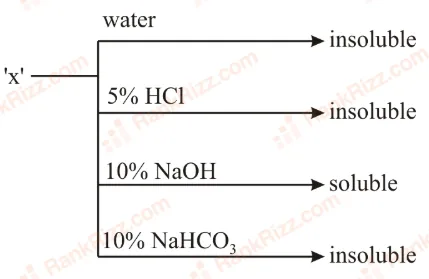
An organic compound 'X' showing the following solubility profile is:

image
  1. A

    m-Cresol

  2. B

    o-Toluidine

  3. C

    Oleic acid

  4. D

    Benzamide

Q57JEE MAIN 2019 · 08 APR S1Reactions and tests of aminesTRANSCRIBED

Which of the following amines can be prepared by Gabriel phthalimide reaction?

  1. A

    t-butylamine

  2. B

    n-butylamine

  3. C

    triethylamine

  4. D

    neo-pentylamine

Q58JEE MAIN 2019 · 08 APR S1Diazonium saltsTRANSCRIBED

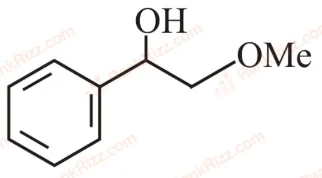
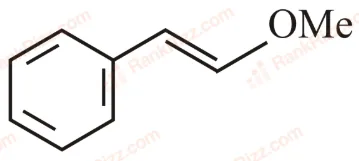
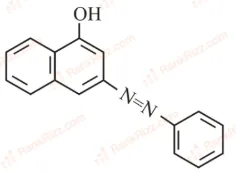
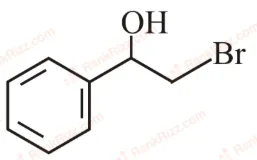
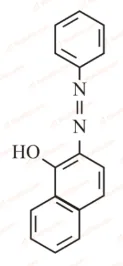
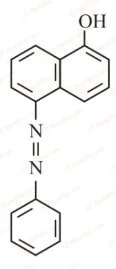
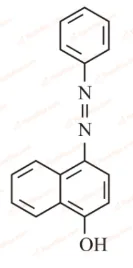
Coupling of benzene diazonium chloride with 1-naphthol in alkaline medium will give:

  1. A
    image
  2. B
    image
  3. C
    image
  4. D
    image
Q59JEE MAIN 2019 · 08 APR S1Reactions and tests of aminesTRANSCRIBED

In the following compounds, the decreasing order of basic strength will be:

  1. A

    C_2H_5NH_2 &gt; NH_3 &gt; (C_2H_5)_2NH

  2. B

    (C_2H_5)NH &gt; NH_3 &gt; C_2H_5NH_2

  3. C

    NH_3 &gt; C_2H_5NH_2 &gt; (C_2H_5)_2NH

  4. D

    (C_2H_5)_2NH &gt; C_2H_5NH_2 &gt; NH_3

Q60JEE MAIN 2019 · 08 APR S1Carbohydrates: classification and monosaccharidesTRANSCRIBED

Maltose on treatment with dilute HCl gives:

  1. A

    D-Glucose

  2. B

    D-Fructose

  3. C

    D-Galactose

  4. D

    D-Glucose and D-Fructose

Mathematics

Q61JEE MAIN 2019 · 08 APR S1Equations with modulus and greatest integerTRANSCRIBED

The sum of the solutions of the equation , x &gt; 0 is equal to:

  1. A

    10

  2. B

    9

  3. C

    12

  4. D

    4

Q62JEE MAIN 2019 · 08 APR S1Cube roots and nth roots of unityTRANSCRIBED

If and be the roots of the equation , then the least value of for which is:

  1. A

    5

  2. B

    4

  3. C

    2

  4. D

    3

Q63JEE MAIN 2019 · 08 APR S1Arrangements with restrictionsTRANSCRIBED

All possible numbers are formed using the digits 1, 1, 2, 2, 2, 2, 3, 4, 4 taken all at a time. The number of such numbers in which the odd digits occupy even places is:

  1. A

    175

  2. B

    162

  3. C

    180

  4. D

    160

Q64JEE MAIN 2019 · 08 APR S1Arithmetic progressionTRANSCRIBED

The sum of all natural numbers such that 100 &lt; n &lt; 200 and H.C.F. (91, n) &gt; 1 is:

  1. A

    3203

  2. B

    3221

  3. C

    3121

  4. D

    3303

Q65JEE MAIN 2019 · 08 APR S1Sums of binomial coefficientsTRANSCRIBED

The sum of the co-efficients of all even degree terms in in the expansion of , is equal to:

  1. A

    26

  2. B

    32

  3. C

    24

  4. D

    29

Q66JEE MAIN 2019 · 08 APR S1Sums of binomial coefficientsTRANSCRIBED

The sum of the series is equal to:

  1. A

  2. B

  3. C

  4. D

Q67JEE MAIN 2019 · 08 APR S1Compound angles and conditional identitiesTRANSCRIBED

If , and 0 &lt; \alpha, \beta &lt; \frac{\pi}{4}, then is equal to:

  1. A

  2. B

  3. C

  4. D

Q68JEE MAIN 2019 · 08 APR S1Equations of a line in various formsTRANSCRIBED

A point on the straight line, which is equidistant from the coordinate axes will lie only in:

  1. A

    1st and 2nd quadrants

  2. B

    1st, 2nd and 4th quadrants

  3. C

    1st quadrant

  4. D

    4th quadrant

Q69JEE MAIN 2019 · 08 APR S1Equation of a circle in various formsTRANSCRIBED

The sum of the squares of the lengths of the chords intercepted on the circle, , by the lines, , , where N is the set of all natural numbers is:

  1. A

    210

  2. B

    105

  3. C

    320

  4. D

    160

Q70JEE MAIN 2019 · 08 APR S1Locus problems in coordinate geometryTRANSCRIBED

Let and be two fixed points. Then, the locus of a point P such that the perimeter of is 4 is:

  1. A

  2. B

  3. C

  4. D

Q71JEE MAIN 2019 · 08 APR S1Tangents to an ellipseTRANSCRIBED

If the tangents on the ellipse at the points (1, 2) and (a, b) are perpendicular to each other, then is equal to:

  1. A

  2. B

  3. C

  4. D

Q72JEE MAIN 2019 · 08 APR S1Limits of trigonometric functionsTRANSCRIBED

equals:

  1. A

  2. B

  3. C

  4. D

    4

Q73JEE MAIN 2019 · 08 APR S1Implications, negation and quantifiersTRANSCRIBED

The contrapositive of the statement "If you are born in India, then you are a citizen of India", is:

  1. A

    If you are not born in India, then you are not a citizen of India.

  2. B

    If you are a citizen of India, then you are born in India.

  3. C

    If you are born in India, then you are not a citizen of India.

  4. D

    If you are not a citizen of India, then you are not born in India.

Q74JEE MAIN 2019 · 08 APR S1Variance and standard deviationTRANSCRIBED

The mean and variance for seven observations are 8 and 16 respectively. If 5 of the observations are 2, 4, 10, 12, 14, then the product of the remaining two observations is:

  1. A

    48

  2. B

    45

  3. C

    49

  4. D

    40

Q75JEE MAIN 2019 · 08 APR S1Types of matrices and matrix algebraTRANSCRIBED

Let , such that . Then, a value of is:

  1. A

    0

  2. B

  3. C

  4. D

Q76JEE MAIN 2019 · 08 APR S1Systems of linear equationsTRANSCRIBED

The greatest value of for which the system of linear equations , , has a non-trivial solution, is:

  1. A

    -1

  2. B

    2

  3. C

  4. D

    0

Q77JEE MAIN 2019 · 08 APR S1Properties and simplification of inverse trigonometric functionsTRANSCRIBED

If , , where 0 &lt; \alpha, \beta &lt; \frac{\pi}{2}, then is equal to:

  1. A

  2. B

  3. C

  4. D

Q78JEE MAIN 2019 · 08 APR S1Differentiability via functional equationsTRANSCRIBED

If , |x| &lt; 1, then is equal to:

  1. A

  2. B

  3. C

  4. D

Q79JEE MAIN 2019 · 08 APR S1Inverse trigonometric differentiation and derivative w.r.t. a functionTRANSCRIBED

If , , then is equal to:

  1. A

  2. B

  3. C

  4. D

    None of these

Q80JEE MAIN 2019 · 08 APR S1Angle between curves and shortest distanceTRANSCRIBED

The shortest distance between the line and the curve is:

  1. A

  2. B

  3. C

  4. D

    2

Q81JEE MAIN 2019 · 08 APR S1Local maxima and minima and concavityTRANSCRIBED

If and are respectively the sets of local minimum and local maximum points of the function, , , then:

  1. A

  2. B

  3. C

  4. D

Q82JEE MAIN 2019 · 08 APR S1Monotonicity and intervals of increase/decreaseTRANSCRIBED

Let be a twice differentiable function such that f''(x) &gt; 0, for all . If , then is:

  1. A

    decreasing on (0, 2)

  2. B

    increasing on (0, 2)

  3. C

    increasing on (0, 1) and decreasing on (1, 2)

  4. D

    decreasing on (0, 1) and increasing on (1, 2)

Q83JEE MAIN 2019 · 08 APR S1Standard integrals and basic manipulationTRANSCRIBED

is equal to:

  1. A

  2. B

  3. C

  4. D

Q84JEE MAIN 2019 · 08 APR S1Definite integrals: properties and King's ruleTRANSCRIBED

If and , then the value of the integral is:

  1. A

  2. B

  3. C

  4. D

Q85JEE MAIN 2019 · 08 APR S1Area under a single curveTRANSCRIBED

The area (in sq. units) of the region is:

  1. A

  2. B

    8

  3. C

  4. D

Q86JEE MAIN 2019 · 08 APR S1Linear first-order differential equationsTRANSCRIBED

Let be the solution of the differential equation, such that . If , then the value of is:

  1. A

  2. B

  3. C

  4. D

    1

Q87JEE MAIN 2019 · 08 APR S1Scalar (dot) productTRANSCRIBED

The magnitude of the projection of the vector on the vector perpendicular to the plane containing the vectors and , is:

  1. A

  2. B

  3. C

  4. D

Q88JEE MAIN 2019 · 08 APR S1Foot of perpendicular, image and distance from a lineTRANSCRIBED

The length of the perpendicular from the point (2, -1, 4) on the straight line is:

  1. A

    greater than 3 but less than 4

  2. B

    greater than 4

  3. C

    less than 2

  4. D

    greater than 2 but less than 3

Q89JEE MAIN 2019 · 08 APR S1Line and plane: intersection, coplanarity and projectionTRANSCRIBED

The equation of a plane containing the line of intersection of the planes and and passing through the point (1, 1, 0) is:

  1. A

  2. B

  3. C

  4. D

Q90JEE MAIN 2019 · 08 APR S1Conditional probability and multiplication theoremTRANSCRIBED

Let and be two non-null events such that . Then, which of the following statements is always correct?

  1. A

  2. B

  3. C

  4. D