All 90 questions of JEE Main 11 Apr 2014, Online, in the order they were asked. Pick an answer on any question to check it against the key. Free to read, nothing to download.
Questions
90
Chemistry · Physics · Mathematics
Answer key
89
questions with a checked key
Under review
1
key not yet trusted
Price
Free
no sign-up
Chemistry
Q1JEE MAIN 2014 · 11 APR ONLINEMole concept, atomic and molar massTRANSCRIBED
A gaseous compound of nitrogen and hydrogen contains 12.5% (by mass) of hydrogen. The density of the compound relative to hydrogen is 16. The molecular formula of the compound is:
Q3JEE MAIN 2014 · 11 APR ONLINEHydrogen spectrum and spectral seriesTRANSCRIBED
Based on the equation: ΔE=−2.0×10⁻¹⁸ J (n221−n121), the wavelength of the light that must be absorbed to excite hydrogen electron from level n = 1 to level n = 2 will be: (h = 6.625×10⁻³⁴ Js, C = 3×10⁸ ms−1)
Q8JEE MAIN 2014 · 11 APR ONLINEGas laws and ideal gas equationTRANSCRIBED
The initial volume of a gas cylinder is 750.0 mL. If the pressure of gas inside the cylinder changes from 840.0 mmHg to 360.0 mmHg, the final volume the gas will be:
Q9JEE MAIN 2014 · 11 APR ONLINEGibbs energy and spontaneityTRANSCRIBED
The molar heat capacity (Cp) of CD2O is 10 cals at 1000 K. The change of entropy associated with cooling of 32 g of CD2O vapour from 1000 K to 100 K at constant pressure will be: (D = deuterium, atomic mass = 2u)
Q15JEE MAIN 2014 · 11 APR ONLINEStratospheric pollution and ozone depletionTRANSCRIBED
Which of the following statements about the depletion of ozone layer is correct?
A
The problem of ozone depletion is less serious at poles because NO2 solidifies and is not available for consuming ClO• radicals.
B
The problem of ozone depletion is more serious at poles because ice crystals in the clouds over poles act as catalyst for photochemical reactions involving the decomposition of ozone of Cl• and ClO• radicals.
C
Freons, chlorofluorocarbons, are inert. Chemically, they do not react with ozone in stratosphere.
D
Oxides of nitrogen also do not react with ozone in stratosphere.
Q17JEE MAIN 2014 · 11 APR ONLINEpH of acids, bases and their mixturesTRANSCRIBED
In some solutions, the concentration of H3O+ remains constant even when small amounts of strong acid or strong base are added to them. These solutions are known as:
Q18JEE MAIN 2014 · 11 APR ONLINEElectrode potentials, electrochemical series and cell EMFTRANSCRIBED
Given: Fe3+(aq) + e−→ Fe2+(aq); E0 = +0.77 V Al3+(aq) + 3e−→ Al(s); E0 = −1.66 V Br2(aq) + 2e−→ 2Br−; E0 = +1.09 V Considering the electrode potentials, which of the following represents the correct order of reducing power?
Q19JEE MAIN 2014 · 11 APR ONLINERate law, order and molecularityTRANSCRIBED
In the reaction of formation of sulphur trioxide by contact process 2SO2+O2⇌2SO3 the rate of reaction was measured as dtd[O2]=−2.5×10⁻⁴ mol L−1 s−1. The rate of reaction in terms of [SO2] in mol L−1 s−1 will be:
Q20JEE MAIN 2014 · 11 APR ONLINERate law, order and molecularityTRANSCRIBED
For the reaction, 2N2O5→4NO2+O2, the rate equation can be expressed in two ways: −dtd[N2O5]=k[N2O5] and +dtd[NO2]=k′[N2O5]. k and k' are related as:
Q32JEE MAIN 2014 · 11 APR ONLINEProjectile motion from level groundTRANSCRIBED
The initial speed of a bullet fired from a rifle is 630 m/s. The rifle is fired at the centre of a target 700 m away at the same level as the target. How far above the centre of the target must the rifle be aimed in order to hit the target?
Q33JEE MAIN 2014 · 11 APR ONLINENewton's laws, free-body diagrams and equilibrium of a particleTRANSCRIBED
A body of mass 5 kg under the action of constant force F=Fxi^+Fyj^ has velocity at t = 0 s as v=(6i^−2j^) m/s and at t = 10 s as v=+6j^ m/s. The force F is:
Q34JEE MAIN 2014 · 11 APR ONLINEKinetic energy and the work-energy theoremTRANSCRIBED
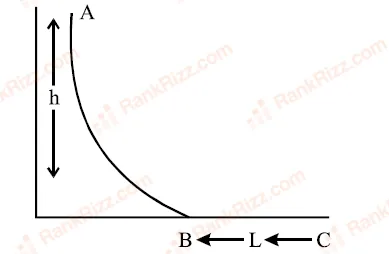
A small ball of mass m starts at a point A with speed vo and moves along a frictionless track AB as shown. The track BC has coefficient of friction μ. The ball comes to stop at C after travelling a distance L which is:
Q35JEE MAIN 2014 · 11 APR ONLINECentre of mass of continuous bodies and cavitiesTRANSCRIBED
A thin bar of length L has a mass per unit length λ, that increases linearly with distance from one end. If its total mass is M and its mass per unit length at the lighter end is λ0, then the distance of the centre of mass from the lighter end is:
Q36JEE MAIN 2014 · 11 APR ONLINEKepler's laws and planetary motionTRANSCRIBED
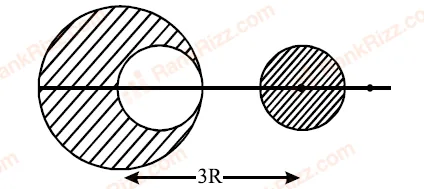
From a sphere of mass M and radius R, a smaller sphere of radius 2R is carved out such that the cavity made in the original sphere is between its centre and the periphery (see the figure). For the configuration in the figure where the distance between the centre of the original sphere and the removed sphere is 3R, the gravitational force between the two spheres is:
Q37JEE MAIN 2014 · 11 APR ONLINEBulk modulus and compressibilityTRANSCRIBED
The bulk moduli of ethanol, mercury and water are given as 0.9, 25 and 2.2 respectively in units of 109 Nm−2. For a given value of pressure, the fractional compression in volume is VΔV. Which of the following statements about VΔV for these three liquids is correct?
Q38JEE MAIN 2014 · 11 APR ONLINEKinetic energy and the work-energy theoremTRANSCRIBED
The average mass of rain drops is 3.0×10⁻⁵ kg and their average terminal velocity is 9 m/s. Calculate the energy transferred by rain to each square metre of the surface at a place which receives 100 cm of rain in a year.
Q39JEE MAIN 2014 · 11 APR ONLINESpeed of efflux and applications of Bernoulli's theoremTRANSCRIBED
A tank with a small hole at the bottom has been filled with water and kerosene (specific gravity 0.8). The height of water is 3 m and that of kerosene is 2 m. When the hole is opened, the velocity of fluid coming out from it is nearly: (take g = 10 ms−2 and density of water = 103 kg m−3)
Q40JEE MAIN 2014 · 11 APR ONLINEExcess pressure in drops and bubblesTRANSCRIBED
An air bubble of radius 0.1 cm is in a liquid having surface tension 0.06 N/m and density 103 kg/m3. The pressure inside the bubble is 1100 Nm−2 greater than the atmospheric pressure. At what depth is the bubble below the surface of the liquid? (g=9.8 ms−2)
Q41JEE MAIN 2014 · 11 APR ONLINENewton's law of coolingTRANSCRIBED
A hot body, obeying Newton's law of cooling is cooling down from its peak value 80°C to an ambient temperature of 30°C. It takes 5 minutes in cooling down from 80°C to 40°C. How much time will it take to cool down from 62°C to 32°C? (Given ln 2 = 0.693, ln 5 = 1.609)
Q42JEE MAIN 2014 · 11 APR ONLINEIsothermal and adiabatic processesTRANSCRIBED
During an adiabatic compression, 830 J of work is done on 2 moles of a diatomic ideal gas to reduce its volume by 50%. The change in its temperature is nearly: (R = 8.3 JK−1 mol−1)
Q43JEE MAIN 2014 · 11 APR ONLINEIdeal gas equation and gas lawsTRANSCRIBED
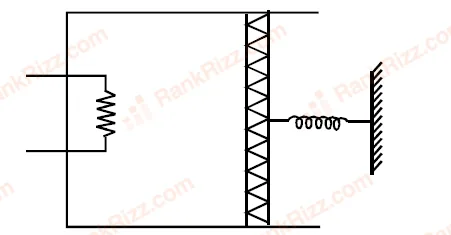
An ideal monoatomic gas is confined in a cylinder by a spring loaded piston of cross section 8.0×10⁻³ m2. Initially the gas is at 300 K and occupies a volume of 2.4×10⁻³ m3 and the spring is in its relaxed state as shown in figure. The gas is heated by a small heater until the piston moves out slowly by 0.1 m. The force constant of the spring is 8000 N/m and the atmospheric pressure is 1.0×10⁵ N/m2. The cylinder and the piston are thermally insulated. The piston and the spring are massless and there is no friction between the piston and the cylinder. The final temperature of the gas will be: (Neglect the heat loss through the lead wires of the heater. The heat capacity of the heater coil is also negligible).
Q44JEE MAIN 2014 · 11 APR ONLINEDamped and forced oscillations and resonanceTRANSCRIBED
The angular frequency of the damped oscillator is given by, ω=(mk−4m2r2) where k is the spring constant, m is the mass of the oscillator and r is the damping constant. If the ratio mkr2 is 8%, the change in time period compared to the undamped oscillator is approximately as follows:
Q45JEE MAIN 2014 · 11 APR ONLINEDoppler effect in soundTRANSCRIBED
Two factories are sounding their sirens at 800 Hz. A man goes from one factory to other at a speed of 2 m/s. The velocity of sound is 320 m/s. The number of beats heard by the person in one second will be:
Q47JEE MAIN 2014 · 11 APR ONLINECapacitors with dielectricsTRANSCRIBED
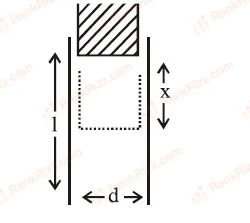
A parallel plate capacitor is made of two plates of length l, width w and separated by a distance d. A dielectric slab (dielectric constant K) that fits exactly between the plates is held near the edge of the plates. It is pulled into the capacitor by a force F=−∂x∂U, where U is the energy of the capacitor when dielectric is inside the capacitor up to distance x (see the figure). If the charge on the capacitor is Q then the force on the dielectric when it is near the edge is:
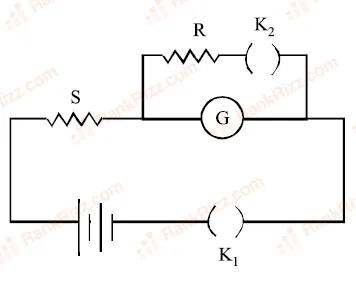
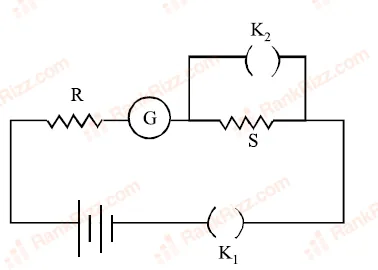
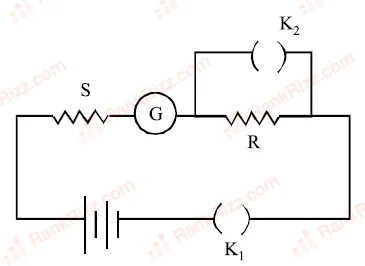
Q49JEE MAIN 2014 · 11 APR ONLINEGalvanometer conversion to ammeter and voltmeterTRANSCRIBED
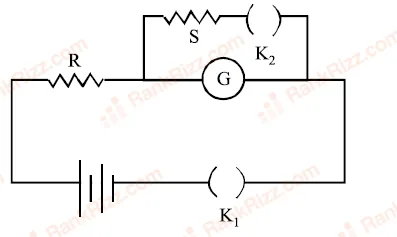
In the circuit diagrams (A, B, C and D) shown below, R is a high resistance and S is a resistance of the order of galvanometer resistance G. The correct circuit, corresponding to the half deflection method for finding the resistance and figure of merit of the galvanometer, is the circuit labelled as:
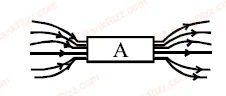
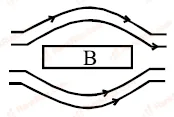
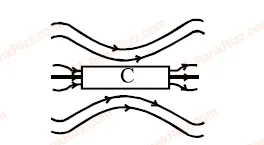
Q50JEE MAIN 2014 · 11 APR ONLINEMagnetisation, magnetic intensity, susceptibility and permeabilityTRANSCRIBED
Three identical bars A, B and C are made of different magnetic materials. When kept in a uniform magnetic field, the field lines around them look as follows:
Make the correspondence of these bars with their material being diamagnetic (D), ferromagnetic (F) and paramagnetic (P):
Q52JEE MAIN 2014 · 11 APR ONLINEMagnetic flux, Faraday's law and Lenz's lawTRANSCRIBED
A coil of circular cross-section having 1000 turns and 4 cm2 face area is placed with its axis parallel to a magnetic field which decreases by 10−2 Wb m−2 in 0.01 s. The e.m.f. induced in the coil is:
Q53JEE MAIN 2014 · 11 APR ONLINEProperties of EM waves: fields, energy, intensity and momentumTRANSCRIBED
An electromagnetic wave of frequency 1×10¹⁴ hertz is propagating along z-axis. The amplitude of electric field is 4 V/m. If ε0=8.8×10⁻¹² C2/N-m2, then average energy density of electric field will be:
Q54JEE MAIN 2014 · 11 APR ONLINEThin lenses: lens formula, lens maker's formula and powerTRANSCRIBED
An object is located in a fixed position in front of a screen. Sharp image is obtained on the screen for two positions of a thin lens separated by 10 cm. The size of the images in two situations are in the ratio 3 : 3. What is the distance between the screen and the object?
Q55JEE MAIN 2014 · 11 APR ONLINEOptical instruments: microscopes and telescopesTRANSCRIBED
In a compound microscope the focal length of objective lens is 1.2 cm and focal length of eye piece is 3.0 cm. When object is kept at 1.25 cm in front of objective, final image is formed at infinity. Magnifying power of the compound microscope should be:
Q56JEE MAIN 2014 · 11 APR ONLINEYoung's double slit experiment: fringe width and intensityTRANSCRIBED
Two monochromatic light beams of intensity 16 and 9 units are interfering. The ratio of intensities of bright and dark parts of the resultant pattern is:
Q57JEE MAIN 2014 · 11 APR ONLINEPhotons: energy, momentum and radiation pressureTRANSCRIBED
A photon of wavelength λ is scattered from an electron, which was at rest. The wavelength shift Δλ is three times of λ and the angle of scattering θ is 60°. The angle at which the electron recoiled is ϕ. The value of tanϕ is: (electron speed is much smaller than the speed of light)
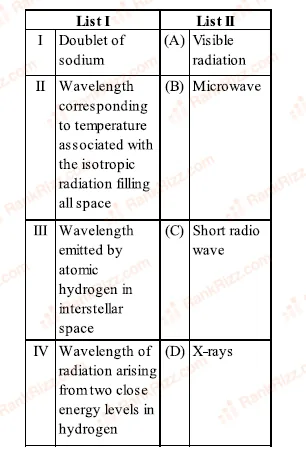
Q58JEE MAIN 2014 · 11 APR ONLINEElectromagnetic spectrum and usesTRANSCRIBED
Match the List-I (Phenomenon associated with electromagnetic radiation) with List-II (Part of electromagnetic spectrum) and select the correct code from the choices given below this lists:
Q59JEE MAIN 2014 · 11 APR ONLINERadioactivity: decay law, half-life and decay modesTRANSCRIBED
A radioactive nuclei with decay constant 0.5/s is being produced at a constant rate of 100 nuclei/s. If at t = 0 there were no nuclei, the time when there are 50 nuclei is:
Q63JEE MAIN 2014 · 11 APR ONLINEFormation of numbers and divisibilityTRANSCRIBED
An eight digit number divisible by 9 is to be formed using digits from 0 to 9 without repeating the digits. The number of ways in which this can be done is:
Q64JEE MAIN 2014 · 11 APR ONLINEGeometric progression and infinite GPTRANSCRIBED
In a geometric progression, if the ratio of the sum of first 5 terms to the sum of their reciprocals is 49, and the sum of the first and the third term is 35. Then the first term of this geometric progression is:
Q68JEE MAIN 2014 · 11 APR ONLINEDistance from a line, foot of perpendicular and imageTRANSCRIBED
The base of an equilateral triangle is along the line given by 3x+4y=9. If a vertex of the triangle is (1,2), then the length of a side of the triangle is:
Q69JEE MAIN 2014 · 11 APR ONLINEPosition of two circles and common tangentsTRANSCRIBED
The set of all real values of λ for which exactly two common tangents can be drawn to the circles x2+y2−4x−4y+6=0 and x2+y2−10x−10y+λ=0 is the interval:
Q71JEE MAIN 2014 · 11 APR ONLINEChords, position of a point and locus on ellipseTRANSCRIBED
A stair-case of length l rests against a vertical wall and a floor of a room. Let P be a point on the stair-case, nearer to its end on the wall, that divides its length in the ratio 1 : 2. If the staircase begins to slide on the floor, then the locus of P is:
Q72JEE MAIN 2014 · 11 APR ONLINENormals to a hyperbolaTRANSCRIBED
Let P(3secθ,2tanθ) and Q(3secϕ,2tanϕ) where θ+ϕ=2π, be two distinct points on the hyperbola 9x2−4y2=1. Then the ordinate of the point of intersection of the normals at P and Q is:
Q75JEE MAIN 2014 · 11 APR ONLINERate of change of quantitiesTRANSCRIBED
Two ships A and B are sailing straight away from a fixed point O along routes such that ∠AOB is always 120°. At a certain instance, OA = 8 km, OB = 6 km and the ship A is sailing at the rate of 20 km/hr while the ship B sailing at the rate of 30 km/hr. Then the distance between A and B is changing at the rate (in km/hr):
Q76JEE MAIN 2014 · 11 APR ONLINEHeights and distancesTRANSCRIBED
The angle of elevation of the top of a vertical tower from a point P on the horizontal ground was observed to be α. After moving a distance 2 metres from P towards the foot of the tower, the angle of elevation changes to β. Then the height (in metres) of the tower is:
Q79JEE MAIN 2014 · 11 APR ONLINEProperties of determinantsTRANSCRIBED
Let for i = 1, 2, 3, pi(x) be a polynomial of degree 2 in x, pi′(x) and pi′′(x) be the first and second order derivatives of pi(x) respectively. Let, A(x)=p1(x)p2(x)p3(x)amp;p1′(x)amp;p2′(x)amp;p3′(x)amp;p1′′(x)amp;p2′′(x)amp;p3′′(x) and B(x)=[A(x)]TA(x). Then determinant of B(x):
Q86JEE MAIN 2014 · 11 APR ONLINEVariable separable equationsTRANSCRIBED
If the general solution of the differential equation y′=xy+Φ(yx), for some function Φ, is given by yln∣cx∣=x, where c is an arbitrary constant, then Φ(2) is equal to: