RankRizzStart free

JEE Advanced 2017 Paper 1 Question Paper

All 54 questions of JEE Advanced 2017 Paper 1, in the order they were asked. Pick an answer on any question to check it against the key. Free to read, nothing to download.

Questions

54

Physics · Chemistry · Mathematics

Answer key

54

questions with a checked key

Under review

0

key not yet trusted

Price

Free

no sign-up

Physics

Q1JEE ADVANCED 2017 · PAPER 1Ideal gas equation and gas lawsTRANSCRIBED

A flat plate is moving normal to its plane through a gas under the action of a constant force F. The gas is kept at a very low pressure. The speed of the plate v is much less than the average speed u of the gas molecules. Which of the following options is/are true?

  1. A

    The pressure difference between the leading and trailing faces of the plate is proportional to uv

  2. B

    The resistive force experienced by the plate is proportional to v

  3. C

    The plate will continue to move with constant non-zero acceleration, at all times

  4. D

    At a later time the external force F balances the resistive force
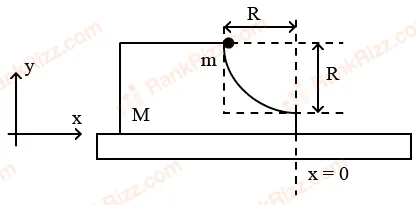
Q2JEE ADVANCED 2017 · PAPER 1Motion of centre of mass, momentum conservation and explosionsTRANSCRIBED

A block of mass M has a circular cut with a frictionless surface as shown. The block rests on the horizontal frictionless surface of a fixed table. Initially the right edge of the block is at x = 0, in a co-ordinate system fixed to the table. A point mass m is released from rest at the topmost point of the path as shown and it slides down. When the mass loses contact with the block, its position is x and the velocity is v. At that instant, which of the following options is/are correct?

  1. A

    The position of the point mass m is:

  2. B

    The velocity of the point mass m is

  3. C

    The x component of displacement of the center of mass of the block M is:

  4. D

    The velocity of the block M is:

Q3JEE ADVANCED 2017 · PAPER 1Progressive waves: wave equation, phase and intensityTRANSCRIBED

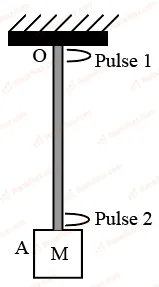
A block M hangs vertically at the bottom end of a uniform rope of constant mass per unit length. The top end of the rope is attached to a fixed rigid support at O. A transverse wave pulse (Pulse 1) of wavelength is produced at point O on the rope. The pulse takes time to reach point A. If the wave pulse of wavelength is produced at point A (Pulse 2) without disturbing the position of M it takes time to reach point O. Which of the following options is/are correct?

  1. A

    The time

  2. B

    The velocities of the two pulses (Pulse 1 and Pulse 2) are the same at the midpoint of rope

  3. C

    The wavelength of Pulse 1 becomes longer when it reaches point A

  4. D

    The velocity of any pulse along the rope is independent of its frequency and wavelength

Q4JEE ADVANCED 2017 · PAPER 1Thermal radiation: Stefan's law, Wien's law and Kirchhoff's lawTRANSCRIBED

A human body has a surface area of approximately 1 . The normal body temperature is 10 K above the surrounding room temperature . Take the room temperature to be . For , the value of (where is the Stefan-Boltzmann constant). Which of the following options is/are correct?

  1. A

    The amount of energy radiated by the body in 1 second is close to 60 Joules

  2. B

    If the surrounding temperature reduces by a small amount , then to maintain the same body temperature the same (living) human being needs to radiate more energy per unit time

  3. C

    Reducing the exposed surface area of the body (e.g. by curling up) allows humans to maintain the same body temperature while reducing the energy lost by radiation

  4. D

    If the body temperature rises significantly then the peak in the spectrum of electromagnetic radiation emitted by the body would shift to longer wavelengths

Q5JEE ADVANCED 2017 · PAPER 1Magnetic flux, Faraday's law and Lenz's lawTRANSCRIBED

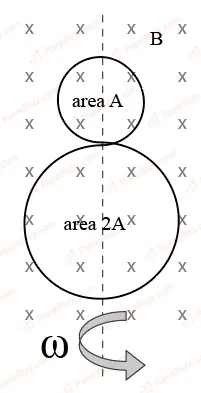
A circular insulated copper wire loop is twisted to form two loops of area 𝐴 and 2𝐴 as shown in the figure. At the point of crossing the wires remain electrically insulated from each other. The entire loop lies in the plane (of the paper). A uniform magnetic field 𝐵 points into the plane of the paper. At 𝑡 = 0, the loop starts rotating about the common diameter as axis with a constant angular velocity ω in the magnetic field. Which of the following options is/are correct?

  1. A

    The emf induced in the loop is proportional to the sum of the areas of the two loops

  2. B

    The amplitude of the maximum net emf induced due to both the loops is equal to the amplitude of maximum emf induced in the smaller loop alone

  3. C

    The net emf induced due to both the loops is proportional to

  4. D

    The rate of change of the flux is maximum when the plane of the loops is perpendicular to plane of the paper

Q6JEE ADVANCED 2017 · PAPER 1AC basics: rms and average values, phasorsTRANSCRIBED

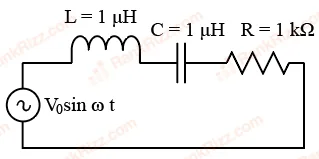
In the circuit shown, and They are connected in series with an a.c. source as shown. Which of the following options is/are correct?

  1. A

    The current will be in phase with the voltage if

  2. B

    The frequency at which the current will be in phase with the voltage is independent of 𝑅

  3. C

    At the current flowing through the circuit becomes nearly zero

  4. D

    At , the circuit behaves like a capacitor

Q7JEE ADVANCED 2017 · PAPER 1Prism: deviation and dispersionTRANSCRIBED

For an isosceles prism of angle 𝐴 and refractive index , it is found that the angle of minimum deviation . Which of the following options is/are correct?

  1. A

    For the angle of incidence , the ray inside the prism is parallel to the base of the prism

  2. B

    For this prism, the refractive index and the angle of prism 𝐴 are related as

  3. C

    At minimum deviation, the incident angle and the refracting angle at the first refracting surface are related by

  4. D

    For this prism, the emergent ray at the second surface will be tangential to the surface when the angle of incidence at the first surface is

Q8JEE ADVANCED 2017 · PAPER 1Surface tension and surface energyTRANSCRIBED

A drop of liquid of radius having surface tension divides itself into 𝐾 identical drops. In this process the total change in the surface energy . If then the value of is

Q9JEE ADVANCED 2017 · PAPER 1Hydrogen spectrum and spectral seriesTRANSCRIBED

An electron in a hydrogen atom undergoes a transition from an orbit with quantum number to another with quantum number . and are respectively the initial and final potential energies of the electron. If , then the smallest possible is

Q10JEE ADVANCED 2017 · PAPER 1Prism: deviation and dispersionTRANSCRIBED

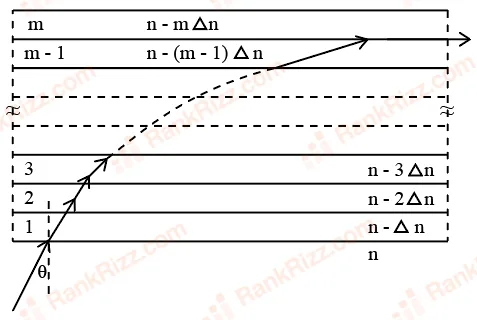
A monochromatic light is travelling in a medium of refractive index n = 1.6. It enters a stack of glass layers from the bottom side at an angle . The interfaces of the glass layers are parallel to each other. The refractive indices of different glass layers are monotonically decreasing as , where is the refractive index of the slab and (see the figure) The ray is refracted out parallel to the interface between the and slabs from the right side of the stack. What is the value of m?

Q11JEE ADVANCED 2017 · PAPER 1Doppler effect in soundTRANSCRIBED

A stationary source emits sound of frequency . The sound is reflected by a large car approaching the source with a speed of . The reflected signal is received by the source and superposed with the original. What will be the beat frequency of the resulting signal in Hz? (Given that the speed of sound in air is and the car reflects the sound at the frequency it has received).

Q12JEE ADVANCED 2017 · PAPER 1Radioactivity: decay law, half-life and decay modesTRANSCRIBED

is an isotope of Iodine that decays to an isotope of Xenon with a half-life of 8 days. A small amount of a serum labelled with is injected into the blood of a person. The activity of the amount of injected was Becquerel (Bq). It is known that the
injected serum will get distributed uniformly in the blood stream in less than half an hour. After 11.5 hours, 2.5 ml of blood is drawn from the person’s body, and gives an activity of 115 Bq. The total volume of blood in the person’s body, in liters is approximately (you may use for and ).

Q13JEE ADVANCED 2017 · PAPER 1Motion of charged particles in a magnetic fieldTRANSCRIBED

In which case will the particle move in a straight line with constant velocity?

  1. A

    (III) (ii) (R)

  2. B

    (IV) (i) (S)

  3. C

    (III) (iii) (P)

  4. D

    (II) (iii) (S)

Q14JEE ADVANCED 2017 · PAPER 1Motion of charged particles in a magnetic fieldTRANSCRIBED

In which case will the particle describe a helical path with axis along the positive z direction?

  1. A

    (IV) (i) (S)

  2. B

    (II) (ii) (R)

  3. C

    (III) (iii) (P)

  4. D

    (IV) (ii) (R)

Q15JEE ADVANCED 2017 · PAPER 1Motion of charged particles in a magnetic fieldTRANSCRIBED

In which case would the particle move in a straight line along the negative direction of y-axis (i.e., move along )?

  1. A

    (II) (iii) (Q)

  2. B

    (III) (ii) (R)

  3. C

    (IV) (ii) (S)

  4. D

    (III) (ii) (P)

Q16JEE ADVANCED 2017 · PAPER 1Zeroth and first law of thermodynamicsTRANSCRIBED

Which of the following options is the only correct representation of a process in which ?

  1. A

    (II) (iv) (R)

  2. B

    (III) (iii) (P)

  3. C

    (II) (iii) (S)

  4. D

    (II) (iii) (P)

Q17JEE ADVANCED 2017 · PAPER 1Multi-step processes and gas-piston-spring systemsTRANSCRIBED

Which one of the following options is the correct combination?

  1. A

    (IV) (ii) (S)

  2. B

    (III) (ii) (S)

  3. C

    (II) (iv) (P)

  4. D

    (II) (iv) (R)

Q18JEE ADVANCED 2017 · PAPER 1Zeroth and first law of thermodynamicsTRANSCRIBED

Which one of the following options correctly represents a thermodynamic process that is used as a correction in the determination of the speed of sound in an ideal gas?

  1. A

    (I) (ii) (Q)

  2. B

    (IV) (ii) (R)

  3. C

    (III) (iv) (R)

  4. D

    (I) (iv) (Q)

Chemistry

Q19JEE ADVANCED 2017 · PAPER 1First law: work, heat and internal energyTRANSCRIBED

An ideal gas is expanded from to under different conditions. The correct statement(s) among the following is(are)

  1. A

    The work done on the gas is maximum when it is compressed irreversibly from to against constant pressure

  2. B

    If the expansion is carried out freely, it is simultaneously both isothermal as well as adiabatic

  3. C

    The work done by the gas is less when it is expanded reversibly from to under adiabatic conditions as compared to that when expanded reversibly from to under isothermal conditions

  4. D

    The change in internal energy of the gas is (i) zero, if it is expanded reversibly with , and (ii) positive, if it is expanded reversibly under adiabatic conditions with

Q20JEE ADVANCED 2017 · PAPER 1Relative lowering of vapour pressureTRANSCRIBED

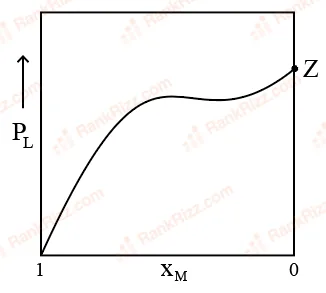
For a solution formed by mixing liquids L and M, the vapour pressure of L plotted against the mole fraction of M in solution is shown in the following figure. Here and represent mole fractions of L and M, respectively, in the solution. The correct statement(s) applicable to this system is(are)

  1. A

    The point Z represents vapour pressure of pure liquid M and Raoult’s law is obeyed from to

  2. B

    The point Z represents vapour pressure of pure liquid L and Raoult’s law is obeyed when

  3. C

    The point Z represents vapour pressure of pure liquid M and Raoult’s law is obeyed when

  4. D

    Attractive intermolecular interactions between L-L in pure liquid L and M-M in pure liquid M are stronger than those between L-M when mixed in solution

Q21JEE ADVANCED 2017 · PAPER 1Oxoacids of halogens and interhalogen compoundsTRANSCRIBED

The correct statement(s) about the oxoacids, and , is(are)

  1. A

    The central atom in both and is hybridized

  2. B

    is more acidic than because of the resonance stabilization of its anion

  3. C

    is formed in the reaction between and

  4. D

    The conjugate base of is weaker base than

Q22JEE ADVANCED 2017 · PAPER 1Oxoacids of halogens and interhalogen compoundsTRANSCRIBED

The colour of the molecules of group 17 elements changes gradually from yellow to violet down the group. This is due to

  1. A

    the physical state of at room temperature changes from gas to solid down the group

  2. B

    decrease in ionization energy down the group

  3. C

    decrease in gap down the group

  4. D

    decrease in HOMO-LUMO gap down the group

Q23JEE ADVANCED 2017 · PAPER 1Colour and magnetic behaviour of complexes from CFTTRANSCRIBED

Addition of excess aqueous ammonia to a pink coloured aqueous solution of and gives an octahedral complex Y in the presence of air. In aqueous solution, complex Y behaves as 1:3 electrolyte. The reaction of X with excess HCl at room temperature results in the formation of a blue coloured complex Z. The calculated spin only magnetic moment of X and Z is 3.87 B.M., whereas it is zero for complex Y. Among the following options, which statement(s) is(are) correct?

  1. A

    Addition of silver nitrate to Y gives only two equivalents of silver chloride

  2. B

    The hybridization of the central metal ion in Y is

  3. C

    Z is a tetrahedral complex

  4. D

    When X and Z are in equilibrium at , the colour of the solution is pink

Q24JEE ADVANCED 2017 · PAPER 1IUPAC nomenclature of organic compoundsTRANSCRIBED

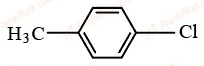
The IUPAC name(s) of the following compound is(are)

  1. A

    1-chloro-4-methylbenzene

  2. B

    4-chlorotoluene

  3. C

    4-methylchlorobenzene

  4. D

    1-methyl-4-chlorobenzene

Q25JEE ADVANCED 2017 · PAPER 1Structural isomerismTRANSCRIBED

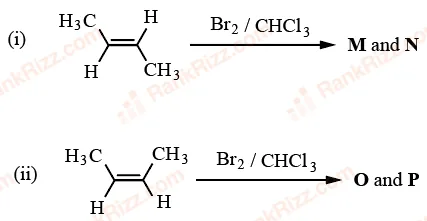
The correct statement(s) for the following addition reactions is(are)

  1. A

    O and P are identical molecules

  2. B

    (M and O) and (N and P) are two pairs of diastereomers

  3. C

    (M and O) and (N and P) are two pairs of enantiomers

  4. D

    Bromination proceeds through trans-addition in both the reactions

Q26JEE ADVANCED 2017 · PAPER 1Voids, radius ratio and structures of ionic solidsTRANSCRIBED

A crystalline solid of a pure substance has a face-centred cubic structure with a cell edge of 400 pm. If the density of the substance in the crystal is 8 g , then the number of atoms present in 256 g of the crystal is . The value of N is

Q27JEE ADVANCED 2017 · PAPER 1Conductance, conductivity and molar conductivityTRANSCRIBED

The conductance of a 0.0015 M aqueous solution of a weak monobasic acid was determined by using a conductivity cell consisting of platinized Pt electrodes. The distance between the electrodes is 120 cm with an area of cross section of . The conductance of this solution was found to be . The pH of the solution is 4. The value of limiting molar conductivity of this weak monobasic acid in aqueous solution is . The value of Z is

Q28JEE ADVANCED 2017 · PAPER 1VSEPR theory and shapes of molecules and ionsTRANSCRIBED

The sum of the number of lone pairs of electrons on each central atom in the following species is
, and
(Atomic numbers: N = 7, F = 9, S = 16, Br = 35, Te = 52, Xe = 54)

Q29JEE ADVANCED 2017 · PAPER 1Molecular orbital theory of diatomic speciesTRANSCRIBED

Among , and , the number of diamagnetic species is
(Atomic numbers: H = 1, He = 2, Li = 3, Be = 4, B = 5, C = 6, N = 7, O = 8, F = 9)

Q30JEE ADVANCED 2017 · PAPER 1AromaticityTRANSCRIBED

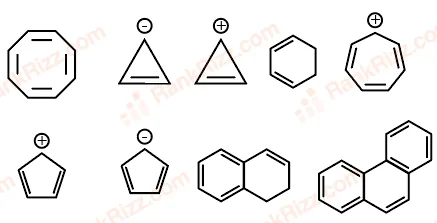
Among the following, the number of aromatic compound(s) is

Q31JEE ADVANCED 2017 · PAPER 1Radial and angular nodes and orbital energiesTRANSCRIBED

For the given orbital in Column 1, the only CORRECT combination for any hydrogen-like species is

  1. A

    (I) (ii) (S)

  2. B

    (IV) (iv) (R)

  3. C

    (II) (ii) (P)

  4. D

    (III) (iii) (P)

Q32JEE ADVANCED 2017 · PAPER 1Radial and angular nodes and orbital energiesTRANSCRIBED

For hydrogen atom, the only CORRECT combination is

  1. A

    (I) (i) (S)

  2. B

    (II) (i) (Q)

  3. C

    (I) (i) (P)

  4. D

    (I) (iv) (R)

Q33JEE ADVANCED 2017 · PAPER 1Radial and angular nodes and orbital energiesTRANSCRIBED

For ion, the only INCORRECT combination is

  1. A

    (I) (i) (R)

  2. B

    (II) (ii) (Q)

  3. C

    (I) (iii) (R)

  4. D

    (I) (i) (S)

Q34JEE ADVANCED 2017 · PAPER 1Reactions of carboxylic acidsTRANSCRIBED

For the synthesis of benzoic acid, the only CORRECT combination is

  1. A

    (II) (i) (S)

  2. B

    (IV) (ii) (P)

  3. C

    (I) (iv) (Q)

  4. D

    (III) (iv) (R)

Q35JEE ADVANCED 2017 · PAPER 1Reactions of carboxylic acidsTRANSCRIBED

The only CORRECT combination that gives two different carboxylic acids is

  1. A

    (II) (iv) (R)

  2. B

    (IV) (iii) (Q)

  3. C

    (III) (iii) (P)

  4. D

    (I) (i) (S)

Q36JEE ADVANCED 2017 · PAPER 1Reactions of carboxylic acidsTRANSCRIBED

The only CORRECT combination in which the reaction proceeds through radical mechanism is

  1. A

    (III) (ii) (P)

  2. B

    (IV) (i) (Q)

  3. C

    (II) (iii) (R)

  4. D

    (I) (ii) (R)

Mathematics

Q37JEE ADVANCED 2017 · PAPER 1Tangents to a hyperbolaTRANSCRIBED

If is a tangent to the hyperbola , then which of the following CANNOT be sides of a right angled triangle?

  1. A

    a, 4, 1

  2. B

    a, 4, 2

  3. C

    2a, 8, 1

  4. D

    2a, 4, 1

Q38JEE ADVANCED 2017 · PAPER 1Chords of a parabola and position of a pointTRANSCRIBED

If a chord, which is not a tangent, of the parabola has the equation , and midpoint (h, k), then which of the following is(are) possible value(s) of p, h and k?

  1. A

    p = −2, h = 2, k = −4

  2. B

    p = −1, h = 1, k = −3

  3. C

    p = 2, h = 3, k = −4

  4. D

    p = 5, h = 4, k = −3

Q39JEE ADVANCED 2017 · PAPER 1Continuity at a pointTRANSCRIBED

Let [x] be the greatest integer less than or equals to x. Then, at which of the following point(s) the function is discontinuous?

  1. A

    x = -1

  2. B

    x = 0

  3. C

    x = 1

  4. D

    x = 2

Q40JEE ADVANCED 2017 · PAPER 1Continuity at a pointTRANSCRIBED

Let be a continuous function. Then, which of the following function(s) has (have) the value zero at some point in the interval (0, 1)?

  1. A

  2. B

  3. C

  4. D

Q41JEE ADVANCED 2017 · PAPER 1Matrix multiplication, powers and matrix equationsTRANSCRIBED

Which of the following is(are) NOT the square of a 3×3 matrix with real entries?

  1. A

  2. B

  3. C

  4. D

Q42JEE ADVANCED 2017 · PAPER 1Algebra of complex numbers and square rootsTRANSCRIBED

Let a, b, x and y be real numbers such that a - b = 1 and . If the complex number z = x + iy satisfies , then which of the following is(are) possible value(s) of x?

  1. A

  2. B

  3. C

  4. D

Q43JEE ADVANCED 2017 · PAPER 1Conditional probability and multiplication theoremTRANSCRIBED

Let X and Y be two events such that and . Then

  1. A

  2. B

  3. C

  4. D

Q44JEE ADVANCED 2017 · PAPER 1Intercepts and position of a pointTRANSCRIBED

For how many values of P, the circle and the coordinate axes have exactly three common points?

Q45JEE ADVANCED 2017 · PAPER 1Limits of trigonometric functionsTRANSCRIBED

Let be a differentiable function such that and . If for , then

Q46JEE ADVANCED 2017 · PAPER 1Systems of linear equationsTRANSCRIBED

For a real number , if the system of linear equations, has infinitely many solutions, then

Q47JEE ADVANCED 2017 · PAPER 1Permutations of letters and words, rank in dictionaryTRANSCRIBED

Words of length 10 are formed using the letters A, B, C, D, E, F, G,H, I, J. Let 𝑥 be the number of such words where no letter is repeated; and let 𝑦 be the number of such words where exactly one letter is repeated twice and no other letter is repeated. Then,

Q48JEE ADVANCED 2017 · PAPER 1Arithmetic progressionTRANSCRIBED

The sides of a right angled triangle are in arithmetic progression. If the triangle has area 24, then what is the length of its smallest side?

Q49JEE ADVANCED 2017 · PAPER 1Tangents and normals to a circleTRANSCRIBED

For , if a tangent is drawn to a suitable conic (Column 1) at the point of contact (-1, 1), then which of the following options is the only CORRECT combination for obtaining equation?

  1. A

    (I) (i) (P)

  2. B

    (I) (ii) (Q)

  3. C

    (II) (ii) (Q)

  4. D

    (III) (i) (P)

Q50JEE ADVANCED 2017 · PAPER 1Tangents, pair of tangents and chord of contactTRANSCRIBED

If a tangent to a suitable conic (Column 1) is found to be y = x + 8 and its point of contact is (8, 16), then which of the following options is the only CORRECT combination?

  1. A

    (I) (ii) (Q)

  2. B

    (II) (iv) (R)

  3. C

    (III) (i) (P)

  4. D

    (III) (ii) (Q)

Q51JEE ADVANCED 2017 · PAPER 1Tangents to a hyperbolaTRANSCRIBED

The tangent to a suitable conic (Column 1) at is found to be , then which of the following options is the only CORRECT combination?

  1. A

    (IV) (iii) (S)

  2. B

    (IV) (iv) (S)

  3. C

    (II) (iii) (R)

  4. D

    (II) (iv) (R)

Q52JEE ADVANCED 2017 · PAPER 1Monotonicity and intervals of increase/decreaseTRANSCRIBED

Which of the following options is the only CORRECT combination?

  1. A

    (I) (i) (P)

  2. B

    (II) (ii) (Q)

  3. C

    (III) (iii) (R)

  4. D

    (IV) (iv) (S)

Q53JEE ADVANCED 2017 · PAPER 1Monotonicity and intervals of increase/decreaseTRANSCRIBED

Which of the following options is the only CORRECT combination?

  1. A

    (I) (ii) (R)

  2. B

    (II) (iii) (S)

  3. C

    (III) (iv) (P)

  4. D

    (IV) (i) (S)

Q54JEE ADVANCED 2017 · PAPER 1Monotonicity and intervals of increase/decreaseTRANSCRIBED

Which of the following options is the only INCORRECT combination?

  1. A

    (I) (iii) (P)

  2. B

    (II) (iv) (Q)

  3. C

    (III) (i) (R)

  4. D

    (II) (iii) (P)