RankRizzStart free

JEE Advanced 2009 Paper 2 Question Paper

All 57 questions of JEE Advanced 2009 Paper 2, in the order they were asked. Pick an answer on any question to check it against the key. Free to read, nothing to download.

Questions

57

Chemistry · Mathematics · Physics

Answer key

26

questions with a checked key

Under review

31

key not yet trusted

Price

Free

no sign-up

Chemistry

Q1JEE ADVANCED 2009 · PAPER 2Collision theory and effect of catalyst on rateTRANSCRIBED

For a first order reaction , the temperature (T) dependent rate constant (k) was found to follow the equation . The pre-exponential factor A and the activation energy , respectively, are

  1. A

    and 9.2 kJ mol

  2. B

    and 16.6 kJ mol

  3. C

    and 16.6 kJ mol

  4. D

    and 38.3 kJ mol

Q2JEE ADVANCED 2009 · PAPER 2Colour and magnetic behaviour of complexes from CFTTRANSCRIBED

The spin onlyimoment value (in Bohr magneton units) of is

  1. A

    0

  2. B

    2.84

  3. C

    4.90

  4. D

    5.92

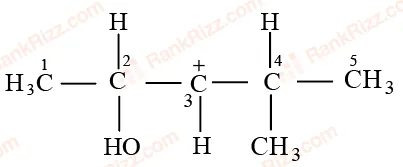
Q3JEE ADVANCED 2009 · PAPER 2Reactive intermediates and rearrangementsTRANSCRIBED

In the following carbocation, that is most likely to migrate to the positively charged carbon is

  1. A

    at C-4

  2. B

    H at C-4

  3. C

    at C-2

  4. D

    at C-2

Q4JEE ADVANCED 2009 · PAPER 2Reactive intermediates and rearrangementsTRANSCRIBED

The correct stability order of the following resonance structures is

  1. A

    (I) > (II) > (IV) > (III)

  2. B

    (I) > (III) > (II) > (IV)

  3. C

    (II) > (I) > (III) > (IV)

  4. D

    (III) > (I) > (IV) > (II)

Q5JEE ADVANCED 2009 · PAPER 2Electrode potentials, electrochemical series and cell EMFTRANSCRIBED

For the reduction of ion in an aqueous solution, is +0.96 V. Values of for some metal ions are given below
V
V
V
V
The pair(s) of metals that is(are) oxidized by in aqueous solution is(are)

  1. A

    V and Hg

  2. B

    Hg and Fe

  3. C

    Fe and Au

  4. D

    Fe and V

Q6JEE ADVANCED 2009 · PAPER 2First law: work, heat and internal energyTRANSCRIBED

Among the following, the state function(s) is(are)

  1. A

    Internal energy

  2. B

    Irreversible expansion work

  3. C

    Reversible expansion work

  4. D

    Molarenthalpy

Q7JEE ADVANCED 2009 · PAPER 2Group 13: general trends and inert pair effectTRANSCRIBED

In the reaction

the amine(s) X is (are)

  1. A

  2. B

  3. C

  4. D

Q8JEE ADVANCED 2009 · PAPER 2Phosphorus and its compoundsTRANSCRIBED

The nitrogen oxide(s) that contain(s) N-N bond(s) is(are)

  1. A

  2. B

  3. C

  4. D

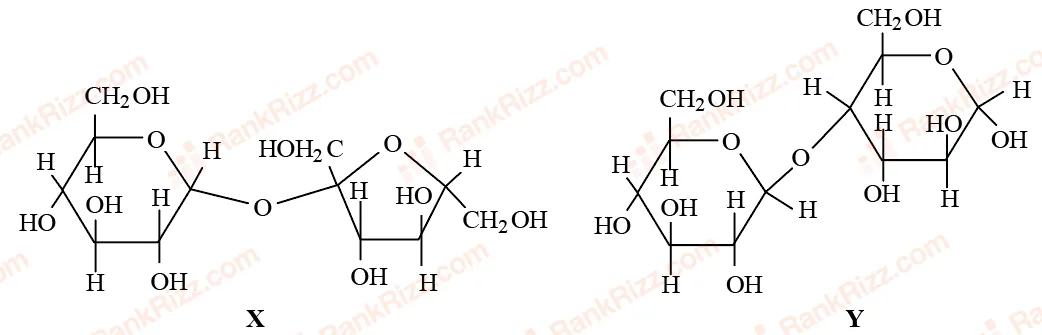
Q9JEE ADVANCED 2009 · PAPER 2Carbohydrates: classification and monosaccharidesTRANSCRIBED

The correct statement(s) about the following sugars X andY is(are)

Figure

  1. A

    X is a reducing sugar and Y is a non-reducing sugar

  2. B

    X is a non-reducing sugar and Y is a reducing sugar

  3. C

    The glucosidic linkages in X and Y are and respectively

  4. D

    The glucosidic linkages in X and Y are and respectively

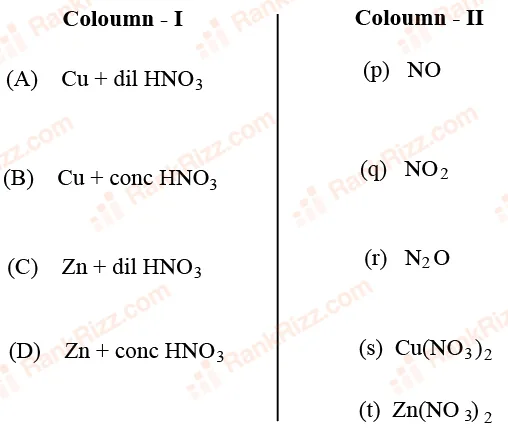
Q10JEE ADVANCED 2009 · PAPER 2Phosphorus and its compoundsTRANSCRIBED

Match each of the reactions given in Column I with the corresponding product(s) given in Column II.

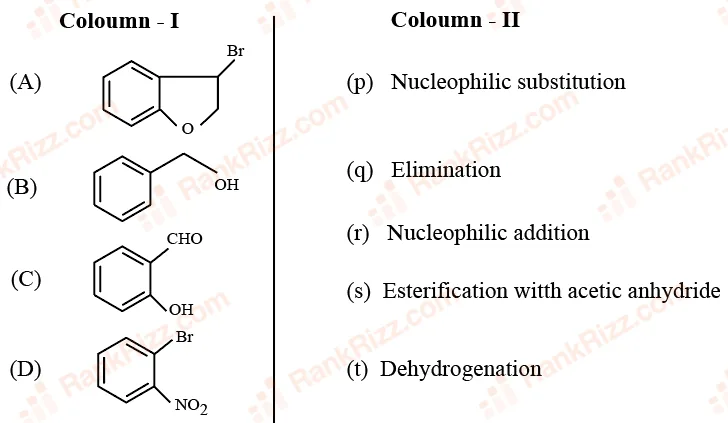
Q11JEE ADVANCED 2009 · PAPER 2Aldol condensation, Cannizzaro and related reactionsTRANSCRIBED

Match each of the compounds given in Column I with the reaction(s), that they can undergo, given in Column II.

Q12JEE ADVANCED 2009 · PAPER 2Enthalpies of reaction and Hess's lawTRANSCRIBED

In a constant volume calorimeter, 3.5 g of a gas with molecular weight 28 was burnt in excess oxygen at 298.0 K. The temperature of the calorimeter was found to increase from 298.0 K to 298.45 K due to the combustion process. Given that the heat capacity of the calorimeteris 2.5 kJ K, the numerical value for the enthalpy of combustion of the gas in kJ mol is

Q13JEE ADVANCED 2009 · PAPER 2Kinetic theory of gases and molecular speedsTRANSCRIBED

At 400 K, the root mean square (rms) speed of a gas X (molecular weight = 40) is equal to the most probable speed of gas Y at 60K. The molecular weight of the gas Y is

Q14JEE ADVANCED 2009 · PAPER 2Hydrolysis of saltsTRANSCRIBED

The dissociation constant of a substituted benzoic acid at is . The pH of a 0.01 M solutionofits sodium salt is

Q15JEE ADVANCED 2009 · PAPER 2Radioactivity and nuclear reactionsTRANSCRIBED

The total number of and particles emitted in the nuclear reaction is

Q16JEE ADVANCED 2009 · PAPER 2Potassium dichromate and potassium permanganateTRANSCRIBED

The oxidation number of Mnin the product of alkaline oxidative fusion of is

Q17JEE ADVANCED 2009 · PAPER 2Werner's theory and coordination terminologyTRANSCRIBED

The number of water molecule(s) directly bonded to the metal centre in is

Q18JEE ADVANCED 2009 · PAPER 2Voids, radius ratio and structures of ionic solidsTRANSCRIBED

The coordination numberof Al in the crystalline state of , is

Q19JEE ADVANCED 2009 · PAPER 2Structural isomerismTRANSCRIBED

The total number of cyclic structural as well as stereo isomers possible for a compound with the molecular formula is

Mathematics

Q20JEE ADVANCED 2009 · PAPER 2Arithmetic progressionTRANSCRIBED

If the sum of first n terms of an A.P. is , then the sum of squares of these n terms is

  1. A

  2. B

  3. C

  4. D

Q21JEE ADVANCED 2009 · PAPER 2Coordinates, direction cosines and direction ratiosTRANSCRIBED

A line with positive direction cosines passes through the point P(2,-1, 2) and makes equal angles with the coordinate axes. The line meets the plane at point Q. The length of the line segment PQ equals

  1. A

    1

  2. B

  3. C

  4. D

    2

Q22JEE ADVANCED 2009 · PAPER 2Normals to an ellipseTRANSCRIBED

The normal at a point P on the ellipse meets the x-axis at Q. If M is the mid point of the line segment PQ, then the locus of M intersects the latus rectums of the given ellipse at the points

  1. A

  2. B

  3. C

  4. D

Q23JEE ADVANCED 2009 · PAPER 2Locus problems in coordinate geometryTRANSCRIBED

The locus of the orthocentre of the triangle formed by the lines
(1 + p)x - py + p(1 + p) = 0,
(1 + q)x - qy + q(1 + q) = 0,
and y = 0, where , is

  1. A

    a hyperbola

  2. B

    a parabola

  3. C

    a nellipse

  4. D

    a straight line

Q24JEE ADVANCED 2009 · PAPER 2Definite integrals: properties and King's ruleTRANSCRIBED

If , n = 0, 1, 2, 3, ....,
then

  1. A

  2. B

  3. C

  4. D

Q25JEE ADVANCED 2009 · PAPER 2Common tangents involving an ellipseTRANSCRIBED

An ellipse intersects the hyperbola orthogonally. The eccentricity of the ellipse is reciprocal of that of the hyperbola. If the axes of the ellipse are along the
coordinate axes, then

  1. A

    Equation of ellipse is

  2. B

    The foci of ellipse are

  3. C

    Equation of ellipse is

  4. D

    The foci of ellipse are

Q26JEE ADVANCED 2009 · PAPER 2Monotonicity and intervals of increase/decreaseTRANSCRIBED

For the function
,

  1. A

    for at least one x x in the interval [1, \infty), f(x + 2) - f(x) < 2

  2. B

  3. C

    for all x in the interval [1, \infty), f(x + 2) - f(x) > 2

  4. D

    f'(x) is strictly decreasing in the interval

Q27JEE ADVANCED 2009 · PAPER 2Locus problems on parabolaTRANSCRIBED

The tangent PT and the normal PN to the parabola at a point P on it meet its axis at points T and N, respectively. The locus of the centroid of the triangle PTN is a parabola whose

  1. A

    vertex is

  2. B

    directrix is x = 0

  3. C

    latus rectum is

  4. D

    focus is (a, 0)

Q28JEE ADVANCED 2009 · PAPER 2Trigonometric series and productsTRANSCRIBED

For 0 < \theta < \frac{\pi}{2}, the solution(s) of

is(are)

  1. A

  2. B

  3. C

  4. D

Q29JEE ADVANCED 2009 · PAPER 2Equation of a circle in various formsTRANSCRIBED

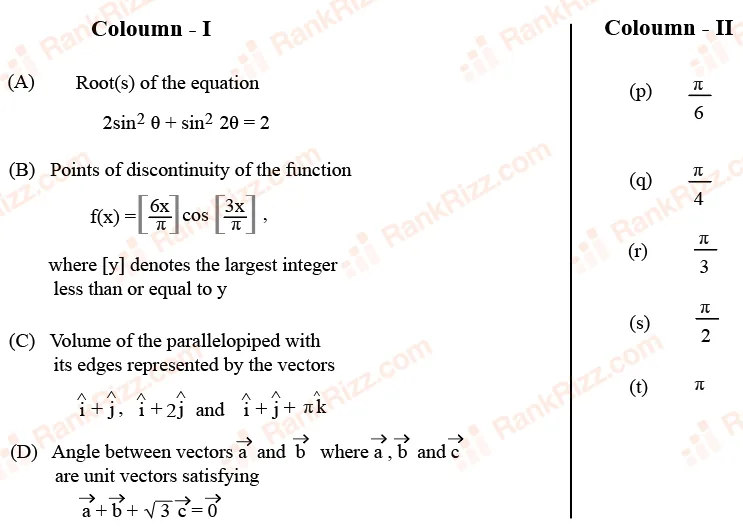
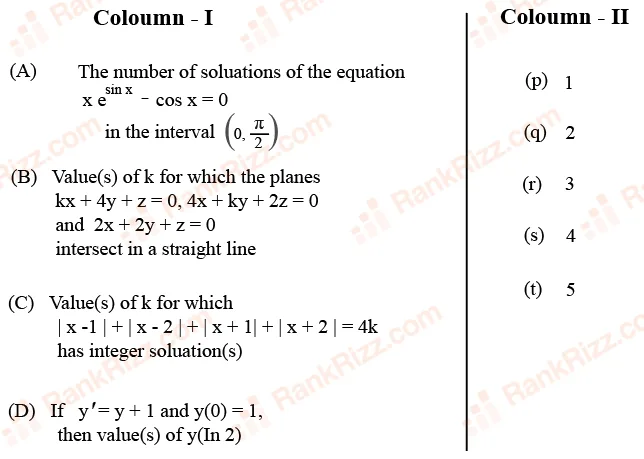
Match the statements/expressions given in Column I with the values given in Column II.

Q30JEE ADVANCED 2009 · PAPER 2Equation of a circle in various formsTRANSCRIBED

Match the statements/expressions given in Column I with the values given in Column II.

Q31JEE ADVANCED 2009 · PAPER 2Optimization word and geometry problemsTRANSCRIBED

The maximum value of the function on the set is

Q32JEE ADVANCED 2009 · PAPER 2Systems of linear equationsTRANSCRIBED

Let (x, y, z) be points with integer coordinates satisfying the system of homogeneous equations:


.
Then the number of such points for which is

Q33JEE ADVANCED 2009 · PAPER 2Half-angle formulas, area and Napier's analogyTRANSCRIBED

Let ABC and ABC' be two non-congruent triangles with sides and angle . The absolute value ofthe difference between the areas of these triangles is

Q34JEE ADVANCED 2009 · PAPER 2Optimization word and geometry problemsTRANSCRIBED

Let p(x) be a polynomial of degree 4 having extremumat x = 1, 2 and
.
Then the value of p(2) is

Q35JEE ADVANCED 2009 · PAPER 2Leibniz rule for differentiating integralsTRANSCRIBED

Let be a continuous function which satisfies
.
Then the value of is

Q36JEE ADVANCED 2009 · PAPER 2Position of two circles and common tangentsTRANSCRIBED

The centres of two circles and each of unit radius are at a distance of 6 units from each other. Let P be the mid point of the line segment joining the centres of and and C be a circle touching circles and externally. If a common tangent to and C passing through Pis also a common tangent to and C, then the radius ofthe circle C is

Q37JEE ADVANCED 2009 · PAPER 2Location of rootsTRANSCRIBED

The smallest value of k, for which both the roots of the equation

are real, distinct and have values at least 4, is

Q38JEE ADVANCED 2009 · PAPER 2Inverse functionsTRANSCRIBED

If the function and , then the value of is

Physics

Q39JEE ADVANCED 2009 · PAPER 2Spring-block oscillationsTRANSCRIBED

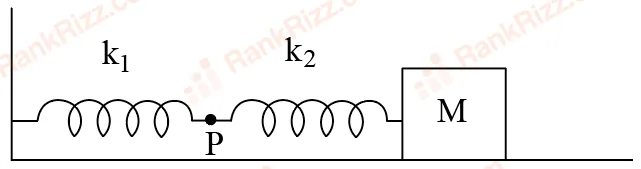
The mass M shown in the figure oscillates in simple harmonic motion with amplitude A. The amplitude of the point P is

  1. A

  2. B

  3. C

  4. D

Q40JEE ADVANCED 2009 · PAPER 2Newton's laws, free-body diagrams and equilibrium of a particleTRANSCRIBED

A piece of wire is bent in the shape of a parabola (y-axis vertical) with a bead of mass m onit. The bead canslide on the wire withoutfriction. It stays at the lowest point of the parabola when the wire is at rest. The wire is now accelerated parallel to the x-axis with a constant acceleration a. The distance of the new equilibrium position of the bead, where the bead can stay at rest with respect to the wire, from the y-axis is

  1. A

  2. B

  3. C

  4. D

Q41JEE ADVANCED 2009 · PAPER 2Photoelectric effect and Einstein's equationTRANSCRIBED

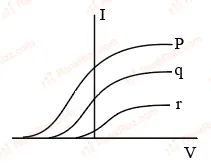
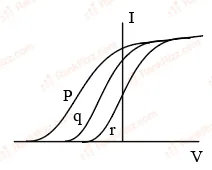
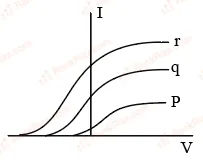
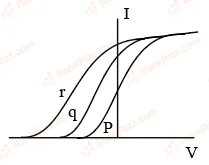
Photoelectric effect experiments are performed using three different metal plates p, q and r having work functions eV, eV and eV, respectively. A light beam containing wavelengths of 550 nm, 450 nm and 350 nm with equal intensities illuminates each of the plates. The correct I-V graph for the experiment is [Take hc = 1240 eV nm]

  1. A
  2. B
  3. C
  4. D
Q42JEE ADVANCED 2009 · PAPER 2Spring-block oscillationsTRANSCRIBED

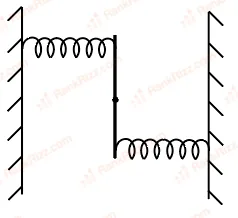
A uniform rod of length L and mass M is pivoted at the centre. Its two ends are attached to two springs of equal spring constants k. The springs are fixed to rigid supports as shown in the figure, and the rod is free to oscillate in the horizontal plane. The rod is gently pushed through a small angle in one direction and released. The frequency of oscillation is

  1. A

  2. B

  3. C

  4. D

Q43JEE ADVANCED 2009 · PAPER 2Motional emf in moving rods and loopsTRANSCRIBED

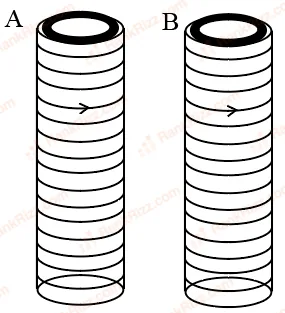
Two metallic rings A and B, identical in shape and size but having different resistivities and , are kept on top of two identical solenoids as shown in the figure. When current J is switched on in both the solenoids in identical manner, the rings A and B jump to heights and , respectively, with h_A > h_B. The possible relation(s) between their resistivities and their masses and is(are)

  1. A

    \rho_A > \rho_B and

  2. B

    \rho_A < \rho_B and

  3. C

    \rho_A > \rho_B and m_A > m_B

  4. D

    \rho_A < \rho_B and m_A < m_B

Q44JEE ADVANCED 2009 · PAPER 2Superposition, interference and beatsTRANSCRIBED

A student performed the experiment to measure the speed of sound in air using resonance air-column method. Two resonances in the air-column were obtained by lowering the water level. The resonance with the shorter air-column is the first resonanceandthat with the longer air-column is the second resonance. Then,

  1. A

    the intensity of the sound heard at the first resonance was more than that at the second resonance

  2. B

    the prongs of the tuning fork were kept in a horizontal plane above the resonance tube

  3. C

    the amplitude of vibration of the ends of the prongsis typically around 1 cm

  4. D

    the length of the air-columnat the first resonance was somewhat shorter than of the wavelength of the sound in air

Q45JEE ADVANCED 2009 · PAPER 2Multi-step processes and gas-piston-spring systemsTRANSCRIBED

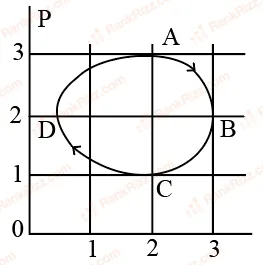
The figure shows the P-V plot of an ideal gas taken through a cycle ABCDA. The part ABC is a semi-circle and CDA is half of an ellipse. Then, 

  1. A

    the process during the path is isothermal

  2. B

    heat flows out of the gas during the path

  3. C

    work done during the path is zero

  4. D

    positive work is done by the gas in the cycle ABCDA

Q46JEE ADVANCED 2009 · PAPER 2Electric charge and Coulomb's lawTRANSCRIBED

Under the influence of the Coulomb field of charge +Q, a charge -q is moving around it in an elliptical orbit. Find out the correct statement(s).

  1. A

    The angular momentum of the charge —q is constant

  2. B

    The linear momentum of the charge —g is constant

  3. C

    The angular velocity of the charge —q is constant

  4. D

    Thelinear speed of the charge —q is constant

Q47JEE ADVANCED 2009 · PAPER 2Rolling with friction, slipping and impulsive forcesTRANSCRIBED

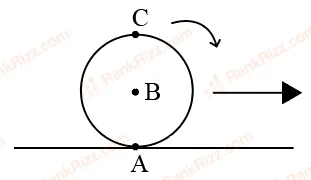
A sphere is rolling without slipping on a fixed horizontal plane surface. In the figure, A is the point of contact, B is the centre of the sphere and C is its topmost point. Then,

  1. A

  2. B

  3. C

  4. D

Q48JEE ADVANCED 2009 · PAPER 2Calculus, graphs and approximations used in physicsTRANSCRIBED

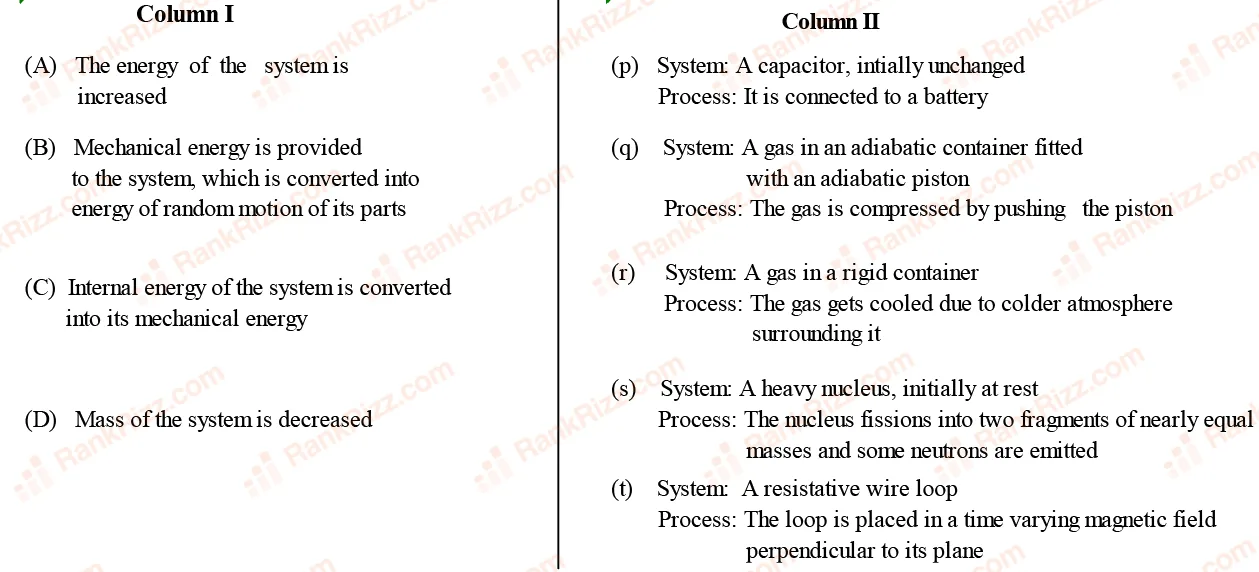
Column II gives certain systems undergoing a process. Column I suggests changes in some of the parameters related to the system. Match the statements in Column I to the appropriate process(es) from Column II.

Q49JEE ADVANCED 2009 · PAPER 2Young's double slit experiment: fringe width and intensityTRANSCRIBED

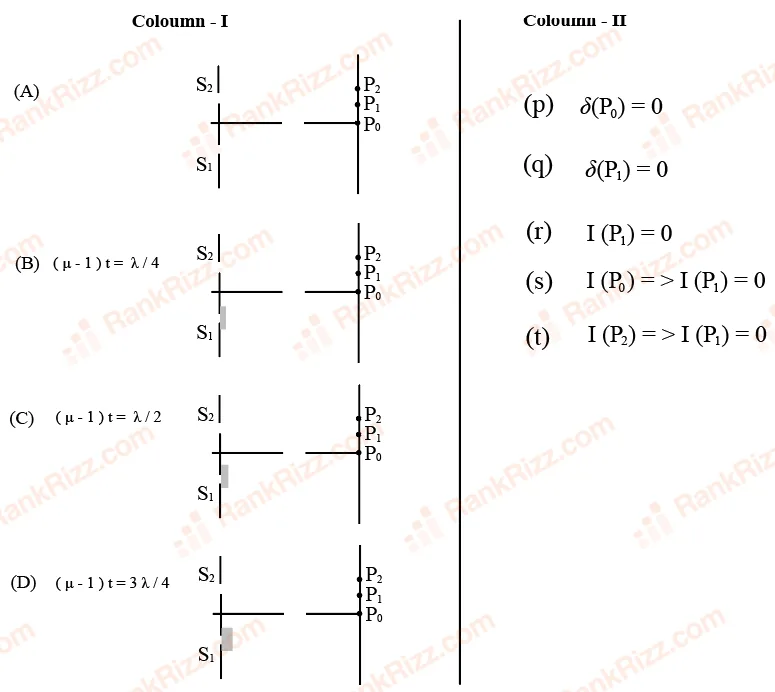
Column I shows four situations of standard Young’s double slit arrangement with the screen placed far away from the slits and . In each of these cases and , where is the wavelength of the light used. In the cases B, C and D, a transparent sheet of refractive index and thickness t is pasted on slit . The thicknesses of the sheets are different in different cases. The phase difference between thelight waves reaching a point P on the screen from the two slits is denoted by and the intensity by . Match each situation given in Column I with the statement(s) in Column II valid for that situation.

Q50JEE ADVANCED 2009 · PAPER 2Calorimetry and specific heat capacityTRANSCRIBED

A metal rod AB of length 10x has its one end A in ice at and the other end B in water at . If a point P on the rod is maintained at , then it is found that equal amounts of water andice evaporate and melt per unit time. The latent heat of evaporation of water is 540 cal/g and latent heat of melting of ice is 80 cal/g. If the point P is at a distance of from the ice end A, find the value of . [Neglect any heat loss to the surrounding.]

Q51JEE ADVANCED 2009 · PAPER 2Equation of continuity and Bernoulli's theoremTRANSCRIBED

A cylindrical vessel of height 500 mm has an orifice (small hole) at its bottom. The orifice is initially closed and wateris filled in it up to height H. Now the top is completely sealed with a cap and theorifice at the bottom is opened. Some water comes out from the orifice and the water level in the vessel becomes steady with height of water column being 200 mm. Find the fall in height (in mm) of water level due to opening ofthe orifice.
[Take atmospheric pressure , density of water and . Neglect any affect of surface tension.]

Q52JEE ADVANCED 2009 · PAPER 2Surface tension and surface energyTRANSCRIBED

Two soap bubbles A and B are kept in a closed chamber where the air is maintained at pressure 8 N/m. The radii of bubbles A and B are 2 cm and 4 cm, respectively. Surface tension of the soap-water used to make bubbles is 0.04 N/m. Find the ratio . Where and are the number of moles of air in bubbles A and B, respectively. [Neglect the effect of gravity.]

Q53JEE ADVANCED 2009 · PAPER 2Motion of centre of mass, momentum conservation and explosionsTRANSCRIBED

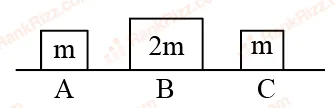
Three objects A. B and C are kept in a straight line on a frictionless horizontal surface. These have:masses m, 2m and m, respectively. The object A moves towards B with a speed 9 m/s and makes an elastic collision with it. Thereafter, B makes completely inelastic collision with C. All motions occur on the same straight line. Find the final speed (in m/s) of the object C.

Q54JEE ADVANCED 2009 · PAPER 2Magnetic field of circular loops, arcs and coilsTRANSCRIBED

A steady current I goes through a wire loop PQR having shape of a right angle triangle with PQ = 3x, PR = 4x and QR = 5x. If the magnitude of the magnetic field at P due to this loop is , find the value of k.

Q55JEE ADVANCED 2009 · PAPER 2Work done by constant and variable forcesTRANSCRIBED

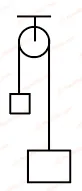
A light inextensible string that goes over a smooth fixed pulley as shown in the figure connects two blocks of masses 0.36 kg and 0.72 kg. Taking g = 10 m/s, find the work
done (in joules) by the string on the block of mass 0.36 kg during the first second after the system is released from rest.

Q56JEE ADVANCED 2009 · PAPER 2Electric field of continuous charge distributionsTRANSCRIBED

A solid sphere of radius R has a charge Q distributed in its volume with a charge densityy , where k and a are constants and r is the distance from its center. If the electric field at is times that at r = R, find the value of a,

Q57JEE ADVANCED 2009 · PAPER 2Progressive waves: wave equation, phase and intensityTRANSCRIBED

A 20 cm long string, having a mass of 1.0 g, is fixed at both the ends. The tension in tne string is 0.5 N. The string is set into vibrations using an external vibrator of
frequency 100 Hz. Find the separation (in em) between the successive nodes on the string.