RankRizzStart free

JEE Advanced 2007 Paper 2 Question Paper

All 66 questions of JEE Advanced 2007 Paper 2, in the order they were asked. Pick an answer on any question to check it against the key. Free to read, nothing to download.

Questions

66

Physics · Chemistry · Mathematics

Answer key

66

questions with a checked key

Under review

0

key not yet trusted

Price

Free

no sign-up

Physics

Q1JEE ADVANCED 2007 · PAPER 2Progressive waves: wave equation, phase and intensityTRANSCRIBED

In the experiment to determine the speed of sound using a resonance column,

  1. A

    prongs of the tuning fork are kept in a vertical plane

  2. B

    prongs of the tuning fork are kept in a horizontal plane

  3. C

    in one of the two resonances observed, the length of the resonating air columnis close to the wave length of sound in air

  4. D

    in one of the two resonances observed, the length of the resonating air column is close to half of the wave length of sound in air
Q2JEE ADVANCED 2007 · PAPER 2Errors in measurement and significant figuresTRANSCRIBED

A student performs an experiment to determine the Young’s modulus of a wire, exactly 2 m long, by Searle’s method. In a particular reading, the student measures the extension in the length of the wire to be 0.8 mm with an uncertainty of mm at load of exactly 1.0 kg. The student also measures the diameter of the wire to be 0.4 mm with an uncertainty of mm. Take g = 9.8 m/s (exact). The Young’s modulus obtained from the reading is

  1. A

  2. B

  3. C

  4. D

Q3JEE ADVANCED 2007 · PAPER 2Newton's laws, free-body diagrams and equilibrium of a particleTRANSCRIBED

A particle moves in the X-Y plane underthe influence of a force such that its linear momentum is , where A and k are constants. The angle between the force and the momentum is

  1. A

  2. B

  3. C

  4. D

Q4JEE ADVANCED 2007 · PAPER 2Rolling with friction, slipping and impulsive forcesTRANSCRIBED

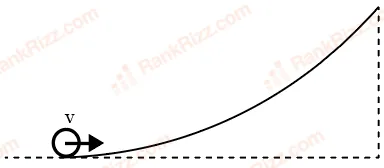
A small object of uniform density rolls up a curved surface with an initial velocity v. It reaches up to a maximum height of with respect to the initial position. The object is

  1. A

    ring

  2. B

    solid sphere

  3. C

    hollow sphere

  4. D

    disc

Q5JEE ADVANCED 2007 · PAPER 2Surface tension and surface energyTRANSCRIBED

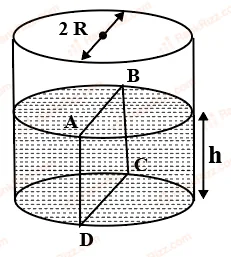
Water is filled up to a height h in a beaker of radius R as shown in the figure. The density of water is , the surface tension of water is T and the atmospheric pressure is . Consider a vertical section ABCD of the water column through a diameter of the beaker. The force on water on one side of this section by water on the other side of this section has magnitude.

  1. A

  2. B

  3. C

  4. D

Q6JEE ADVANCED 2007 · PAPER 2Electric flux and Gauss's lawTRANSCRIBED

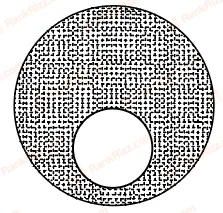
A spherical portion has been removed from a solid sphere having a charge distributed uniformly in its volume as showing the figure. The electric field inside the emptied space is

  1. A

    zero everywhere

  2. B

    non-zero and uniform

  3. C

    non-uniform

  4. D

    zero only at its center

Q7JEE ADVANCED 2007 · PAPER 2Relation between field and potential, equipotential surfacesTRANSCRIBED

Positive and negative point charges of equal magnitude are kept at and , respectively. The work done by the electric field when another positive point charge is moved from (-a, 0, 0) to (0, a, 0) is

  1. A

    positive

  2. B

    negative

  3. C

    zero

  4. D

    depends on the path connecting the initial and final positions

Q8JEE ADVANCED 2007 · PAPER 2Calculus, graphs and approximations used in physicsTRANSCRIBED

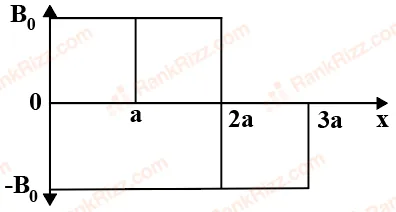
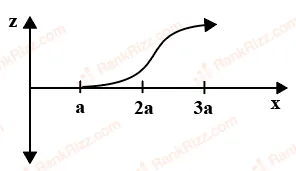
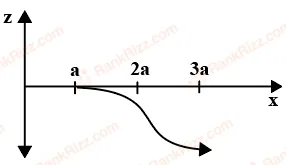
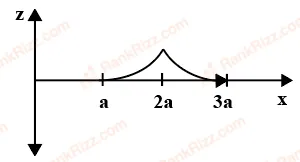
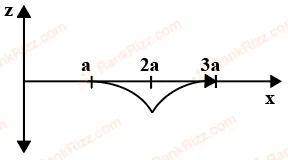
A magnetic field exists in the region a < x < 2a and , in the region 2a < x < 3a, where is a positive constant. A positive point charge moving with a velocity , where is a positive constant, enters the magnetic field at x = a. The trajectory of the charge in this region can be like,

  1. A
  2. B
  3. C
  4. D
Q9JEE ADVANCED 2007 · PAPER 2de Broglie wavelength of matter wavesTRANSCRIBED

Electrons with de-Broglie wave length fall on the target in an X-ray tube. The cut-off wavelength of the emitted X-rays is

  1. A

  2. B

  3. C

  4. D

Q10JEE ADVANCED 2007 · PAPER 2Equilibrium of rigid bodies and topplingTRANSCRIBED

STATEMENT-1
If there is no external torque on a body aboutits center of mass, then the velocity of the center of mass remains constant.
because
STATEMENT-2
The linear momentum of an isolated system remains constant.

  1. A

    Statement-1 is True, Statement-2 is True; Statement-2 is a correct explanation for Statement-1

  2. B

    Statement-1 is True, Statement-2 is True; Statement-2 is NOT a correct explanation for Statement-1

  3. C

    Statement-1 is True, Statement-2 is False

  4. D

    Statement-1 is False, Statement-2 is True

Q11JEE ADVANCED 2007 · PAPER 2Newton's laws, free-body diagrams and equilibrium of a particleTRANSCRIBED

STATEMENT-1
A cloth covers a table. Some dishes are kept on it. The cloth can be pulled out without dislodging the dishes from thetable.
because
STATEMENT-2
For every action there is an equal and opposite reaction.

  1. A

    Statement-1 is True, Statement-2 is True; Statement-2 is a correct explanation for Statement-1

  2. B

    Statement-1 is True, Statement-2 is True; Statement-2 is NOT a correct explanation for Statement-1

  3. C

    Statement-1 is True, Statement-2 is False

  4. D

    Statement-1 is False, Statement-2 is True

Q12JEE ADVANCED 2007 · PAPER 2AC basics: rms and average values, phasorsTRANSCRIBED

STATEMENT-1
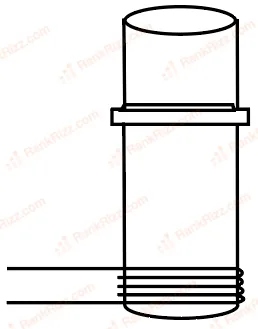
A vertical iron rod has a coil of wire wound over it at the bottom end. An alternating current flows in the coil. The rod goes through a conducting ring as showing the figure. The ring can float at a certain height above the coil.
because
STATEMENT-2
In the above situation, a current is induced in the ring which interacts with the horizontal component of the magnetic field to produce an average force in the upward direction.

  1. A

    Statement-1 is True, Statement-2 is True; Statement-2 is a correct explanation for Statement-1

  2. B

    Statement-1 is True, Statement-2 is True; Statement-2 is NOT a correct explanation for Statement-1

  3. C

    Statement-1 is True, Statement-2 is False

  4. D

    Statement-1 is False, Statement-2 is True

Q13JEE ADVANCED 2007 · PAPER 2Ideal gas equation and gas lawsTRANSCRIBED

STATEMENT-1
The total translational kinetic energy of all the molecules of a given massof an ideal gas is 1.5 times the product of its pressure and its volume.
because
STATEMENT-2
The molecules of a gas collide with each other and the velocities of the molecules change dueto thecollision.

  1. A

    Statement-1 is True, Statement-2 is True; Statement-2 is a correct explanation for Statement-1

  2. B

    Statement-1 is True, Statement-2 is True; Statement-2 is NOT a correct explanation for Statement-1

  3. C

    Statement-1 is True, Statement-2 is False

  4. D

    Statement-1 is False, Statement-2 is True

Q14JEE ADVANCED 2007 · PAPER 2Doppler effect in soundTRANSCRIBED

The speed of sound of the whistle is

  1. A

    340 m/s for passengers in A and 310 m/s for passengers in B

  2. B

    360 m/s for passengers in A and 310 m/s for passengers in B

  3. C

    310 m/s for passengers in A and 360 m/s for passengers in B

  4. D

    340 m/s for passengersin both the trains

Q15JEE ADVANCED 2007 · PAPER 2Doppler effect in soundTRANSCRIBED

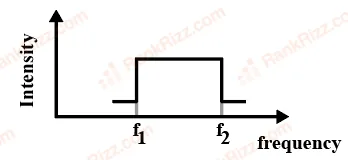
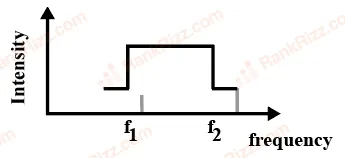
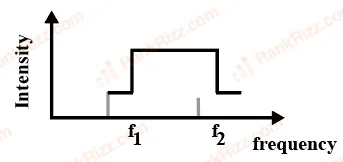
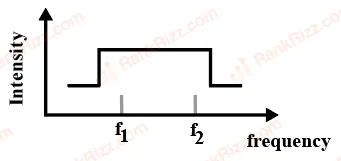
The distribution of the sound intensity of the whistle as observed by the passengers in train A is best represented by

  1. A
  2. B
  3. C
  4. D
Q16JEE ADVANCED 2007 · PAPER 2Doppler effect in soundTRANSCRIBED

The spread of frequency as observed by the passengersin train B is

  1. A

    310 Hz

  2. B

    330 Hz

  3. C

    350 Hz

  4. D

    290 Hz

Q17JEE ADVANCED 2007 · PAPER 2Young's double slit experiment: fringe width and intensityTRANSCRIBED

Light travels as a

  1. A

    parallel beam in each medium

  2. B

    convergent beam in each medium

  3. C

    divergent beam in each medium

  4. D

    divergent beam in one medium and convergent beam in the other medium

Q18JEE ADVANCED 2007 · PAPER 2Young's double slit experiment: fringe width and intensityTRANSCRIBED

The phases of the light wave at c, d, e and f are and respectively. It is given that .

  1. A

    cannot be equal to

  2. B

    can be equal to

  3. C

    is equal to

  4. D

    is not equal to

Q19JEE ADVANCED 2007 · PAPER 2Young's double slit experiment: fringe width and intensityTRANSCRIBED

Speed of light is

  1. A

    the same in medium-1 and medium-2

  2. B

    larger in medium-1 than in medium-2

  3. C

    larger in medium-2 than in medium-1

  4. D

    different at b and d

Q20JEE ADVANCED 2007 · PAPER 2Calculus, graphs and approximations used in physicsTRANSCRIBED

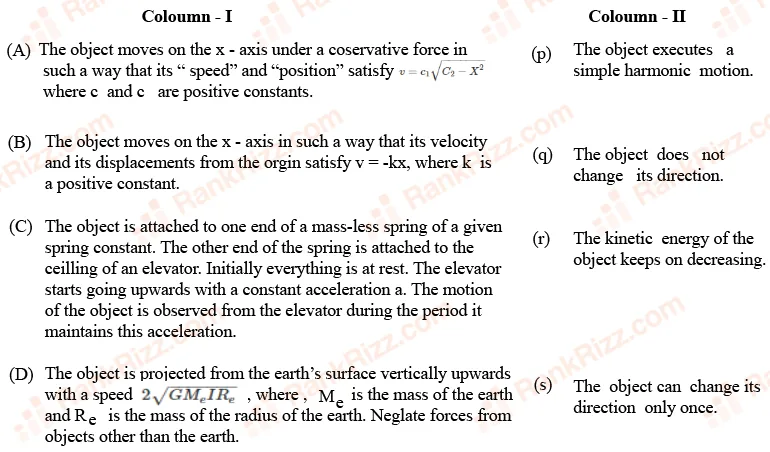
Column I describes some situations in which a small object moves. Column II describes some characteristics of these motions. Match the situations in Column I with the characteristics in Column II and indicate your answer by darkening appropriate bubbles in the matrix given in the ORS.

Q21JEE ADVANCED 2007 · PAPER 2Magnetic field of circular loops, arcs and coilsTRANSCRIBED

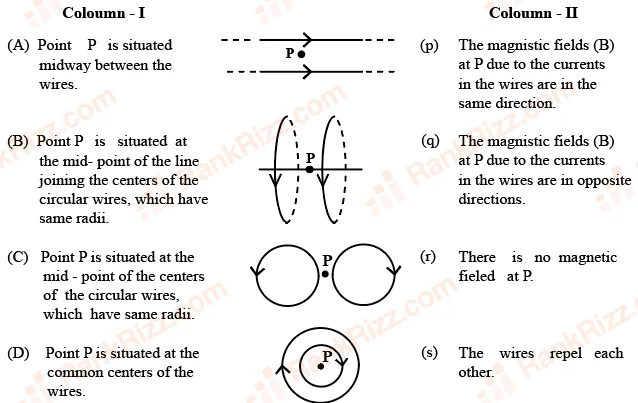
Two wires each carrying a steady current J are shown in four configurations in Column I. Some of the resulting effects are described in Column II. Match the statements in Column I with the statements in Column II and indicate your answer by darkening appropriate bubbles in the matrix given in the ORS.

Q22JEE ADVANCED 2007 · PAPER 2Temperature scales and thermal expansionTRANSCRIBED

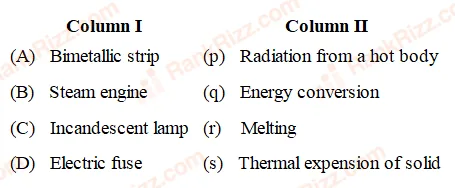
Column I gives some devices and Column II gives some processes on which the functioning of these devices depend. Match the devices in Column I with the processes in Column II and indicate your answer by darkening appropriate bubbles in the matrix given in the ORS.

Chemistry

Q23JEE ADVANCED 2007 · PAPER 2Redox titrationsTRANSCRIBED

Consider a titration of potassium dichromate solution with acidified Mohr’s salt solution using diphenylamine as indicator. The number of moles of Mohr’s salt required per mole of dichromate is

  1. A

    3

  2. B

    4

  3. C

    5

  4. D

    6

Q24JEE ADVANCED 2007 · PAPER 2Metal carbonyls and synergic bondingTRANSCRIBED

Among the following metal carbonyls, the C-O bond order is lowest in

  1. A

  2. B

  3. C

  4. D

Q25JEE ADVANCED 2007 · PAPER 2Group analysis and confirmatory tests of cationsTRANSCRIBED

A solution of a metal ion when treated with KI gives a red precipitate which dissolves in excess KI to give a colourless solution. Moreover, the solution of metal ion on treatment with a solution of cobalt(II) thiocyanate gives rise to a deep blue crystalline precipitate. The metal ion is

  1. A

  2. B

  3. C

  4. D

Q26JEE ADVANCED 2007 · PAPER 2Aldol condensation, Cannizzaro and related reactionsTRANSCRIBED

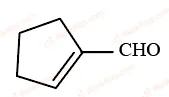
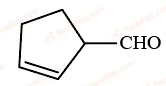
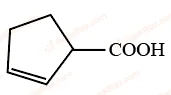
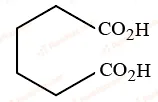
Cyclohexene on ozonolysis followed by reaction with zinc dust and water gives compound E. Compound E on further treatment with aqueous KOH yields compound F. Compound F is

  1. A
  2. B
  3. C
  4. D
Q27JEE ADVANCED 2007 · PAPER 2Structural isomerismTRANSCRIBED

The numberof stereoisomers obtained by bromination of trans-2-butene is

  1. A

    1

  2. B

    2

  3. C

    3

  4. D

    4

Q28JEE ADVANCED 2007 · PAPER 2Resonance and hyperconjugationTRANSCRIBED

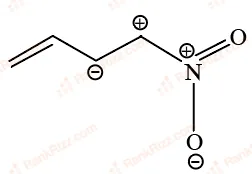
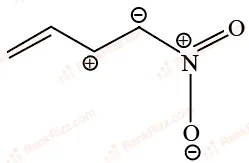
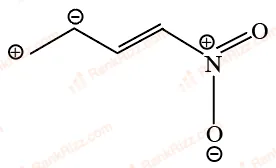
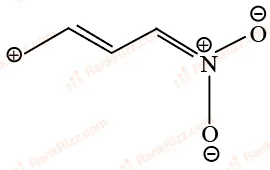
Among the following, the least stable resonance structure is

  1. A
  2. B
  3. C
  4. D
Q29JEE ADVANCED 2007 · PAPER 2Radioactivity and nuclear reactionsTRANSCRIBED

A positron is emitted from . The ratio of the atomic mass and atomic number of the resulting nuclide is

  1. A

  2. B

  3. C

  4. D

Q30JEE ADVANCED 2007 · PAPER 2First law: work, heat and internal energyTRANSCRIBED

For the process (1 bar, 373 K) (1 bar, 373 K), the correct set of thermodynamic parameters is

  1. A

  2. B

  3. C

  4. D

Q31JEE ADVANCED 2007 · PAPER 2Methods to determine order of reactionTRANSCRIBED

Consider a reaction Products. When concentration of both the reactants G and is doubled, the rate increases by eight times. However, when concentration of G is doubled keeping the concentration of H fixed, the rate is doubled. The overall order of the reaction is

  1. A

    0

  2. B

    1

  3. C

    2

  4. D

    3

Q32JEE ADVANCED 2007 · PAPER 2Compounds of alkali metalsTRANSCRIBED

STATEMENT-1: Alkali metals dissolve in liquid ammoniato give blue solutions.
because
STATEMENT-2: Alkali metals in liquid ammonia give solvated species of the type (M = alkali metals).

  1. A

    Statement-1 is True, Statement-2 is True; Statement-2 is a correct explanation for Statement-1

  2. B

    Statement-1 is True, Statement-2 is True; Statement-2 is NOT a correct explanation for Statement-1

  3. C

    Statement-1 is True, Statement-2 is False

  4. D

    Statement-1 is False, Statement-2 is True

Q33JEE ADVANCED 2007 · PAPER 2Carbohydrates: classification and monosaccharidesTRANSCRIBED

STATEMENT-1: Glucose gives a reddish-brown precipitate with Fehling’s solution.
because
STATEMENT-2: Reaction of glucose with Fehling’s solution gives CuO and gluconic acid.

  1. A

    Statement-1 is True, Statement-2 is True; Statement-2 is a correct explanation for Statement-1

  2. B

    Statement-1 is True, Statement-2 is True; Statement-2 is NOT a correct explanation for Statement-1

  3. C

    Statement-1 is True, Statement-2 is False

  4. D

    Statement-1 is False, Statement-2 is True

Q34JEE ADVANCED 2007 · PAPER 2Structural isomerismTRANSCRIBED

STATEMENT-1: Molecules that are not superimposable on their mirror images are chiral.
because
STATEMENT-2: All chiral molecules have chiral centres.

  1. A

    Statement-1 is True, Statement-2 is True; Statement-2 is a correct explanation for Statement-1

  2. B

    Statement-1 is True, Statement-2 is True; Statement-2 is NOT a correct explanation for Statement-1

  3. C

    Statement-1 is True, Statement-2 is False

  4. D

    Statement-1 is False, Statement-2 is True

Q35JEE ADVANCED 2007 · PAPER 2Oxides of carbon, silica, silicones and silicatesTRANSCRIBED

STATEMENT-1: Band gap in germanium is small.
because
STATEMENT-2: The energy spread of each germanium atomic energy level is infinitesimally small.

  1. A

    Statement-1 is True, Statement-2 is True; Statement-2 is a correct explanation for Statement-1

  2. B

    Statement-1 is True, Statement-2 is True; Statement-2 is NOT a correct explanation for Statement-1

  3. C

    Statement-1 is True, Statement-2 is False

  4. D

    Statement-1 is False, Statement-2 is True

Q36JEE ADVANCED 2007 · PAPER 2Electrode potentials, electrochemical series and cell EMFTRANSCRIBED

Among the following, identify the correct statement.

  1. A

    Chloride ion is oxidised by

  2. B

    is oxidised by iodine

  3. C

    Iodide ion is oxidised by chlorine

  4. D

    is oxidised by chlorine

Q37JEE ADVANCED 2007 · PAPER 2Electrode potentials, electrochemical series and cell EMFTRANSCRIBED

While is stable, is not stable in acid solution because

  1. A

    oxidises to

  2. B

    oxidises both to and to

  3. C

    oxidises to

  4. D

    oxidises to

Q38JEE ADVANCED 2007 · PAPER 2Quantitative estimation of elementsTRANSCRIBED

Sodium fusion extract, obtained from aniline, on treatment with iron(II) sulphate and in presence of air gives a Prussian blue precipitate. The blue colour is due to the formation of

  1. A

  2. B

  3. C

  4. D

Q39JEE ADVANCED 2007 · PAPER 2Reactions of phenolsTRANSCRIBED

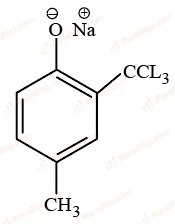
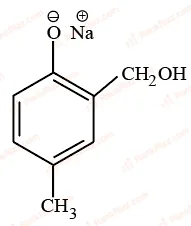
Which one of the following reagents is used in the above reaction?

  1. A

  2. B

  3. C

  4. D

Q40JEE ADVANCED 2007 · PAPER 2Reactions of phenolsTRANSCRIBED

The electrophile in this reaction is

  1. A

  2. B

  3. C

  4. D

Q41JEE ADVANCED 2007 · PAPER 2Reactions of phenolsTRANSCRIBED

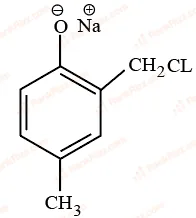
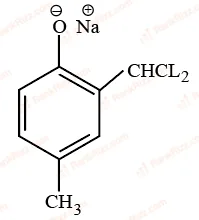
The structure of the intermediate I is

  1. A
  2. B
  3. C
  4. D
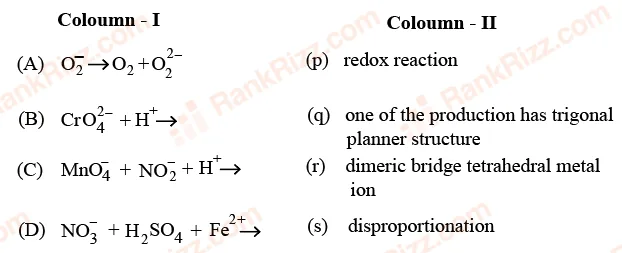
Q42JEE ADVANCED 2007 · PAPER 2Oxidising/reducing agents and types of redox reactionsTRANSCRIBED

Match the reactions in Column I with nature of the reactions/type of the products in Column II. Indicate your answer by darkening the appropriate bubbles of the matrix given in the ORS.

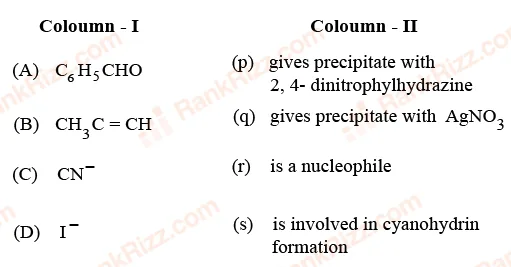
Q43JEE ADVANCED 2007 · PAPER 2Aldol condensation, Cannizzaro and related reactionsTRANSCRIBED

Match the compounds/ions in Column I with their properties/reactions in Column II. Indicate your answer by darkening the appropriate bubbles of the matrix given in the ORS.

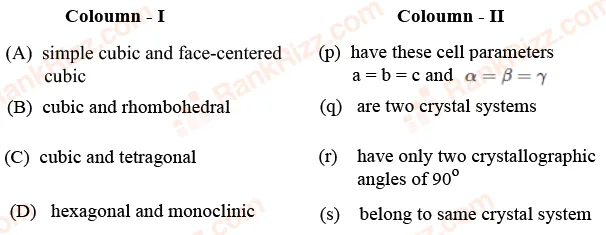
Q44JEE ADVANCED 2007 · PAPER 2Voids, radius ratio and structures of ionic solidsTRANSCRIBED

Match the crystal system/unit cells mentioned in Column I with their characteristic features mentioned in Column II. Indicate your answer by darkening the appropriate bubbles of the matrix given in the ORS.

Mathematics

Q45JEE ADVANCED 2007 · PAPER 2Centroid, incentre, circumcentre and orthocentreTRANSCRIBED

Let O(0, 0), P(3, 4), Q(6, 0) be the vertices of the triangle OPQ. The point R inside the triangle OPQ is such that the triangles OPR, PQR, OQR are of equal area. The coordinates of R are

  1. A

  2. B

  3. C

  4. D

Q46JEE ADVANCED 2007 · PAPER 2Locus and regions in the Argand planeTRANSCRIBED

If and , then all the values of lie on

  1. A

    a line not passing through the origin

  2. B

  3. C

    the x-axis

  4. D

    the y-axis

Q47JEE ADVANCED 2007 · PAPER 2Conditional probability and multiplication theoremTRANSCRIBED

Let denote the complement of an event E. Let E, F, G be pairwise independent events with P(G) &gt; 0 and . Then equals

  1. A

  2. B

  3. C

  4. D

Q48JEE ADVANCED 2007 · PAPER 2Higher order derivativesTRANSCRIBED

equals

  1. A

  2. B

  3. C

  4. D

Q49JEE ADVANCED 2007 · PAPER 2Order, degree and formation of differential equationsTRANSCRIBED

The differential equation determines a family of circles with

  1. A

    variable radii and a fixed centre at (0, 1)

  2. B

    variable radii and a fixed centre at (0, -1)

  3. C

    fixed radius 1 and variable centres along the x-axis

  4. D

    fixed radius 1 and variable centres along the y-axis

Q50JEE ADVANCED 2007 · PAPER 2Vector (cross) product and areaTRANSCRIBED

Let be unit vectors such that . Which one of the following is correct?

  1. A

  2. B

  3. C

  4. D

    are mutually perpendicular

Q51JEE ADVANCED 2007 · PAPER 2Tangents and normals to a circleTRANSCRIBED

Let ABCD be a quadrilateral with area 18, with side AB parallel to the side CD and AB =2CD. Let AD be perpendicular to AB and CD. If a circle is drawn inside the quadrilateral ABCD touchingall the sides, then its radius is

  1. A

    3

  2. B

    2

  3. C

  4. D

    1

Q52JEE ADVANCED 2007 · PAPER 2Integration by substitutionTRANSCRIBED

Lat for and . Then equals

  1. A

  2. B

  3. C

  4. D

Q53JEE ADVANCED 2007 · PAPER 2Arrangements with restrictionsTRANSCRIBED

The letters of the word COCHIN are permuted and all the permutations are arranged in an alphabetical order as in an English dictionary. The number of words that appear before the word COCHIN is

  1. A

    360

  2. B

    192

  3. C

    96

  4. D

    48

Q54JEE ADVANCED 2007 · PAPER 2Line and plane: intersection, coplanarity and projectionTRANSCRIBED

Consider the planes and .
STATEMENT-1: The parametric equations of the line of intersection of the given planes are 14\hat{i} + 2 \hat{j} + 15 \hat{k}$$ is parallel to the line ofintersection of given planes.

  1. A

    Statement-1 is True, Statement-2 is True; Statement-2 is a correct explanation for Statement-1

  2. B

    Statement-1 is True, Statement-2 is True; Statement-2 is NOT a correct explanation for Statement-1

  3. C

    Statement-1 is True, Statement-2 is False

  4. D

    Statement-1 is False, Statement-2 is True

Q55JEE ADVANCED 2007 · PAPER 2Standard parabola and basic propertiesTRANSCRIBED

STATEMENT-1: The curve is symmetric with respect to the line x = 1.
because
STATEMENT-2: A parabola is symmetric aboutits axis.

  1. A

    Statement-1 is True, Statement-2 is True; Statement-2 is a correct explanation for Statement-1

  2. B

    Statement-1 is True, Statement-2 is True; Statement-2 is NOT a correct explanation for Statement-1

  3. C

    Statement-1 is True, Statement-2 is False

  4. D

    Statement-1 is False, Statement-2 is True

Q56JEE ADVANCED 2007 · PAPER 2Differentiability at a pointTRANSCRIBED

Let for all real x.
STATEMENT-1: For each real t, there exists a point c in such that
because
STATEMENT-2: for each real t.

  1. A

    Statement-1 is True, Statement-2 is True; Statement-2 is a correct explanation for Statement-1

  2. B

    Statement-1 is True, Statement-2 is True; Statement-2 is NOT a correct explanation for Statement-1

  3. C

    Statement-1 is True, Statement-2 is False

  4. D

    Statement-1 is False, Statement-2 is True

Q57JEE ADVANCED 2007 · PAPER 2Angle bisectorsTRANSCRIBED

Lines and intersect the line at P and Q, respectively. The bisector of the acute angle between and intersects at R.
STATEMENT-1: The ratio PR : RQ equals
because
STATEMENT-2: In any triangle, bisector of an angle divides the triangle into two similar triangles.

  1. A

    Statement-1 is True, Statement-2 is True; Statement-2 is a correct explanation for Statement-1

  2. B

    Statement-1 is True, Statement-2 is True; Statement-2 is NOT a correct explanation for Statement-1

  3. C

    Statement-1 is True, Statement-2 is False

  4. D

    Statement-1 is False, Statement-2 is True

Q58JEE ADVANCED 2007 · PAPER 2AM, GM, HM and the AM-GM inequalityTRANSCRIBED

Which one of the folowing statements is correct?

  1. A

    G_1 &gt; G_2 &gt; G_3 &gt; ....

  2. B

    G_1 &lt; G_2 &lt; G_3 &lt; ....

  3. C

  4. D

    G_1 &lt; G_3 &lt; G_5 &lt; .... and G_2 &gt; G_4 &gt; G_6 &gt; ....

Q59JEE ADVANCED 2007 · PAPER 2AM, GM, HM and the AM-GM inequalityTRANSCRIBED

Which one of the following statements is correct?

  1. A

    A_1 &gt; A_2 &gt; A_3 &gt; ...

  2. B

    A_1 &lt; A_2 &lt; A_3 &lt; ...

  3. C

    A_1 &gt; A_3 &gt; A_5 &gt; ... and A_2 &lt; A_4 &lt; A_6 &lt; ...

  4. D

    A_1 &lt; A_3 &lt; A_5 &lt; ... and A_2 &gt; A_4 &gt; A_6 &gt; ...

Q60JEE ADVANCED 2007 · PAPER 2AM, GM, HM and the AM-GM inequalityTRANSCRIBED

Which one of the following statements is correct?

  1. A

    H_1 &gt; H_2 &gt; H_3 &gt; ...

  2. B

    H_1 &lt; H_2 &lt; H_3 &lt; ...

  3. C

    H_1 &gt; H_3 &gt; H_5 &gt; ... and H_2 &lt; H_4 &lt; H_6 &lt; ...

  4. D

    H_1 &lt; H_3 &lt; H_5 &gt; ... and H_2 &gt; H_4 &gt; H_6 &gt; ...

Q61JEE ADVANCED 2007 · PAPER 2Monotonicity for inequalities and number of rootsTRANSCRIBED

The line y = x meets for at

  1. A

    no point

  2. B

    one point

  3. C

    two points

  4. D

    more than two points

Q62JEE ADVANCED 2007 · PAPER 2Monotonicity for inequalities and number of rootsTRANSCRIBED

The positive value of k for which has only one root is

  1. A

  2. B

    1

  3. C

    e

  4. D

Q63JEE ADVANCED 2007 · PAPER 2Monotonicity for inequalities and number of rootsTRANSCRIBED

For k &gt; O, the set of all values of k for which has two distinct roots is

  1. A

  2. B

  3. C

  4. D

Q64JEE ADVANCED 2007 · PAPER 2Rational and polynomial inequalitiesTRANSCRIBED

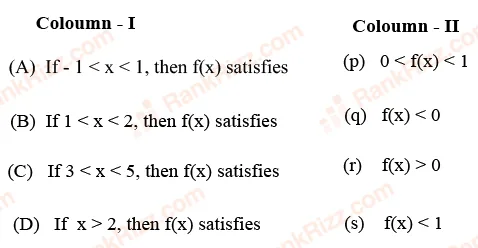
Let .
Match the expressions/statements in Column I with expressions/statements in Column II and indicate your answer by darkening the appropriate bubbles in the matrix given in the ORS.

Q65JEE ADVANCED 2007 · PAPER 2Properties and simplification of inverse trigonometric functionsTRANSCRIBED

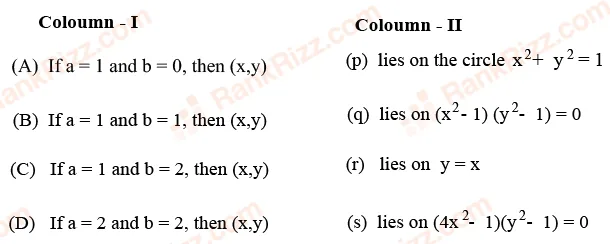
Let (x, y) be such that
Match the statements in Column I with statements in Column II and indicate your answer by darkening the appropriate bubbles in the matrix given in the ORS.

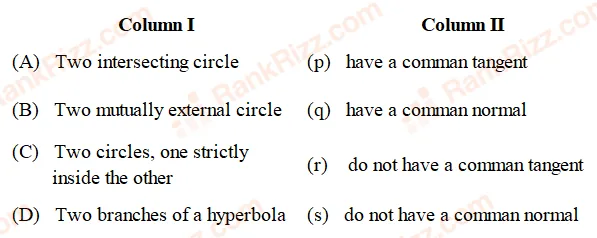
Q66JEE ADVANCED 2007 · PAPER 2Equation of a circle in various formsTRANSCRIBED

Match the statements in Column I with the properties in Column II and indicate your answer by darkening the appropriate bubbles in the matrix given in the ORS.